Crewed Itinerary · Turkey · Bodrum

A Carian Week: Bodrum and the Gulf of Gökova

By the third afternoon, the rhythm has set. The day began with espresso on the aft deck and a slow run east through the Gulf of Gökova, the north shore tucked behind pine-clad mountains while the meltemi blew thirty knots a few miles out beyond the headland. Lunch ran two hours at a quay with a wooden jetty and a single grill, the captain's family among the regulars, the order set the moment you sat down. By six the day boats had gone home and the cove was yours alone. This is the Carian week — the Turkish coast around Bodrum and the Gulf of Gökova, the cruising ground the international brokers send their best motor yachts to.

Most guests booking this week are first-timers on the Turkish coast or repeat Med charterers wanting the Aegean side without the meltemi pressure on the open Cyclades. The 7-day round trip from Yalıkavak runs roughly 100 nautical miles total — short hops, long lunches, the north shore of the Gulf of Gökova as a meltemi-protected playground. Built around a 30- to 50-meter motor yacht with a chef and full crew; modern luxury gulets and sailing yachts work the same route at different paces. Embarkation at Yalıkavak Marina (Palmarina) at the western tip of the Bodrum peninsula, twenty-five minutes by road from Milas-Bodrum airport (BJV). Prime season runs May through October — June and September the strongest weeks of the year on this coast.

Duration
7 days / 8 nights
Base
Yalıkavak Marina (Bodrum)
Plan your Turkey charter Custom-tailored to your dates and group preferences
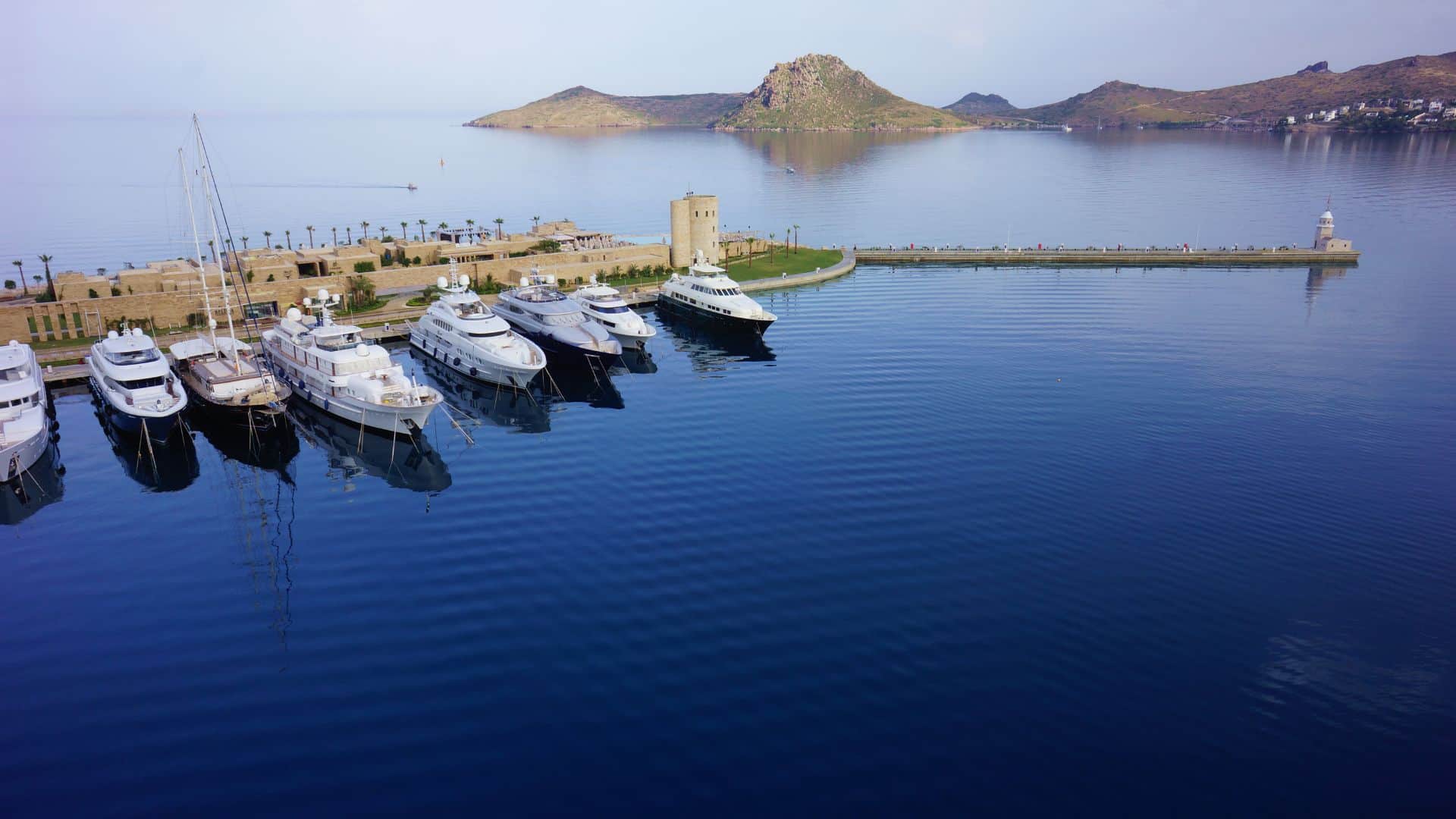
Yalıkavak Marina at the start of the charter week — yacht moored, restaurant row in background.
Maçakizi pontoon at evening with visiting yacht moored — Türkbükü Bay sunset.
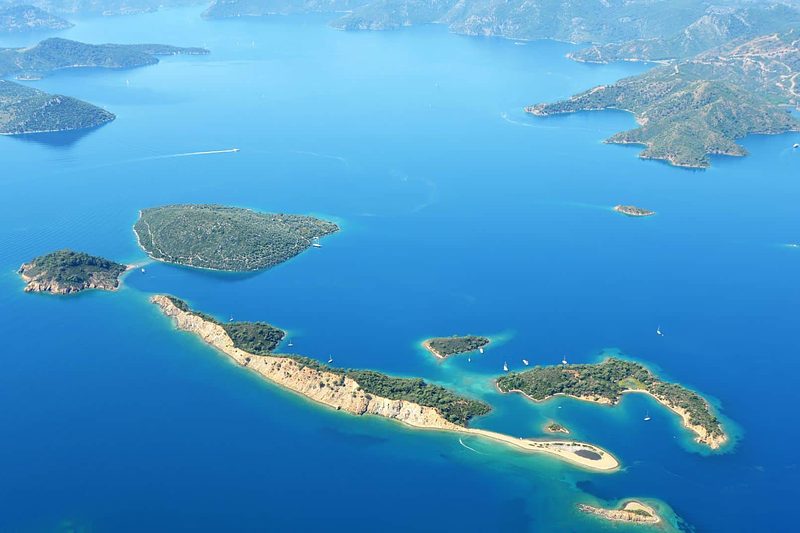
Çökertme taverna anchorage on the north shore of the Gulf of Gökova.
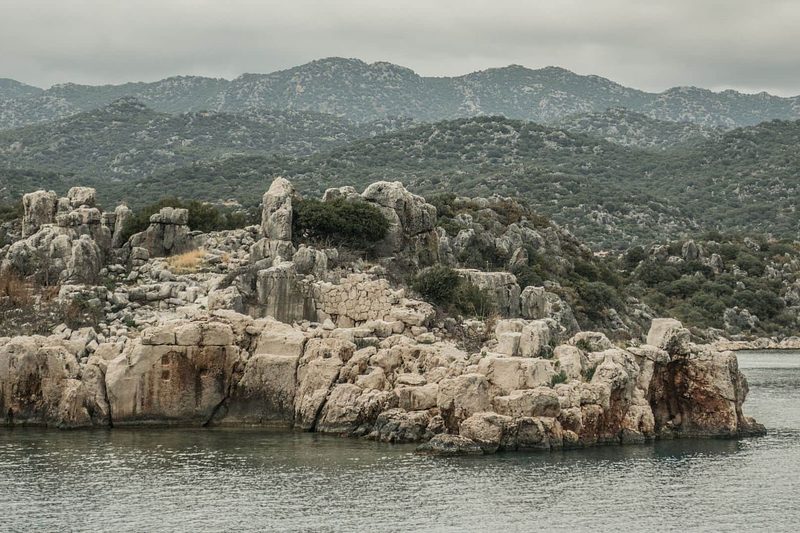
Yacht anchored in the ancient harbor at Knidos, the Aphrodite Euploia temple ruins on the headland above.

The Carian week most regulars build around the Gulf of Gökova

This is the social-and-archaeology week. A first night at Yalıkavak's Marina under the celebrity-chef restaurant row — Zuma, Novikov, Nusr-Et, Bagatelle — followed by a tender north into Türkbükü Bay for dinner at Maçakizi, the Bodrum peninsula's one-Michelin-star anchor. Then the slow turn east into the Gulf of Gökova: an afternoon swim and walk at Cleopatra Beach on Sedir Island, where the towels-on-sand prohibition has been enforced for twenty years and the Cedrae ruins above the protected sand are the actual reason to come ashore. North-shore anchorages at Çökertme and English Harbor — the wooden-jetty grills the captains have been booking for years, the meltemi blowing thirty knots a few miles north and your yacht in flat water. Then the long leg west around the Datça peninsula's tip to Knidos, where you anchor in the larger of the two ancient harbors and walk the marble streets of a Doric port city with the Aphrodite Euploia temple on the headland above. Datça's olive country for the last evening, mezze along the quay. And the final morning's run back to Yalıkavak.

Two more Turkish weeks run alongside this one. The Turquoise Coast itinerary out of Göcek runs the Lycian shore — twelve islands at the mouth of Fethiye Gulf, Butterfly Valley by tender, Kalkan and Kaş for shore dinners, Kekova and the sunken city of Simena. The Bodrum-to-Göcek one-way runs both grounds in seven days with the Dalyan river excursion as the day off the boat. Pricing on this coast starts around $40,000 a week and scales well into superyacht territory. **A note on flag and embarkation:** as of 2024, foreign-flagged yachts under thirty-nine meters cannot legally embark guests from Turkish ports without a special license. The standard configuration for US guests on a foreign-flagged yacht is a Greek-flagged (or Greek-licensed) yacht embarking in Kos and crossing into Turkey on day one. We walk through which structure fits your yacht before you book.

1

Day 1 of 7 · Yalıkavak → Türkbükü

Yalıkavak Embark — Maçakizi at Sundown
Anchorage: Türkbükü Bay
Yalıkavak Marina at the western tip of the Bodrum peninsula — 620 berths, capacity to 140 meters, three-time World's Best Superyacht Marina.

The week starts at Yalıkavak. Twenty-five minutes by road from Milas-Bodrum airport, on the western tip of the Bodrum peninsula, the marina runs along a kilometer of restaurant-lined quay — Zuma, Novikov, Nusr-Et, Bagatelle Bodrum, Birds, the most concentrated celebrity-chef cluster in the Mediterranean, walked to from your aft deck. Your crew meets you at the slip with cold drinks and the chart briefing. The galley is already stocked, the steward settles your luggage into cabins, and the chef walks you through the welcome plate while the captain readies the boat to leave.

By late afternoon the captain is slipping lines. A gentle twelve-nautical-mile run north and east around the Bodrum peninsula to Türkbükü — the protected bay on the north shore that's been Bodrum's St. Tropez since the early 2000s. The anchorage is offshore in eight to twelve meters of sand, swim platform open by sunset. Tender ashore for dinner at Maçakizi: one Michelin star in the 2026 guide, Aret Sahakyan in the kitchen, two private pontoons reserved for visiting yachts. Reservations through your captain — the relationship is what gets the booking.

Day Highlights

  • Welcome at Yalıkavak Marina, twenty-five minutes from BJV airport.
  • Restaurant cluster walked to from your aft deck — Zuma, Novikov, Nusr-Et, Bagatelle.
  • Twelve-nautical-mile evening run north into Türkbükü Bay.
  • Dinner ashore at Maçakizi (1-star Michelin) at the private yacht pontoon.
2

Day 2 of 7 · Türkbükü → Sedir Island (Cleopatra Beach)

Cleopatra Beach and the Cedrae Ruins

Anchorage: Offshore Sedir Island, Gulf of Gökova
The kind of slow morning the Gulf of Gökova is for — anchored, the boat working on lunch, the day in no particular hurry.

A slow morning underway: the captain points the bow east-southeast for the twenty-five-nautical-mile run into the Gulf of Gökova, north shore tucked behind pine-clad mountains while the meltemi blows in the open Cyclades a few miles to the north. Sedir Island sits in the gulf — a small protected island with a single landmark, Cleopatra Beach, where the spherical-grain white sand has been protected by Turkish heritage law since 1974. Towels are prohibited; slippers off the sand are prohibited; the rule about not pocketing a single grain is enforced by an attendant at the wooden boardwalk.

Above the beach, the actual archaeology: the ruins of ancient Cedrae, a small Carian-Roman city with a theater, an agora, and the foundations of a temple of Apollo. The folklore about Mark Antony importing the sand from Egypt for Cleopatra is just folklore — the city is real, the sand is unusual, the romance is local color. A long lunch on the aft deck after the swim, the chef's plates set on white linen with the gulf opening east toward Marmaris. By afternoon the day boats have cleared; you have the bay to yourself.

Dinner is on board at anchor, the silhouette of Sedir off the bow as the lights come on along the wooden boardwalk and the attendant heads back to the village ferry. The water in the gulf in June and September runs in the mid-twenties Celsius, swimmable into the late evening; the air drops just enough overnight that the cabin AC isn't necessary.

Day Highlights

  • Twenty-five-nautical-mile morning run east into the Gulf of Gökova.
  • Afternoon at Cleopatra Beach — Cedrae ruins above, protected sand below.
  • Long lunch on the aft deck, swim platform open through the afternoon.
  • Dinner at anchor with the bay to yourselves after the day boats clear.
3

Day 3 of 7 · Sedir → Çökertme

Çökertme — North Shore Taverna in the Wind Shadow

Anchorage: Çökertme, north shore Gulf of Gökova
Çökertme on the north shore — pine-clad mountains acting as a concrete wall against the meltemi blowing in the open channel.

A short ten-nautical-mile hop north and east to Çökertme, one of the wooden-jetty taverna anchorages that defines the Gulf of Gökova's north shore. The captain reads conditions before deciding whether to anchor or pick up a quayside tie — Çökertme runs both options depending on traffic. Captain Ibrahim's runs the longest-serving grill on the bay; the captain books the table on arrival, a row of mezze hits the table within ten minutes, and the day-boat fish lands grilled in nothing but lemon and salt.

What makes the day specific is the meltemi math. The pine-covered mountains south of the Datça peninsula act as a concrete wall — while the channel between Bodrum and the Cyclades blows thirty knots in August afternoons, Çökertme runs flat, calm water with a steady ten-knot afternoon thermal. It's the reason this north-shore route holds up when the Aegean side is pinned in port. A long swim before lunch, an afternoon nap, dinner ashore at the taverna or back on board — both work.

Day Highlights

  • Short ten-nautical-mile hop east to Çökertme.
  • Pine-clad mountain shelter — flat water inside the gulf while the meltemi runs in the open channel.
  • Captain Ibrahim's grill on the wooden jetty — mezze, day-boat fish, raki.
  • Swim, nap, dinner ashore or aboard — the day-off pattern of the Gulf of Gökova.
4

Day 4 of 7 · Çökertme → English Harbor

English Harbor — A WWII Anchorage Still Quiet

Anchorage: English Harbor (Tuzla), Gulf of Gökova
Mid-week underway — the meltemi off-peak in the gulf, the boat in no hurry.

Twelve nautical miles further east along the north shore to English Harbor — locally Tuzla, named for the British naval presence here during the Second World War. The anchorage is deep and protected, mostly empty in early-summer and late-summer charter weeks, and the shore is largely undeveloped pine forest. The captain anchors in eight to twelve meters of sand, drops the swim platform, and the boat shifts into anchor mode for a full day — water sports kit deployed off the stern, a long swim, the chef working on a slow lunch.

Mid-afternoon, a tender ashore for a walk through the pine woods to one of the small fish restaurants the locals run on the inland edge of the harbor. The pattern is the same as Çökertme — mezze across the table, day-boat fish, raki — but without the wooden-jetty crowd. Back on board for sundowners. Dinner is on the aft deck at anchor, the harbor empty as the light goes.

Day Highlights

  • Twelve nautical miles east along the north shore.
  • Deep, protected anchorage — undeveloped pine-forest shore.
  • Full day at anchor with water sports off the stern.
  • Tender ashore for a quiet inland-restaurant walk.
5

Day 5 of 7 · English Harbor → Knidos

Knidos — Anchored Below the Aphrodite Temple

Anchorage: Knidos ancient commercial harbor, Datça peninsula
Knidos at the western tip of the Datça peninsula — sea-only access, the Aphrodite Euploia temple above the anchorage, two theaters on the slope behind.

The longest leg of the week — thirty nautical miles south and west, around the eastern shoulder of the Datça peninsula and along its south coast to Knidos at the western tip. Knidos has no road; the only way in is by sea. Charter yachts anchor in the larger of the two ancient harbors — the commercial harbor on the east — in eight to fifteen meters of clear water, with the columns of the Aphrodite Euploia temple visible on the headland above the bow.

Knidos was a major Doric port city, fortified by Sparta in the fifth century BC and famous for two things: Praxiteles' nude Aphrodite of Knidos (sculpted around 365 BC, the first life-size female nude in Greek art, the original lost but copied for centuries), and a commercial fleet that traded across the Aegean for six hundred years. The site has two theaters — a smaller five-thousand-seat theater that looks down on the anchorage, a larger twenty-thousand-seat amphitheater on the slope behind — plus an agora, terraced streets, and the temple foundations on the headland between the two harbors. You walk the marble streets in the morning while your yacht swings at anchor below.

Dinner is on board at anchor in the ancient harbor. There is no taverna at Knidos — the site is a heritage zone, not a village. The night silence is the point: the temple ruins lit by your deck lights, the empty harbor, the boat the only one moored where six hundred years of Doric commerce once tied up.

Day Highlights

  • Thirty-nautical-mile leg around the Datça peninsula's eastern shoulder.
  • Sea-only access to Knidos — the only way in is from your yacht.
  • Anchor in the ancient commercial harbor below the Aphrodite Euploia temple.
  • Two theaters above the anchorage; agora, terraced streets, temple foundations.
6

Day 6 of 7 · Knidos → Datça

Datça — Olive Country and the Mezze Tavernas

Anchorage: Datça quay (or offshore)
Datça's quayside meyhane — mezze, grilled day-boat fish, and the olive oil pressed at the village mill the week your charter started.

Fifteen nautical miles east back along the south shore of the Datça peninsula to Datça itself — a quiet port town on the southern coast, mostly avoided by the cruise crowd, the kind of harbor that's still mostly Turkish rather than tour-flavored. The captain ties up at the quay or anchors offshore depending on space and reads conditions. Datça's calling card is its olives: the same trees the Carians planted, the oil pressed at the village mill, the small-family meyhanes along the harbor that have served the same families for forty years.

Dinner is ashore at one of the quayside meyhanes — the captain picks the place. Mezze in flat dishes across a long table, grilled day-boat fish dressed in nothing but lemon and salt, raki served with cold water and ice that turns the glass milky as the night goes. The bill is a fraction of what the same meal would cost at Yalıkavak. The character is what changes: Datça is what the Bodrum coast used to be, before the Turkish lira and the international yacht charter market both arrived.

Day Highlights

  • Fifteen-nautical-mile run east along the Datça peninsula's south shore.
  • Quiet port town largely off the cruise circuit.
  • Olive country — the trees the Carians planted, the oil at the village mill.
  • Quayside meyhane dinner, mezze and raki, the family welcoming the captain by name.
7

Day 7 of 7 · Datça → Yalıkavak

Final Run West — Yalıkavak Disembark

Anchorage: Yalıkavak Marina (disembark)
The last passage of the week — the Bodrum peninsula on the bow, the chef working on the farewell plate.

A last slow breakfast on deck at the Datça quay, a final swim off the swim platform if the morning is warm enough, and the captain slips lines for the thirty-nautical-mile crossing north and west back to Yalıkavak. The route runs north across the Hisarönü and Gökova mouths, the open channel taking the only meltemi exposure of the week — usually a building afternoon thermal that the boat handles in stride. Lunch is on board through the leg, the chef's farewell plate, a final glass of the cellar's best, and the silhouette of the Bodrum peninsula growing on the bow.

Disembarkation at Yalıkavak by mid-afternoon. The crew has the transfer arranged — direct to BJV for guests flying out the same day, or to a hotel in Bodrum for guests adding a night ashore. Many groups extend with a half-day at Pamukkale (a domestic flight from BJV, two hours) or a private-driver day to Ephesus (three hours by road). Your captain and chef will step off the boat already talking about when you're coming back, which is usually how the good ones end.

Day Highlights

  • Last breakfast at the Datça quay, slow run north back to Yalıkavak.
  • Open-channel crossing — the only meltemi exposure of the week.
  • Disembarkation at Yalıkavak by mid-afternoon.
  • Post-charter Pamukkale or Ephesus options for guests with onward time.

Frequently asked

How long is a typical Bodrum / Carian Coast itinerary?
Seven days is standard — the right number to do the Gulf of Gökova north shore, Cleopatra Beach, Knidos at the peninsula's tip, and Datça's olive country without rushing. Ten-day variants extend to the Greek Dodecanese (Symi, Kos, Rhodes) — see the Bodrum-to-Göcek connector for the more compact two-region option.
When's the best time of year for a Bodrum charter?
June and September are the strongest weeks — water in the mid-twenties Celsius, the meltemi off-peak, anchorages still quiet. Late May and early October work for guests who want quieter water. July and August are peak heat with the meltemi running thirty knots most afternoons in the open channel; the Gulf of Gökova's north shore stays calm regardless, which is why this itinerary holds up in mid-summer.
Sailing yacht, motor yacht, or modern luxury gulet?
Most yachts on the Carian week are motor yachts — the Gulf of Gökova's anchorages are short-hop, swim-led, and motor yachts move efficiently through the meltemi when conditions kick up. Sailing yachts work and reward the slower pace. For modern luxury gulets — 40 meters and up, post-2000 builds, six cabins with master suites and full air-conditioning — we work with the Turkish gulet specialists on request; tell us what you're after.
What's included in a crewed Turkey charter?
Crew (captain, chef, mate, deckhand on most yachts), the yacht, water toys, and soft furnishings. Turkey runs the Mediterranean plus-expenses model — base rate plus a 25–35% APA (Advance Provisioning Allowance) covering food, drinks, fuel, marina dockage, harbor fees, and any Greek-island day-trip customs. **0% VAT for foreign-flagged commercial yachts** — the lowest in the Mediterranean. 10–15% crew gratuity, paid directly to the captain on disembarkation.

Ready to set sail in Turkey?

Every itinerary we send is custom-tailored. Tell us your dates, the size of your group, and what you want out of your charter—we'll handle the rest.