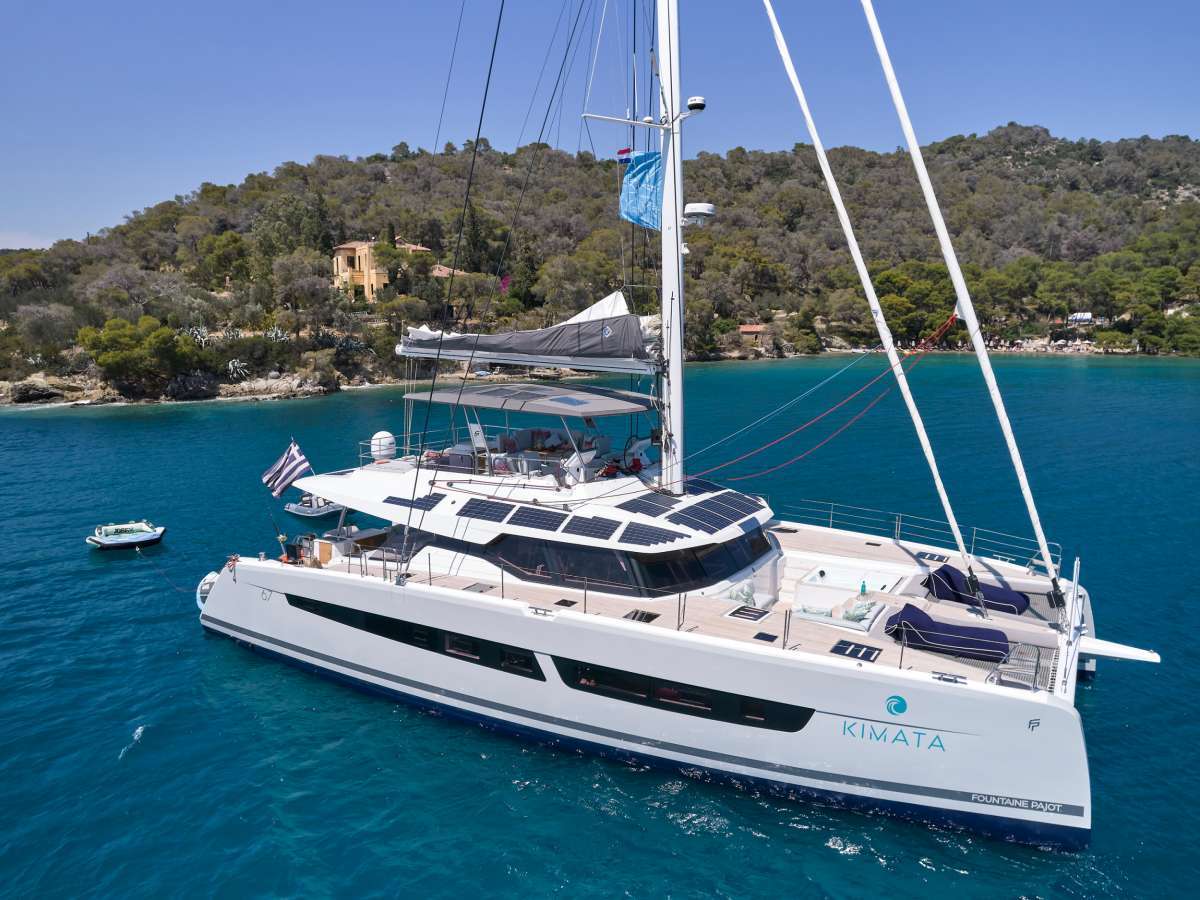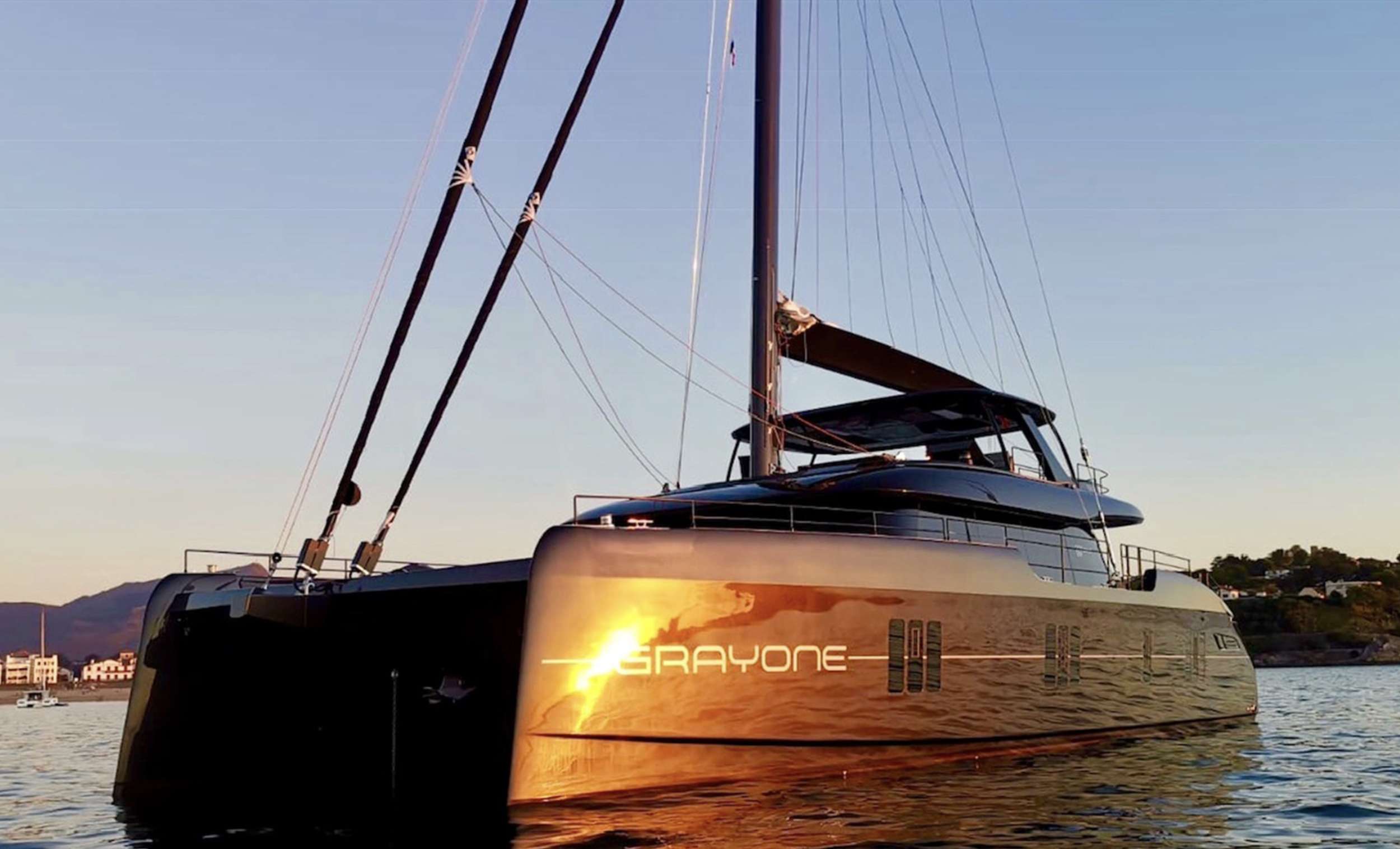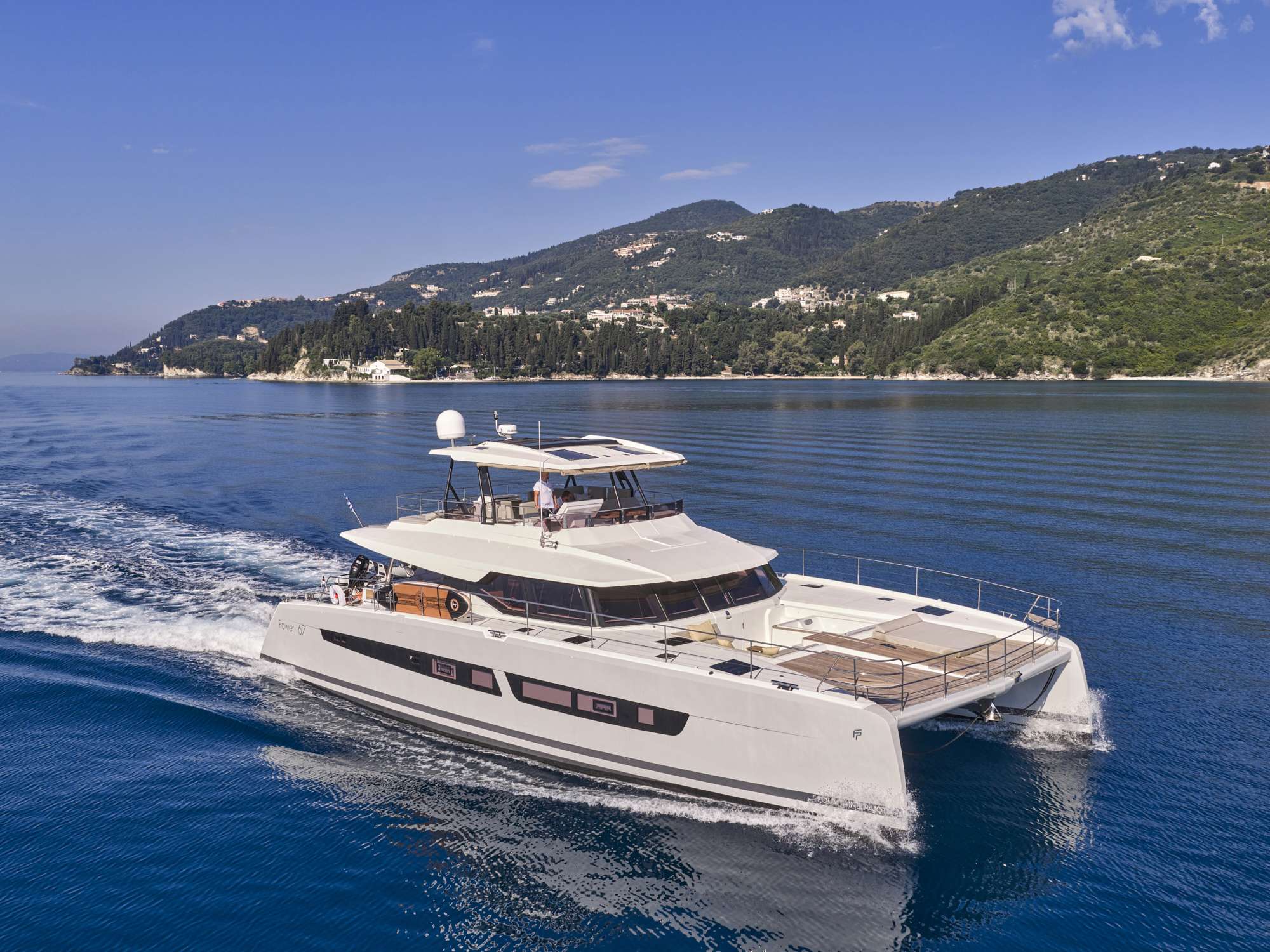

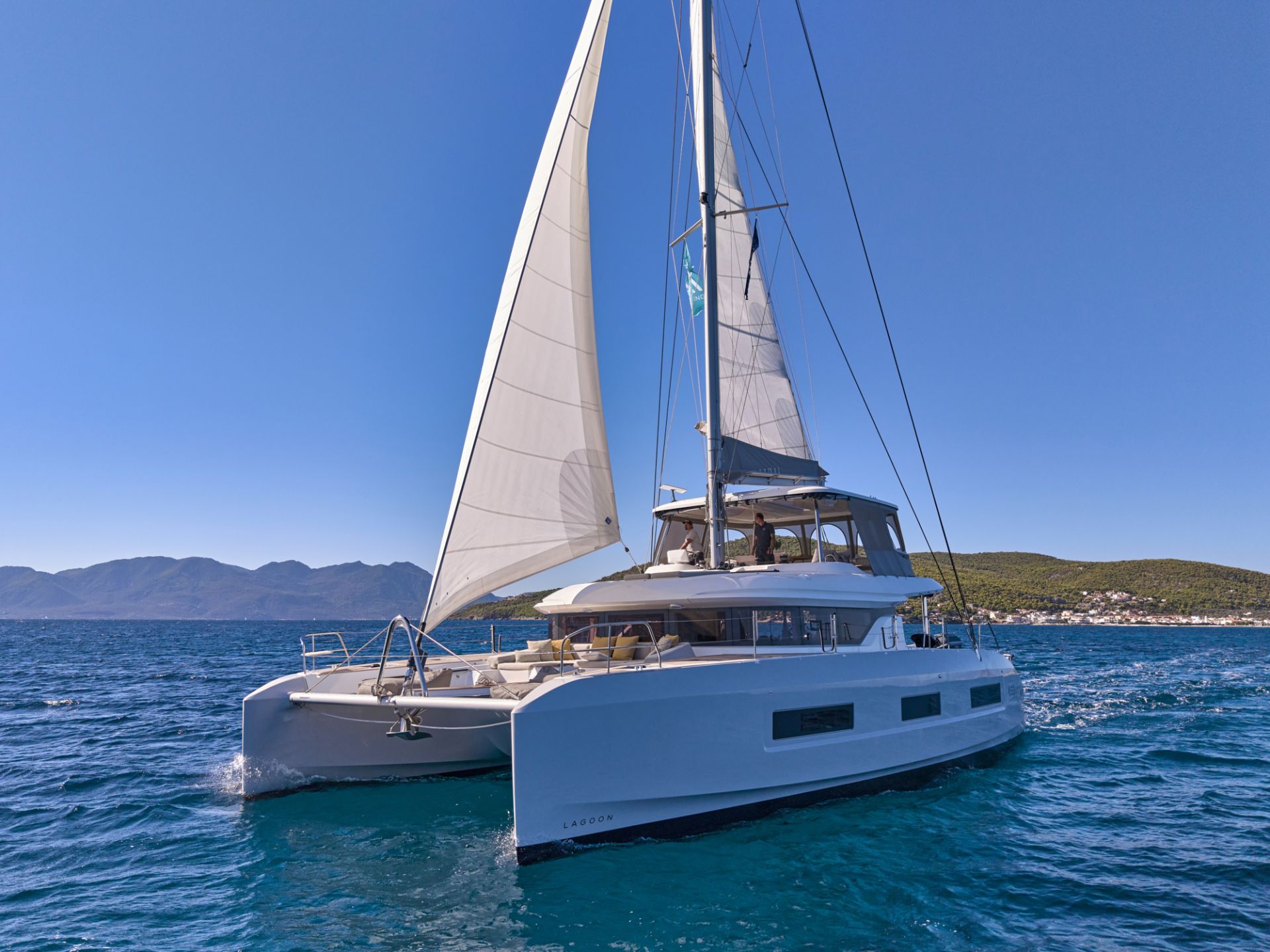
Lulu
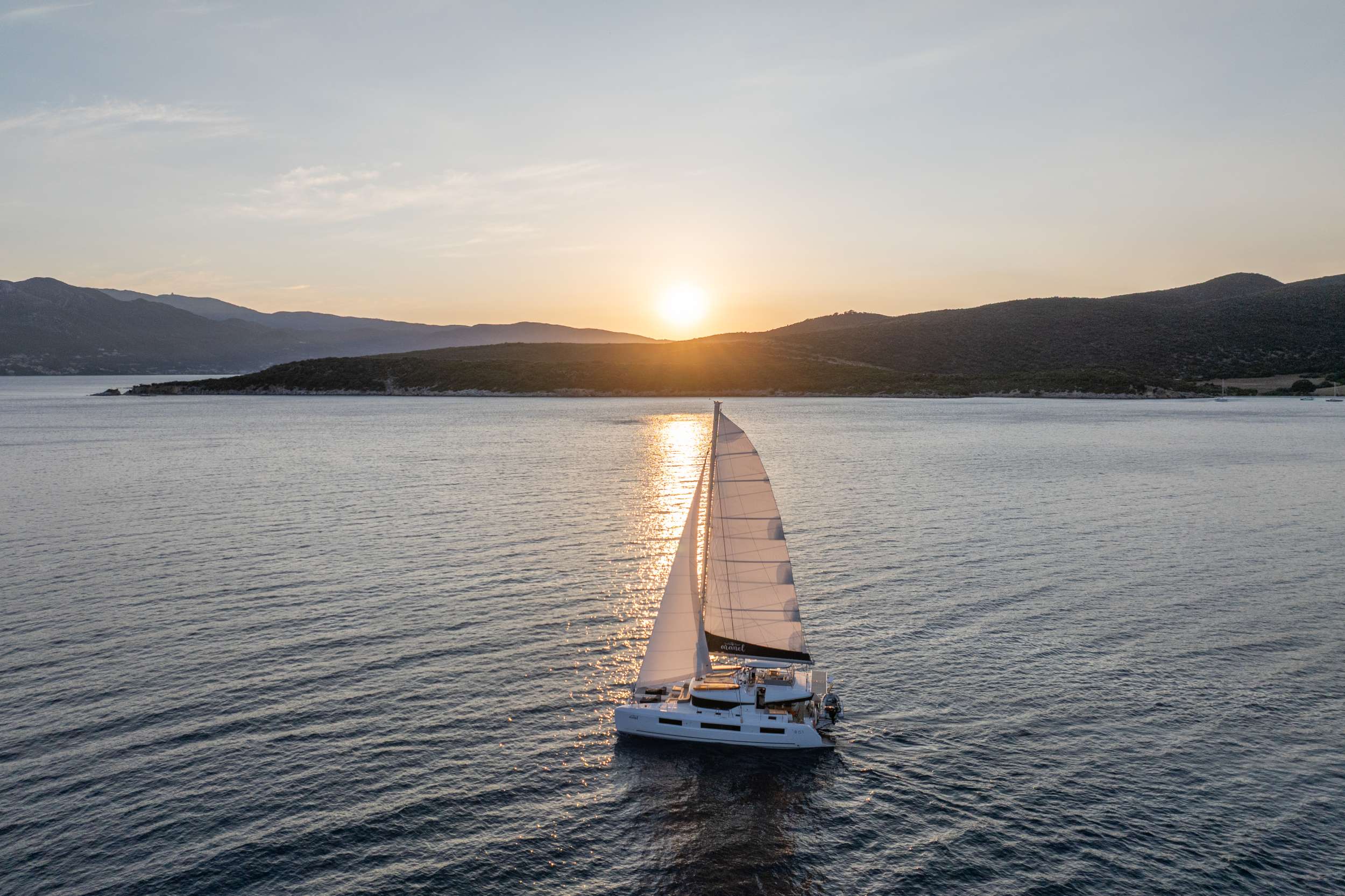
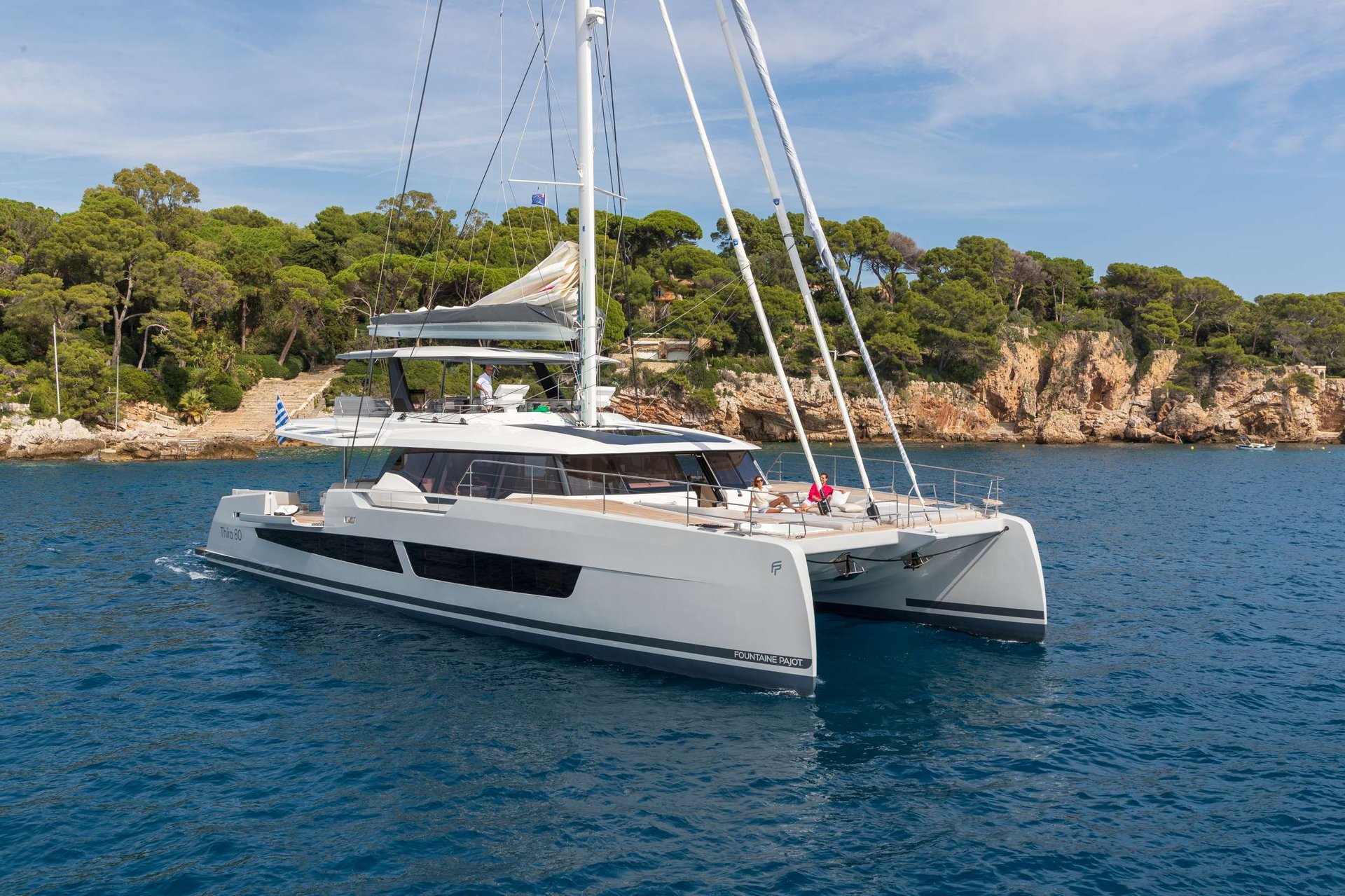
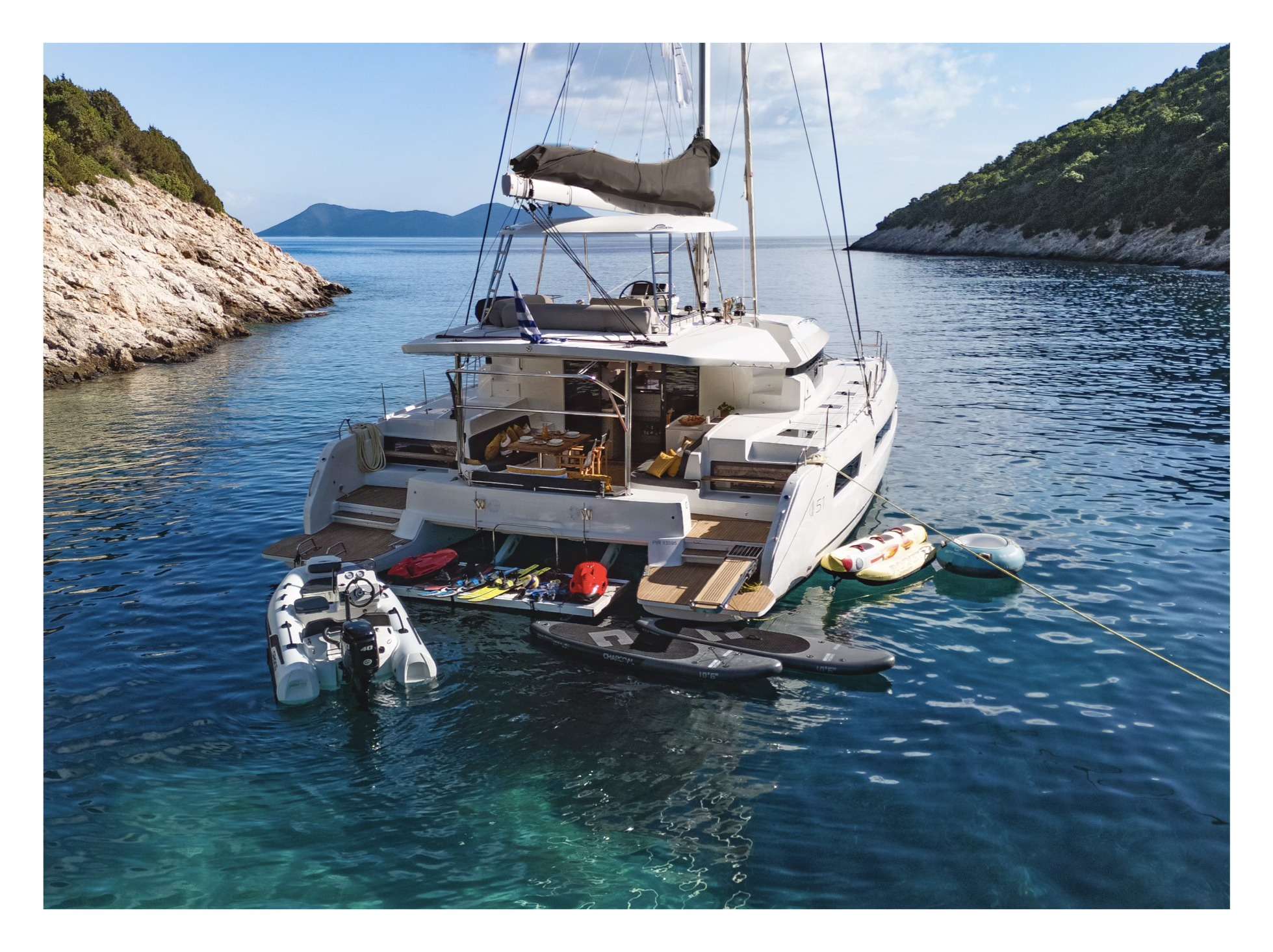
54FT · SAILING CATAMARAN
Pricing from €22,000/week
8 Guests · 4 Cabins
Caribbean
Eastern Mediterranean
Western Mediterranean
South Pacific
United States
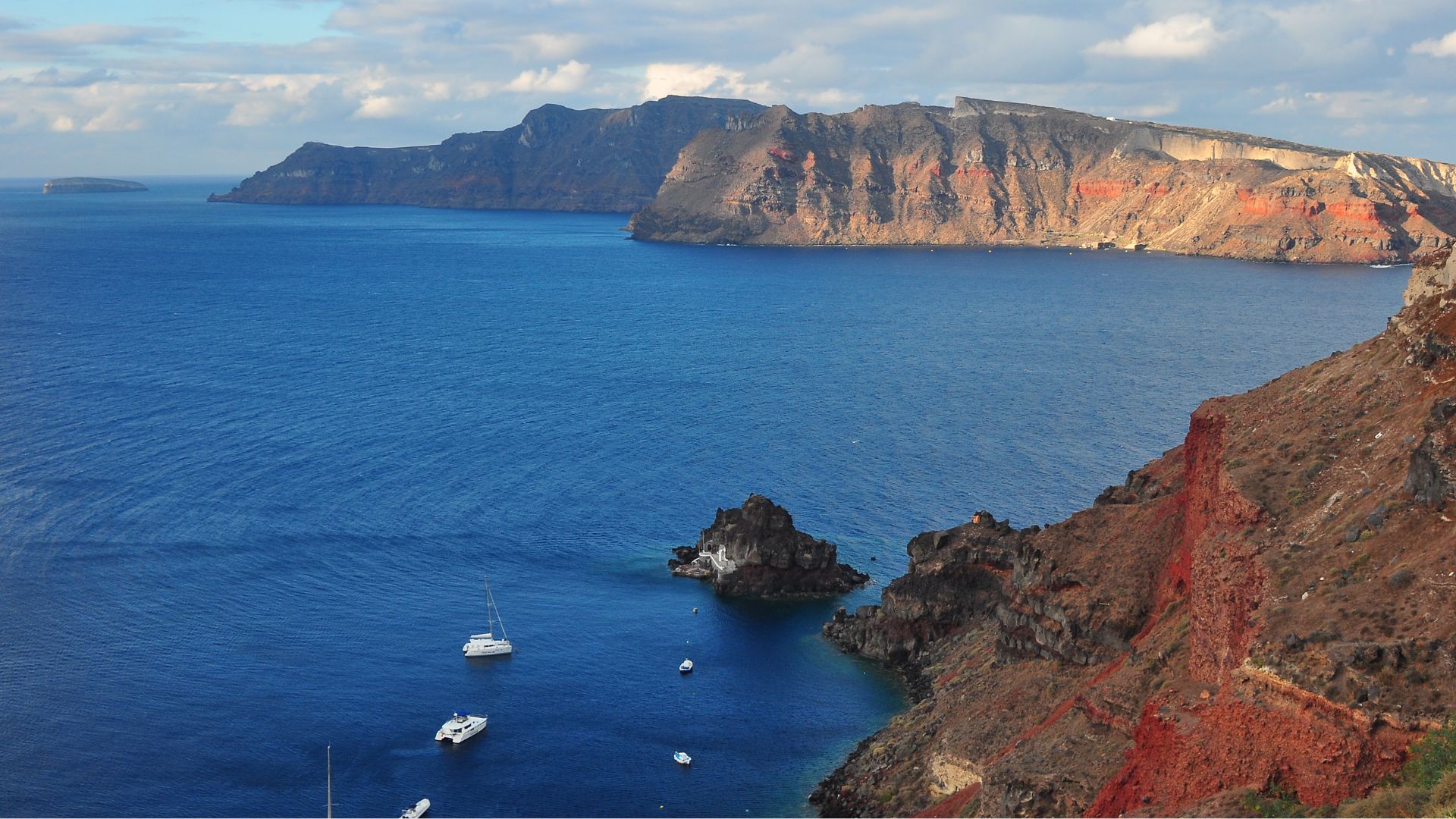
Crewed sailing yacht and motor yacht charters across the Aegean and Ionian — Cyclades, Ionian, Saronic, and Dodecanese routes from Athens, Corfu, or Kos.
Why Greece
Greece is the deepest charter ground in the Mediterranean. Five different one-week itineraries across four cruising regions, and each one delivers a completely different version of Greece. The Cyclades is the postcard week — Mykonos windmills above Little Venice, the marble Portara of Naxos at sunset, Santorini's caldera glowing pink off the bow, and the Meltemi pushing the boat downwind through the chain. The Saronic Gulf trades the postcards for cultural muscle: a 2,500-year-old Doric temple by lunchtime on Day 1, the car-free harbor of Hydra in the afternoon, and a play in a 4th-century BC UNESCO theatre under the stars before the week is out. The Ionian is the gentle side — out of the Meltemi entirely, thermal afternoon breezes, forested anchorages, a taverna walk every night. And the Dodecanese strings out along the Turkish coast in the eastern Aegean, where the medieval walled city of Rhodes opens to the harbor and Patmos's hilltop monastery is where the Book of Revelation was written.
Yacht choice changes what's possible. Motor yachts cover more ground per day than sailing yachts, and Greece's cruising regions vary enough that some itineraries only work on one or the other. The Southern Cyclades caldera tour from Athens covers 310 nautical miles in seven days to bring Santorini, Milos, and Sifnos into a single week — a planing motor yacht moves through it comfortably and a sailing yacht cannot, no matter how good the captain is. The Northern Cyclades route is the inverse: built around a sailing yacht's strengths in the summer Meltemi, 200 nautical miles downwind from Athens to Mykonos with the wind on the quarter for most of it. The Saronic and Ionian work on either yacht type. The Dodecanese assumes a motor yacht for the longer eastern Aegean legs. We walk through the route, the yacht, and your group before booking — the right Greek week is the intersection of all three, not just the first.
What sets Greece apart from anywhere else in the charter industry is the depth of the cultural pairing. Wood-fired octopus and fresh-caught barbouni in tavernas that have been on the same harbor for generations. Assyrtiko poured from the volcanic vineyards on Santorini's caldera rim. Vinsanto made from the same grapes, dried in the sun, and almost impossible to find outside the islands they're grown on. The UNESCO sites — Delos, Patmos's Monastery of St. John, Rhodes's old town, the theatre at Epidaurus — sit on the same week-long route as fishing villages serving the day's catch. Plus-expenses pricing, Saturday-to-Saturday charter weeks, and a fleet that ranges from 42-foot sailing catamarans up to 160-foot motor yachts give guests more range across budget and yacht style than any other charter ground in the Mediterranean.
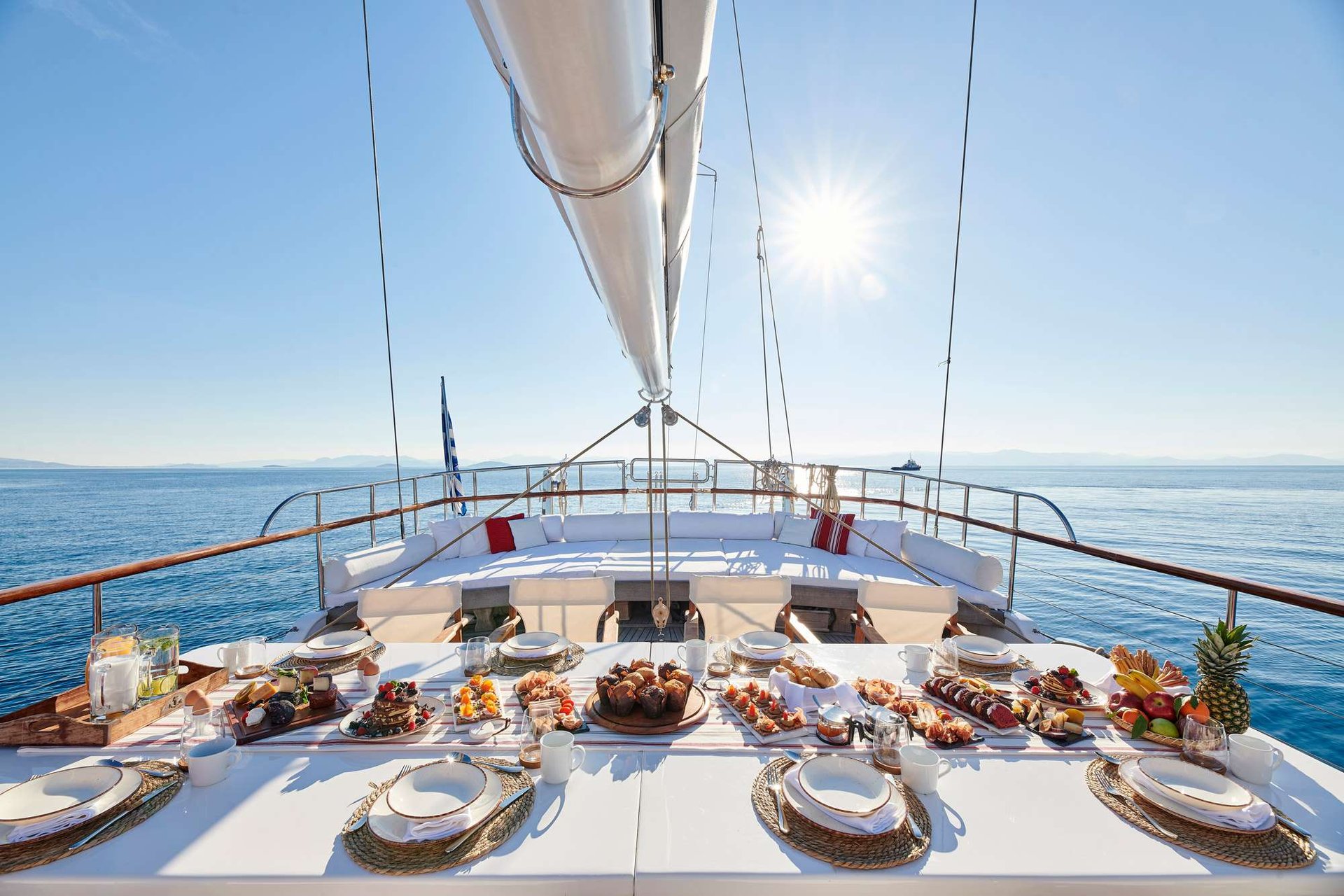
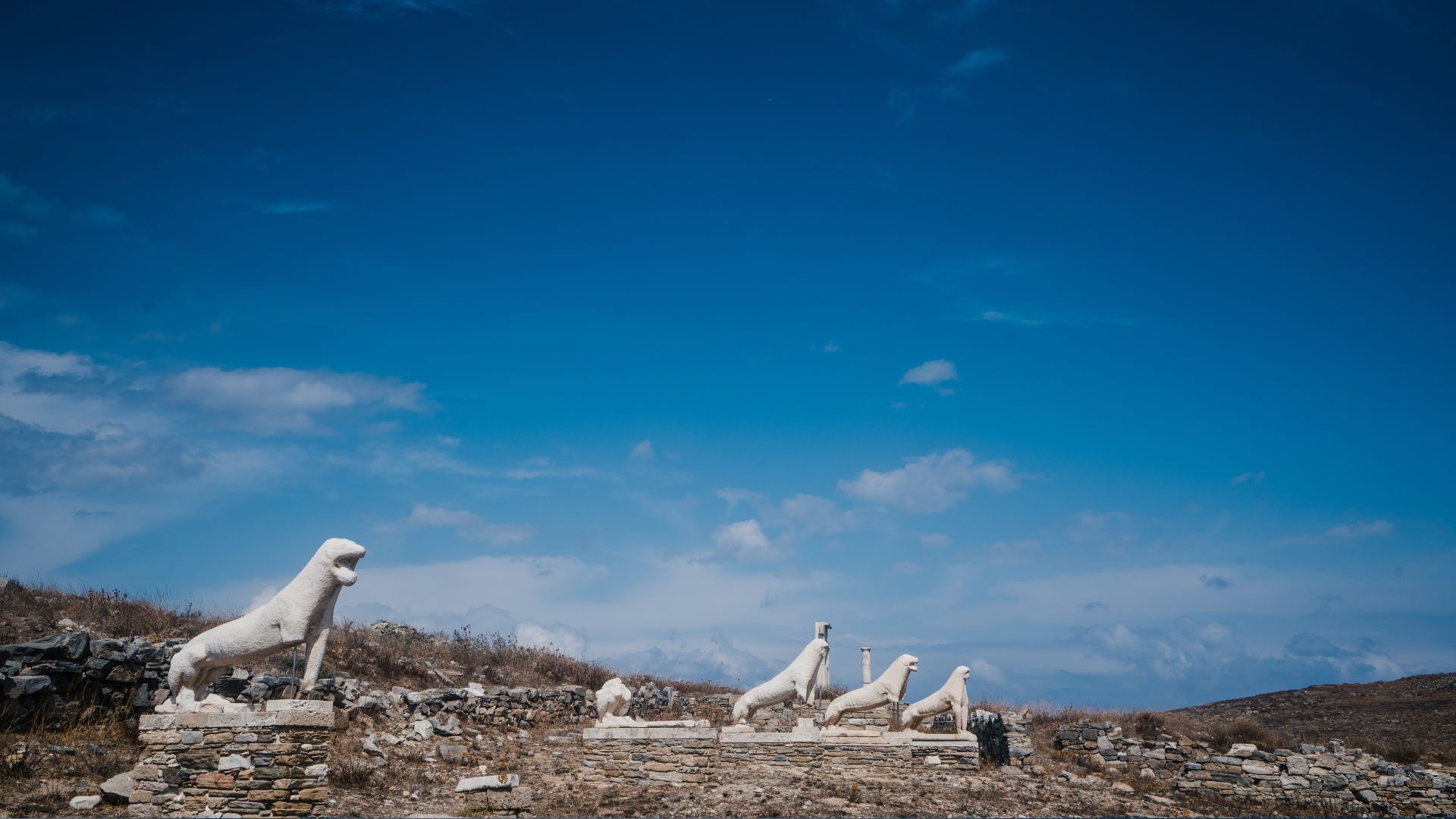
Four characteristics that distinguish Greece from the other Mediterranean charter grounds.
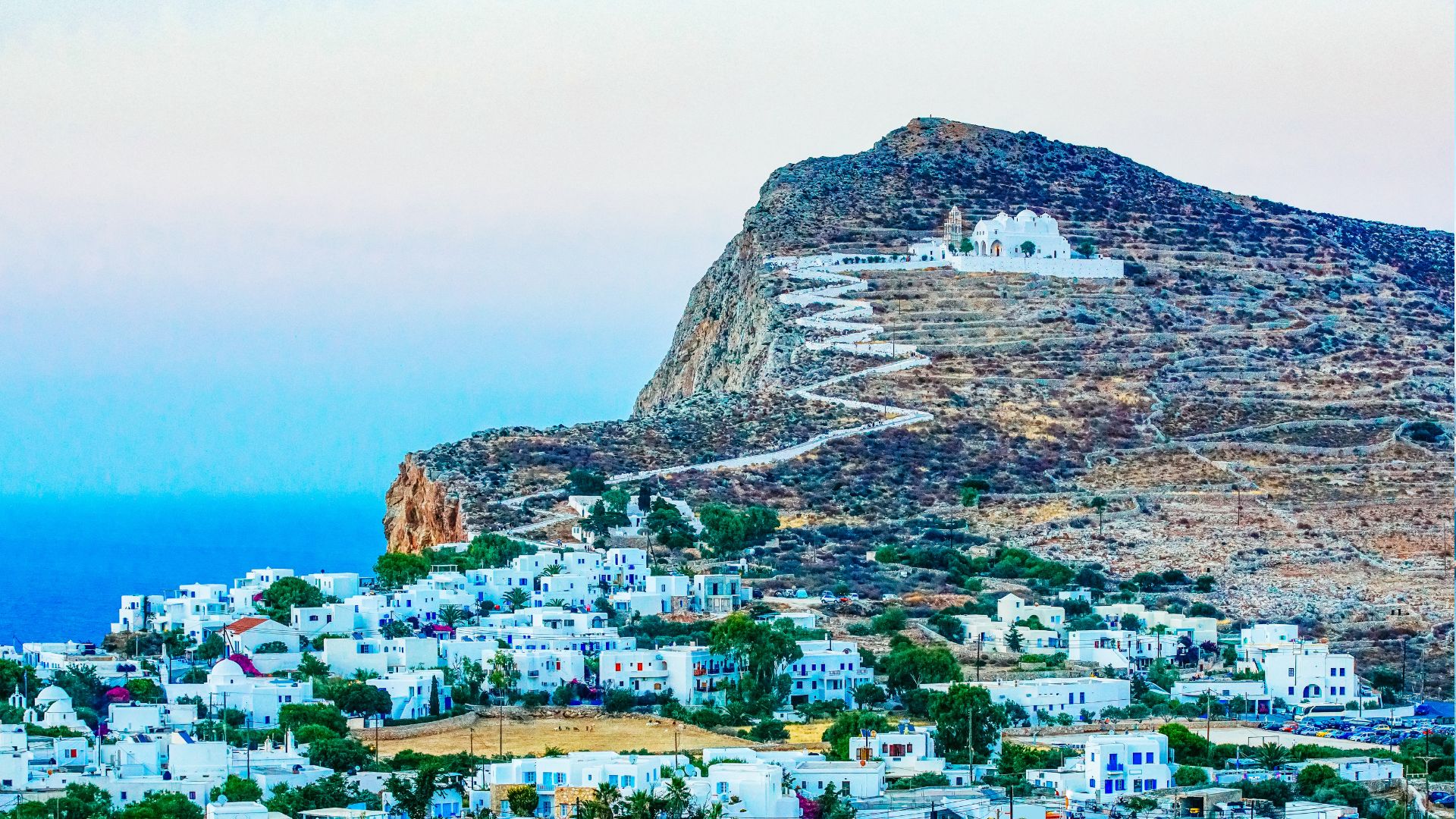
The image of Greece most charter guests carry into the trip — Mykonos windmills, Little Venice waterfront, the marble Portara of Naxos, Santorini's caldera at sunset, the whitewashed villages stacked on barren volcanic hillsides — is the Cyclades. The Meltemi, the dry steady northerly that defines an Aegean summer, blows June through September and turns the chain into one of the great downwind sailing grounds of the Mediterranean. Two distinct routes work the region: the Northern Cyclades from Athens to Mykonos for sailing yachts, and the Southern Cyclades caldera tour for motor yachts that can hold the longer legs to Santorini and Milos.
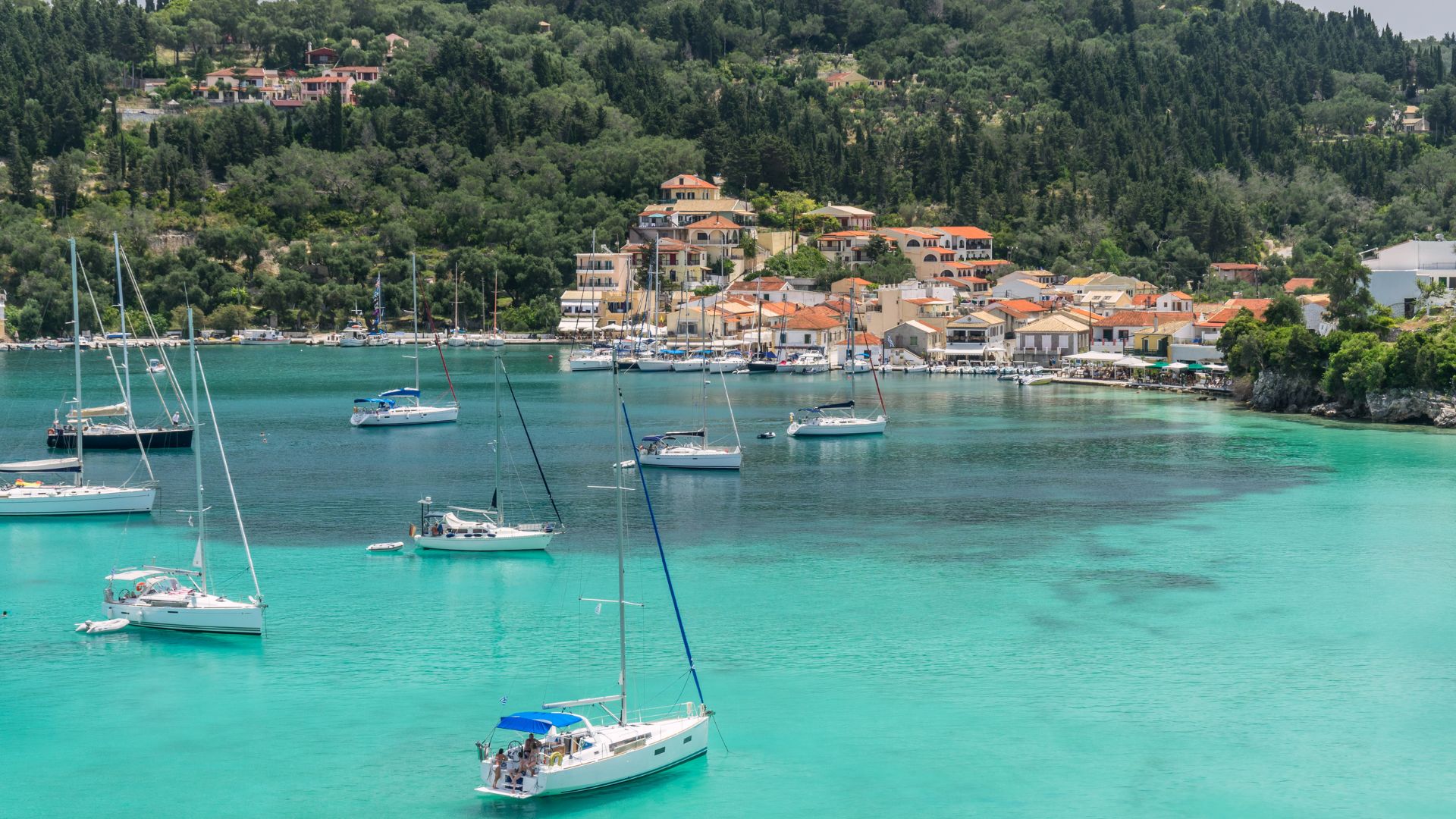
The Ionian Islands sit off Greece's northwestern coast, in the lee of the mainland and out of the Meltemi entirely. Thermal afternoon breezes build politely by mid-afternoon and drop again by dinner. Short hops of ten to twenty-five nautical miles separate Corfu, Paxos, Lefkas, Ithaca, and Kefalonia. Lee-shore anchoring at Sivota's Blue Lagoon, Lakka Bay on Paxos, and Voutoumi on Antipaxos. The route is the right call for first-time charterers, multigenerational groups, and any week where the priority is calm water over wind sport.
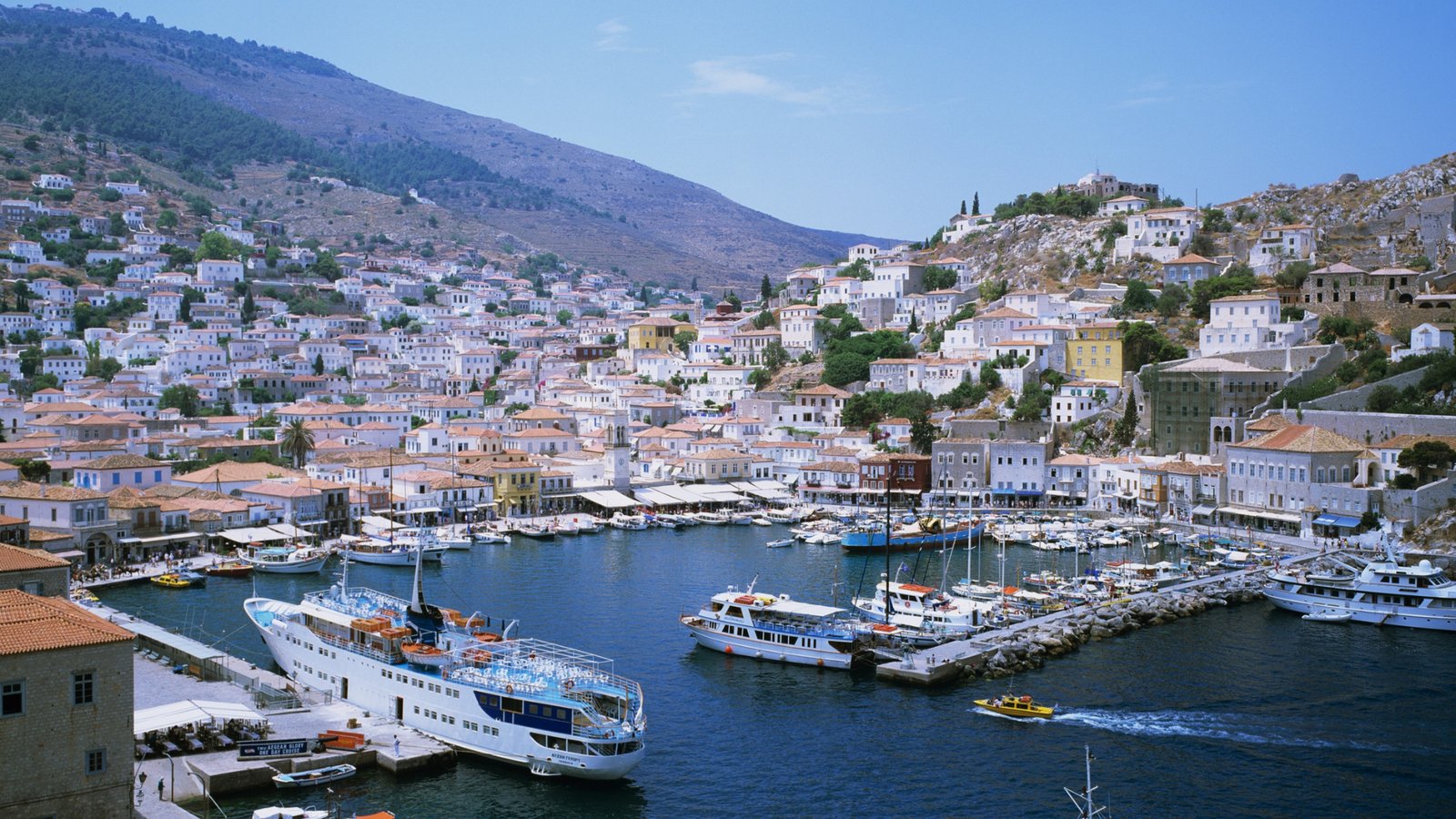
Greek food and wine are cultural infrastructure. Tavernas in every village serve wood-fired octopus, fresh-caught barbouni and tsipoura, mezedhes drawn from the day's market, and local wines that don't travel outside the country — Assyrtiko from Santorini, Vinsanto from the same vineyards, Mandilaria from the Dodecanese, Robola from Kefalonia, and a half-dozen Cycladic varietals you'll only find on the islands they're grown on. A typical charter mixes chef-prepared meals on board with several taverna dinners ashore — the captain books ahead at the standout rooms because they fill weeks in advance during peak season.
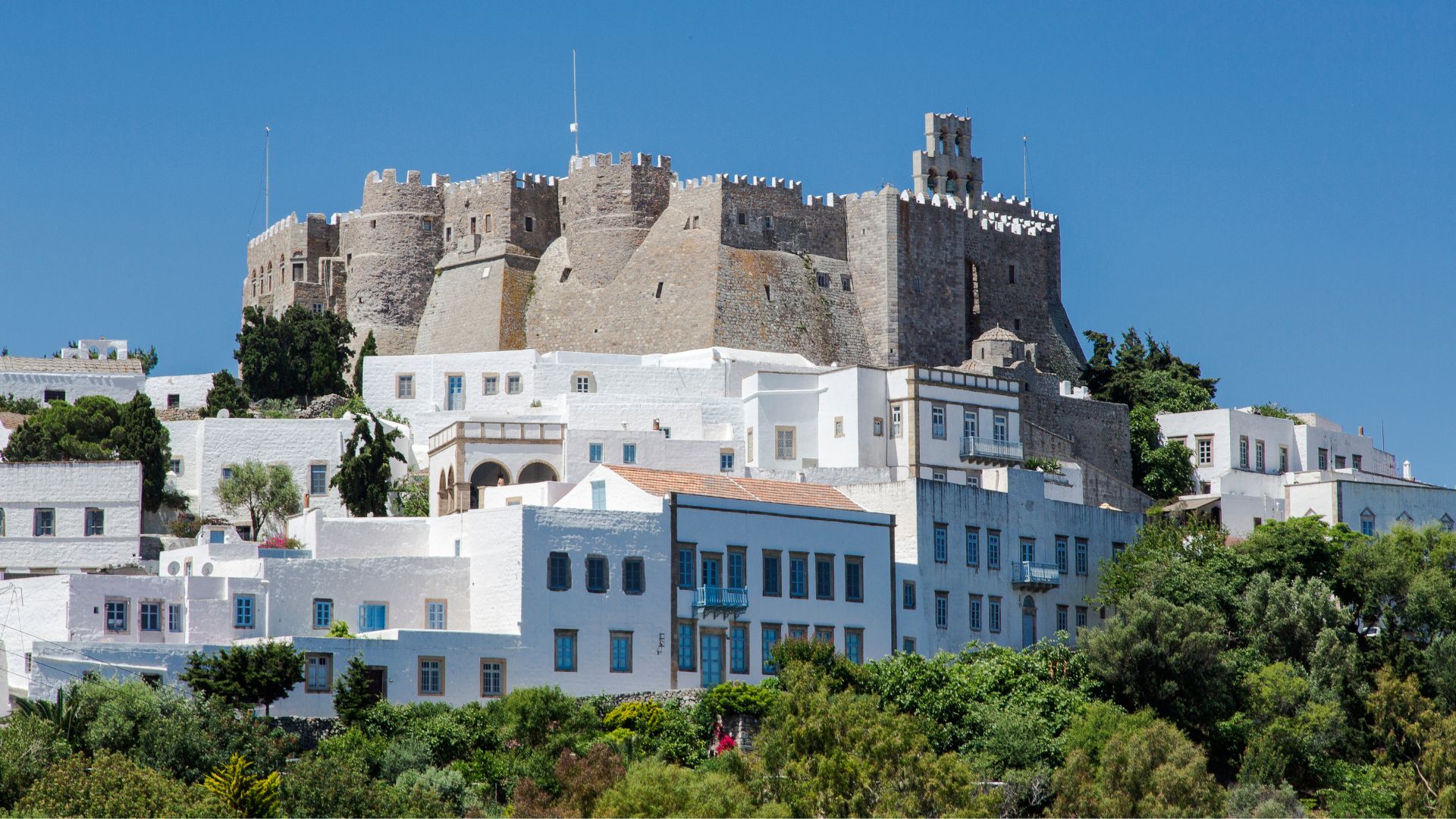
The Dodecanese strings out along the Turkish coast in the eastern Aegean — Rhodes's medieval walled old city (the largest intact medieval walled city in Europe), Symi's pastel neoclassical harbor at Yialos, Patmos's UNESCO hilltop Monastery of St. John where the Book of Revelation was written, the active volcano on Nisyros you can walk into, and Lipsi's quieter anchorages. The route is built around a Kos round-trip with a one-way arrival into Rhodes. The Meltemi blows here in summer too, but more spread out and less concentrated than in the Cyclades, and the southern position extends the comfortable charter season from May into October.
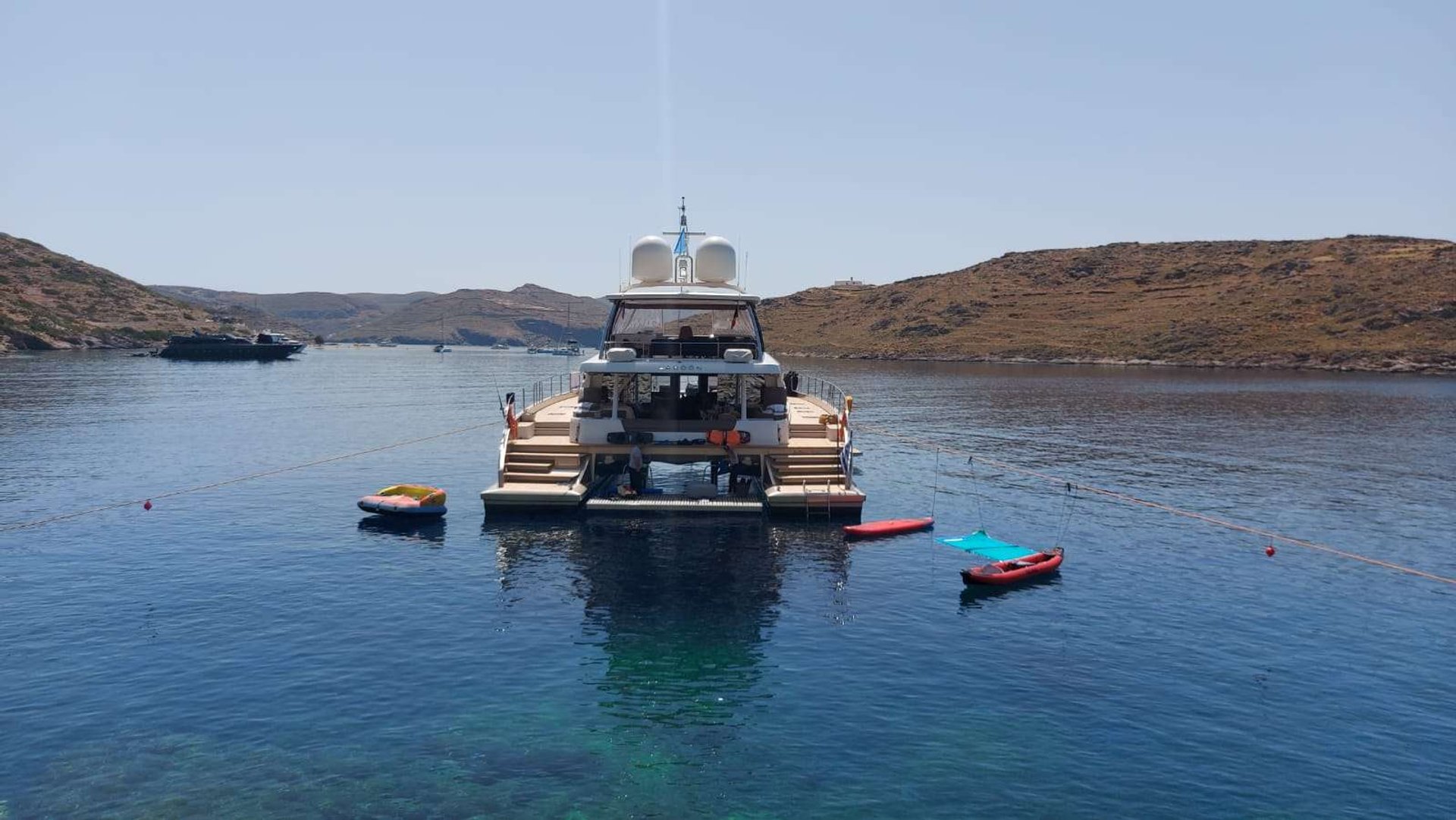
A hand-picked selection of crewed charter yachts for Greece — yachts and crews we know firsthand.
Your week is shaped around your group's interests, the season, and the conditions on the water — your captain tailors the days as they unfold. Treat these itineraries as starting points for inspiration.
Crewed Itinerary · Greece
This Mykonos itinerary is the classic Greek sailing week—the one with the Mykonos windmills above Little Venice, the whitewashed villages stacked on barren Cycladic hillsides, the Meltemi-driven downwind reaches between islands you've seen on every postcard, and the Temple of Poseidon framing the bow on the way out of Athens. It's the postcard-Greece week, and it's deliberately built to fit a sailing yacht. Six islands, an archaeological day on UNESCO-listed Delos, and a one-way arrival into Mykonos with direct flights home. Your professional captain and private chef handle every detail. You step aboard, settle in, and let the Meltemi do the rest.
This is the sailing-yacht-friendly Cyclades route—about two hundred nautical miles end to end, with short legs and every island reachable comfortably on a sailing catamaran or monohull. The route is deliberately downwind. The Meltemi—the dry, steady northerly that defines a Cyclades summer—blows from June through September, often 25–35 knots at its July and August peak. Pointed the right way, that's a gift: fast, dry reaches through the chain with reliable landfalls by mid-afternoon. The two flexible legs—Paros to Antiparos to Mykonos, and the Delos crossing—are left loose enough that your captain can adjust timing when the Meltemi really pipes up. That's the whole trick to sailing the Aegean well.
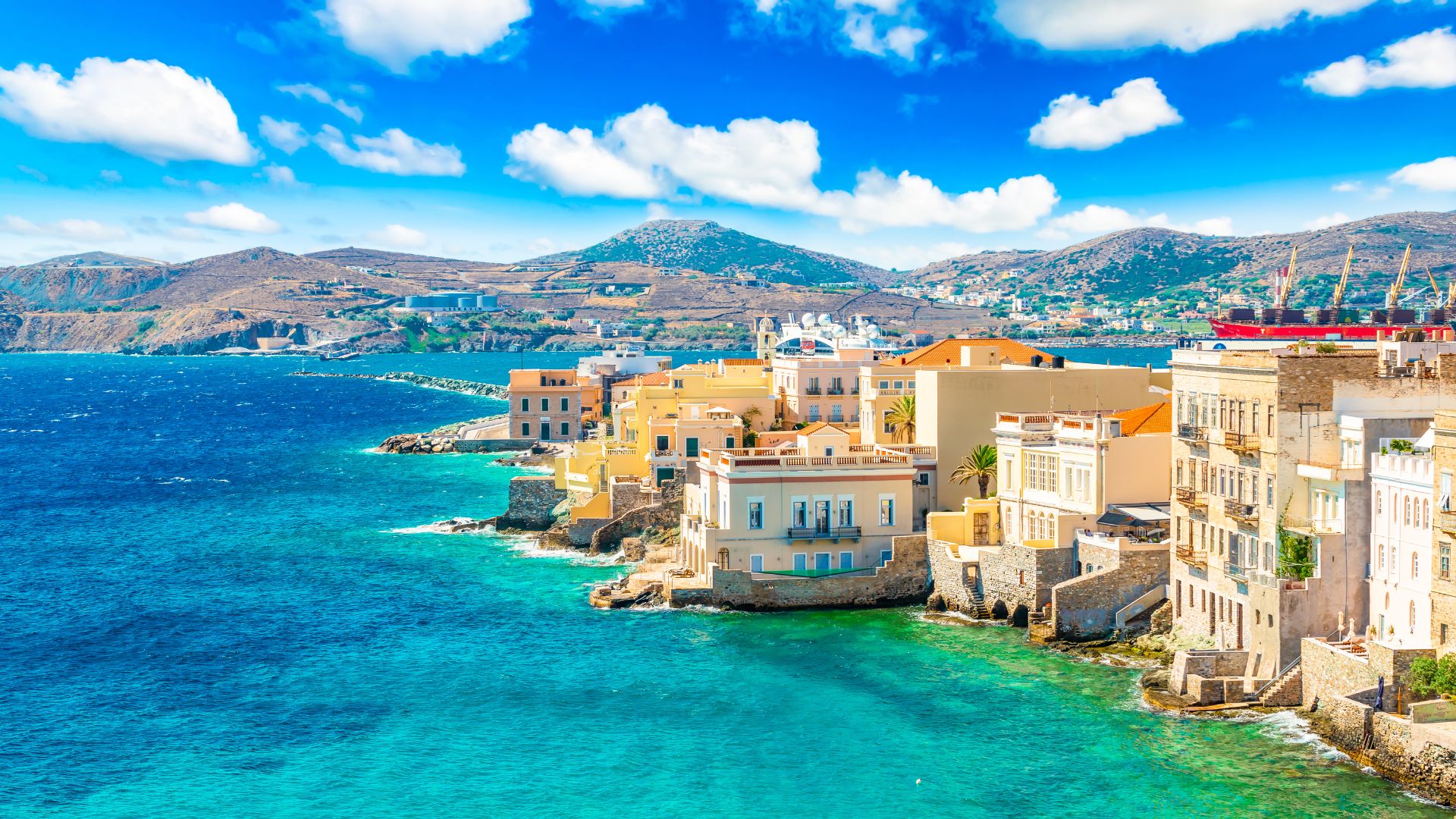
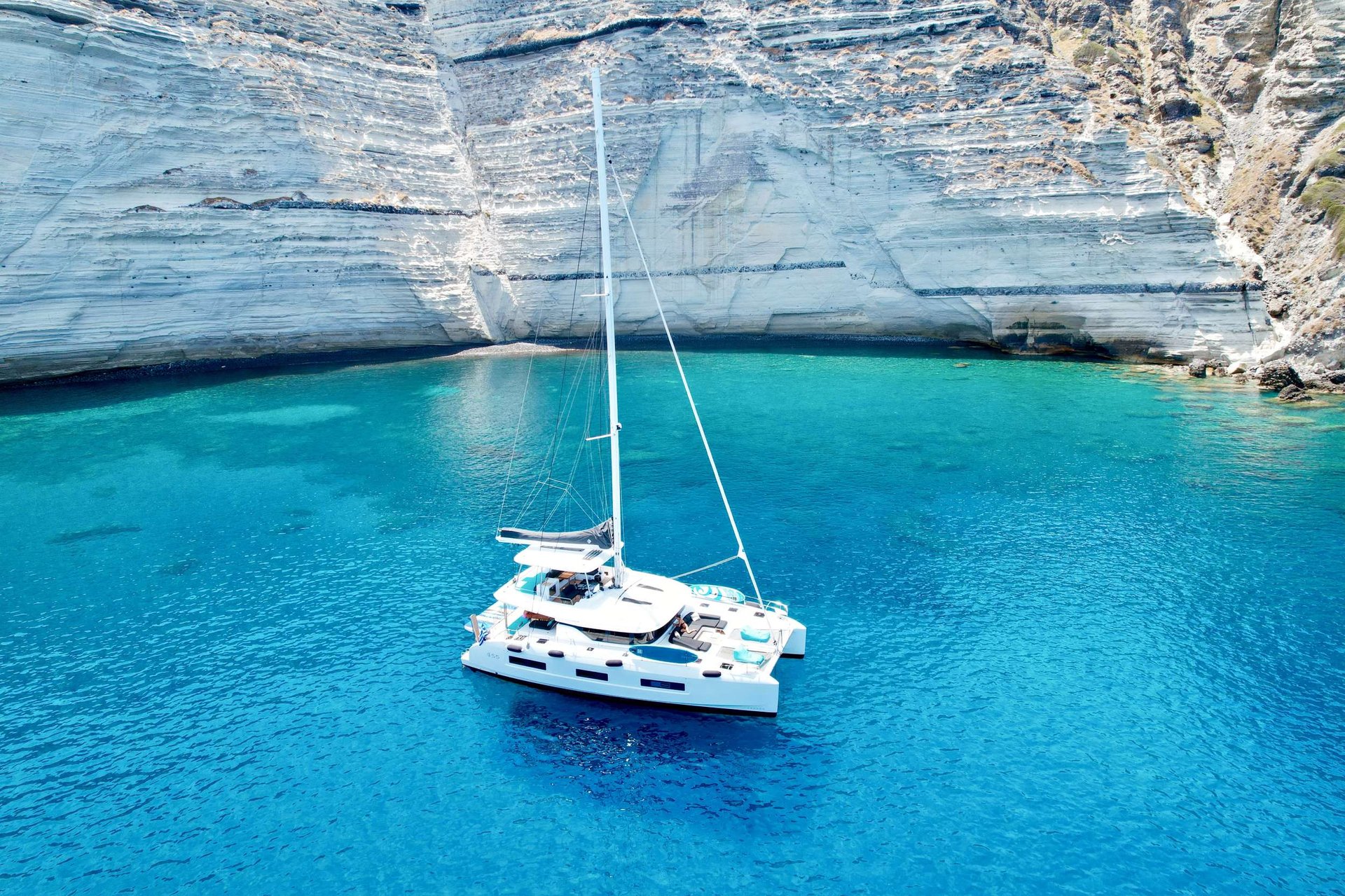
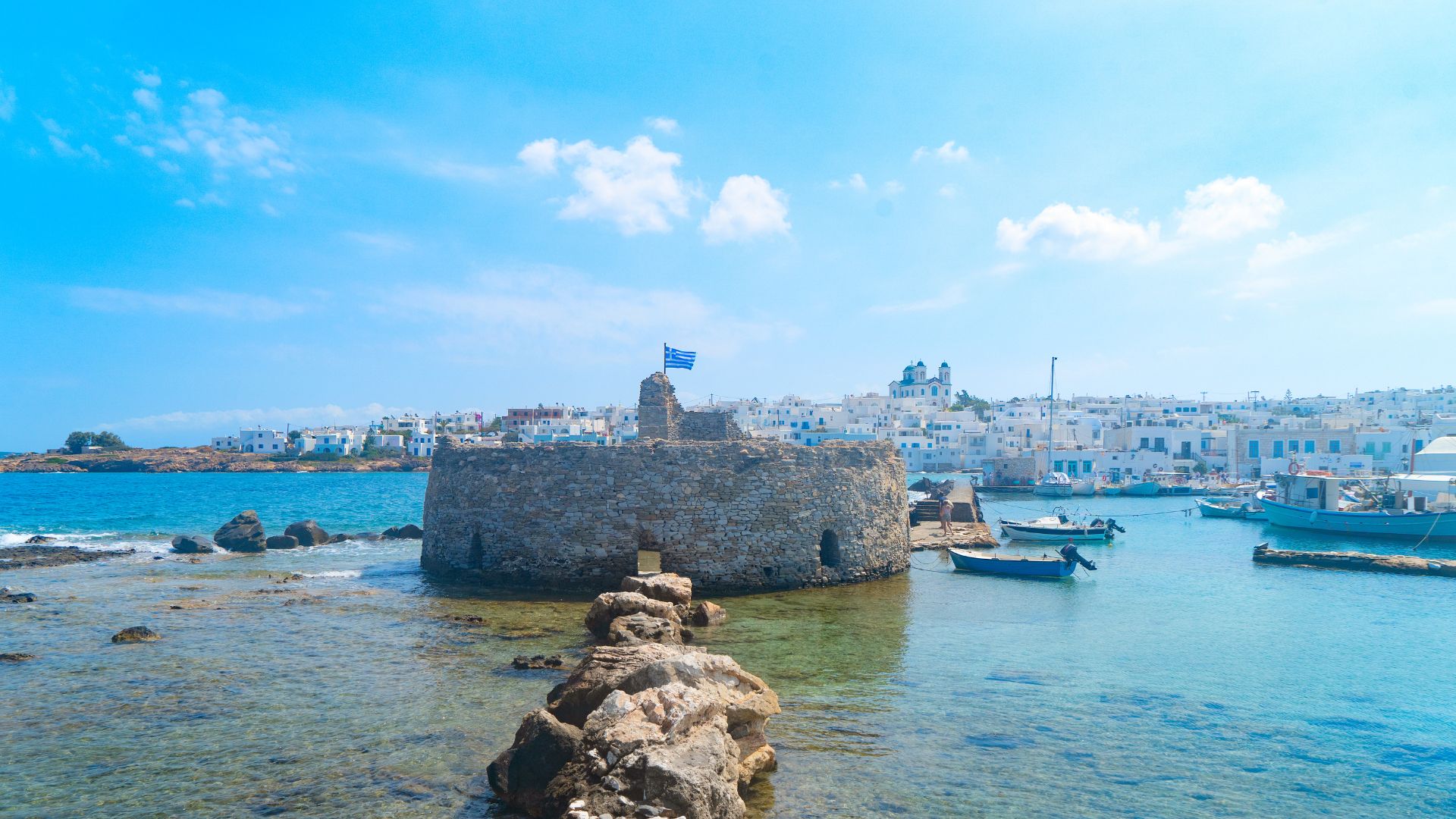
Athens to Mykonos is the highest-volume search in the Greek charter market, and it's the framing this Northern Cyclades itinerary is built around. Pickup at Alimos Marina (15 minutes from Athens airport), drop-off at Mykonos with direct flights home. Six islands in between: Kythnos for the first quiet anchorage, Syros for the neoclassical port at Ermoupoli, Paros for Naoussa harbor, Naxos for the Portara at sunset, UNESCO Delos for the archaeology day, and Mykonos for the final.
About 200 nautical miles end-to-end, deliberately downwind to ride the Meltemi instead of fight it. This Greek islands itinerary is sailing-yacht friendly — short legs (15–35 nm typical), reliable landfalls by mid-afternoon, anchorages your captain can pick based on the Meltemi forecast that morning. If you want Santorini in the lineup, that's the Southern Cyclades route on a motor yacht; Northern Cyclades is the slower, more sailing-led week.
Day 1 of 7 · Athens → Kea
Your journey begins at Alimos Marina on the Athens Riviera—the largest marina in Greece and the logical base for any serious Cyclades charter. After the short transfer from Athens International, your professional crew welcomes you aboard with cool refreshments, a glass of something crisp, and a chart briefing that frames the week ahead. Stow your gear, get the lay of the saloon, and take a minute on deck while the city hum fades behind the breakwater.
By early afternoon, your captain slips lines for the forty-nautical-mile crossing to Kea, the closest Cycladic island to the mainland. It's the longest leg of the week, and we do it first on purpose—with fresh guests, fresh wind, and the rest of the trip stacked in your favor. Expect a fast reach across the Saronic and into the Cyclades proper, Cape Sounion's Temple of Poseidon off to starboard for the first hour if the light is right.
Your crew drops the hook in Vourkari, a small U-shaped harbor on the northwest corner of the island lined with whitewashed tavernas and fishing boats. Tender in for dinner at Aristos, the seafood place everyone sends you to for a reason. Grilled octopus, a cold bottle of assyrtiko, and the sun going down behind the church on the hill. You're in Greece now.
Day Highlights
Day 2 of 7 · Kea → Kythnos
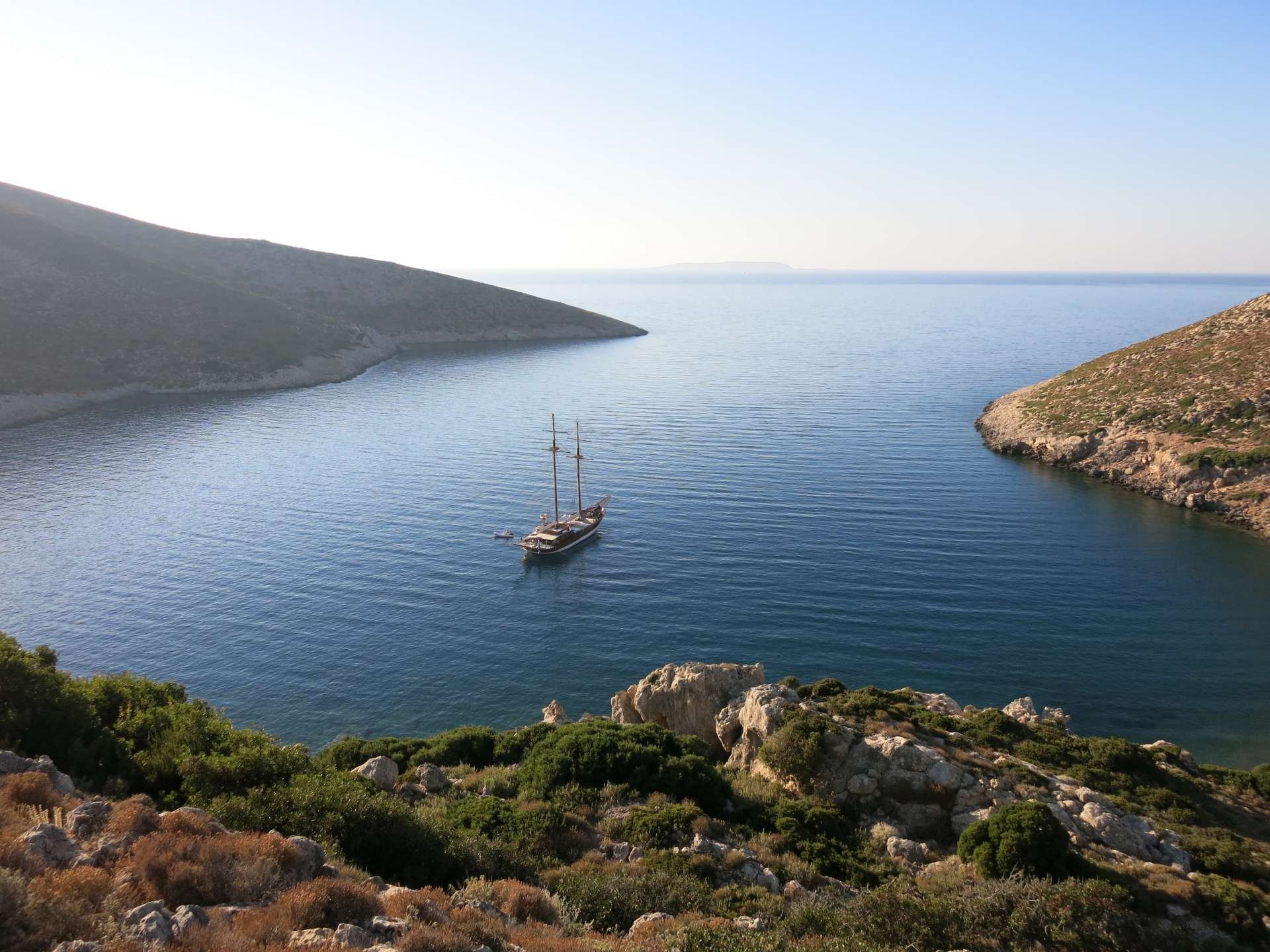
After a slow breakfast aboard and a swim off the back of the boat, your crew points the bow south for the twenty-five-mile passage to Kythnos. This is an easy day on the water—a half-day reach in the typical Meltemi with Kea's bluffs receding behind you and Kythnos growing slowly on the horizon. Most of the morning you'll be on the foredeck with a book, or up at the helm if you want to learn how the boat handles in a steady northerly.
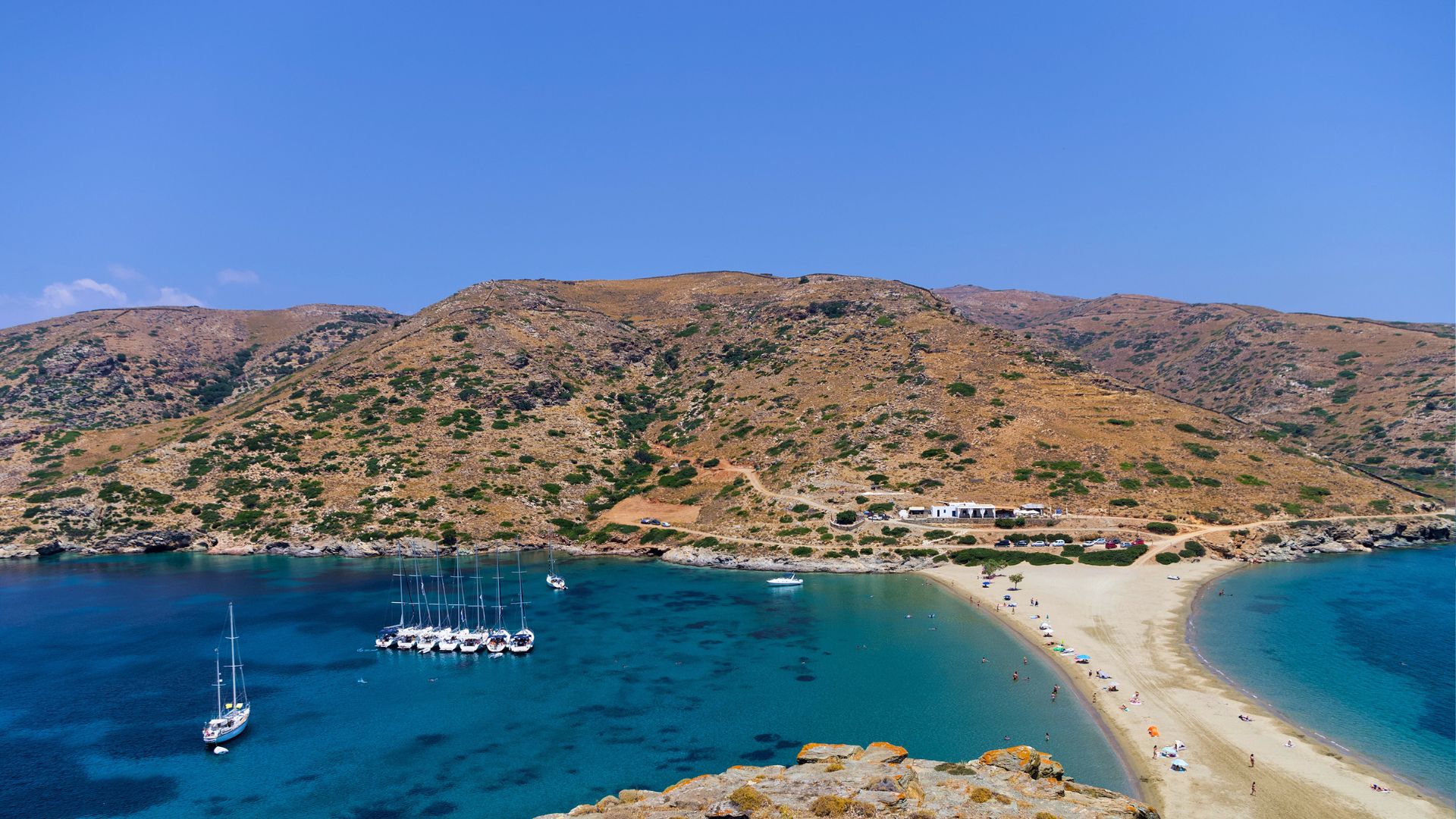
The destination is Kolona—a thin tongue of white sand connecting Kythnos to a small offshore islet, with open sea on one side and a protected bay on the other. You swim between two different seas. It's one of the most photographed anchorages in the Aegean and it earns the attention. Your captain will drop anchor off the lee side where the holding is best, launch the tender, and set up the swim platform. Most of the afternoon is spent in and out of the water, a shore walk along the sand if you feel like stretching your legs, a long lunch aboard, and not much else on the schedule.
Dinner is aboard tonight—your chef leans into the local catch and a few mezze plates for the table. The anchorage is quiet enough that you'll hear nothing but the breeze and the boat rocking gently on its chain.
Day Highlights
Day 3 of 7 · Kythnos → Syros
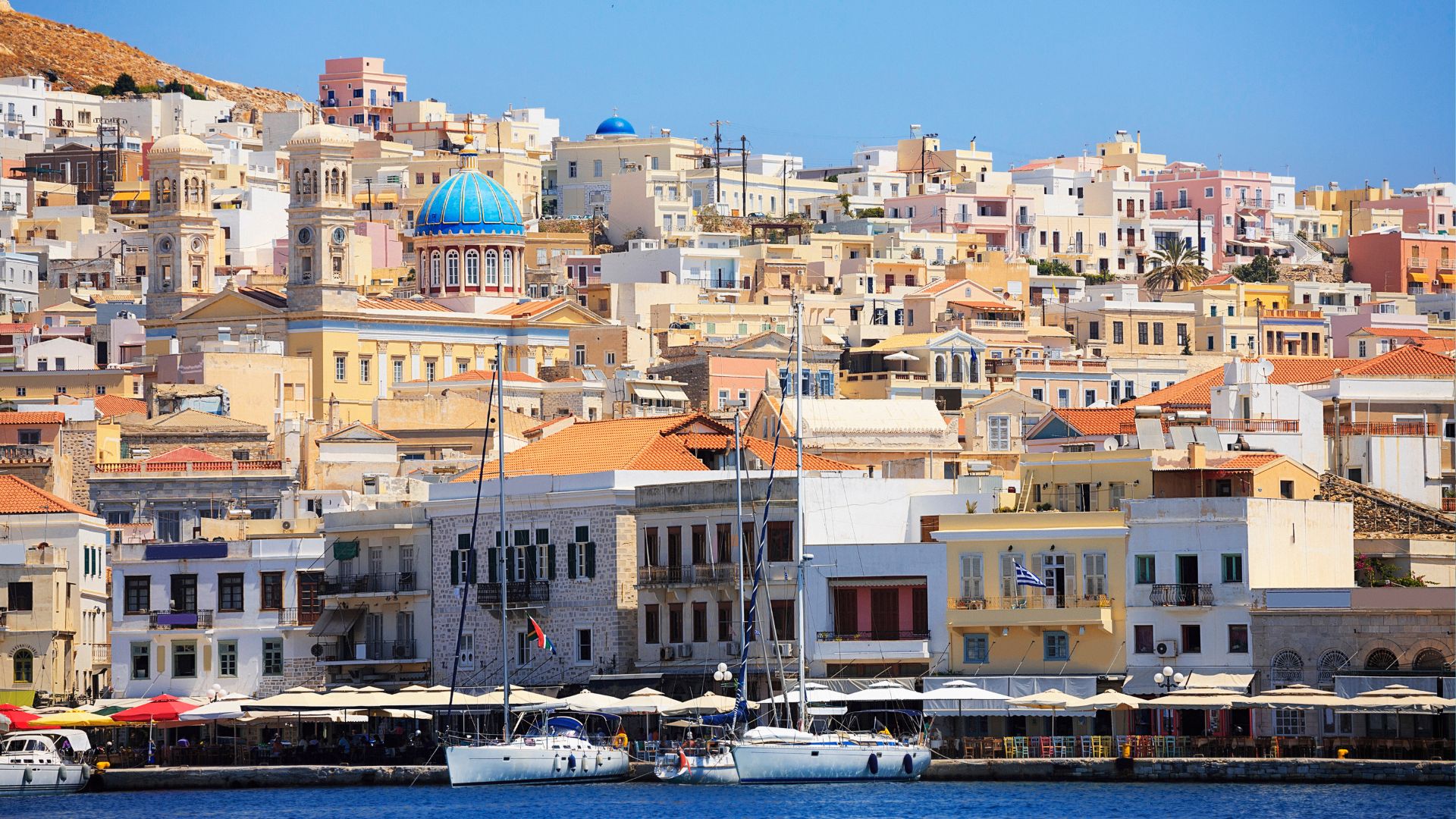
Today is a thirty-five-mile easterly run to Syros, the administrative capital of the Cyclades and the island most charter guests sail right past. They shouldn't. Syros was the largest port in Greece for most of the 19th century, and the wealth of that period built a town that looks nothing like the rest of the chain—an Italianate, neoclassical waterfront of pastel facades, a marble central square, and a working ferry harbor that has carried Aegean traffic for two hundred years. After the whitewashed simplicity of Kea and Kythnos, the contrast lands hard.
Your captain ties up alongside in the inner port at Ermoupoli—one of the few places on the route where the boat sits directly in town rather than on the hook. Walk the marble streets of Miaouli Square past the town hall, an Ernst Ziller-designed neoclassical building that wouldn't look out of place in Vienna or Trieste, and climb the stone lanes up to Ano Syros, the medieval Catholic quarter on the higher of the town's two hills. Syros is one of the only Greek islands with a long-standing Catholic population—a legacy of the Venetian and Frankish presence in the medieval Cyclades—and Ano Syros has the cathedral, the bishop's residence, and a hilltop village character that has barely changed in three hundred years.
Settle in at one of the kafenio tables along the climb for a cold drink and a long view down to the harbor where your yacht is waiting. The walk back down winds through the lower town and lands you back at the boat in time to clean up for dinner.
Dinner is ashore at Mazi or Thalassaki, both right on the Ermoupoli waterfront. Fresh fish, a bottle of local white from the Syros vineyards, and the lights of the ferries coming and going across the bay. This is the cosmopolitan Cyclades stop nobody talks about, and it's better for it.
Day Highlights
Day 4 of 7 · Syros → Paros
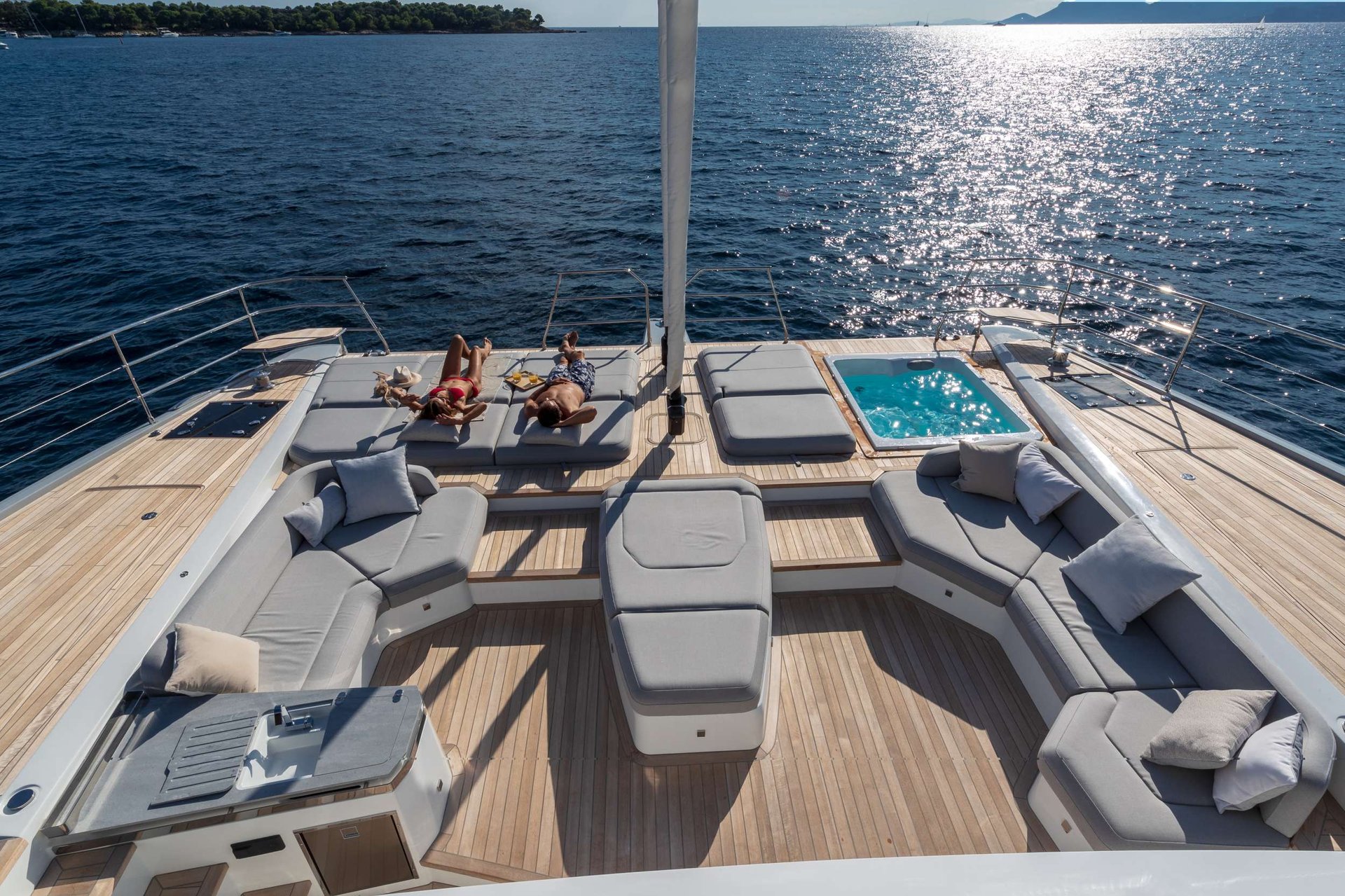
A short twenty-five-mile run southeast to Paros, and one of the better reaches of the week if the Meltemi cooperates. In a steady blow it's a fast, dry sail with the boat up on her numbers and the miles disappearing underneath you. In lighter conditions, it's a comfortable afternoon under full canvas with plenty of time on deck and a long lunch underway.
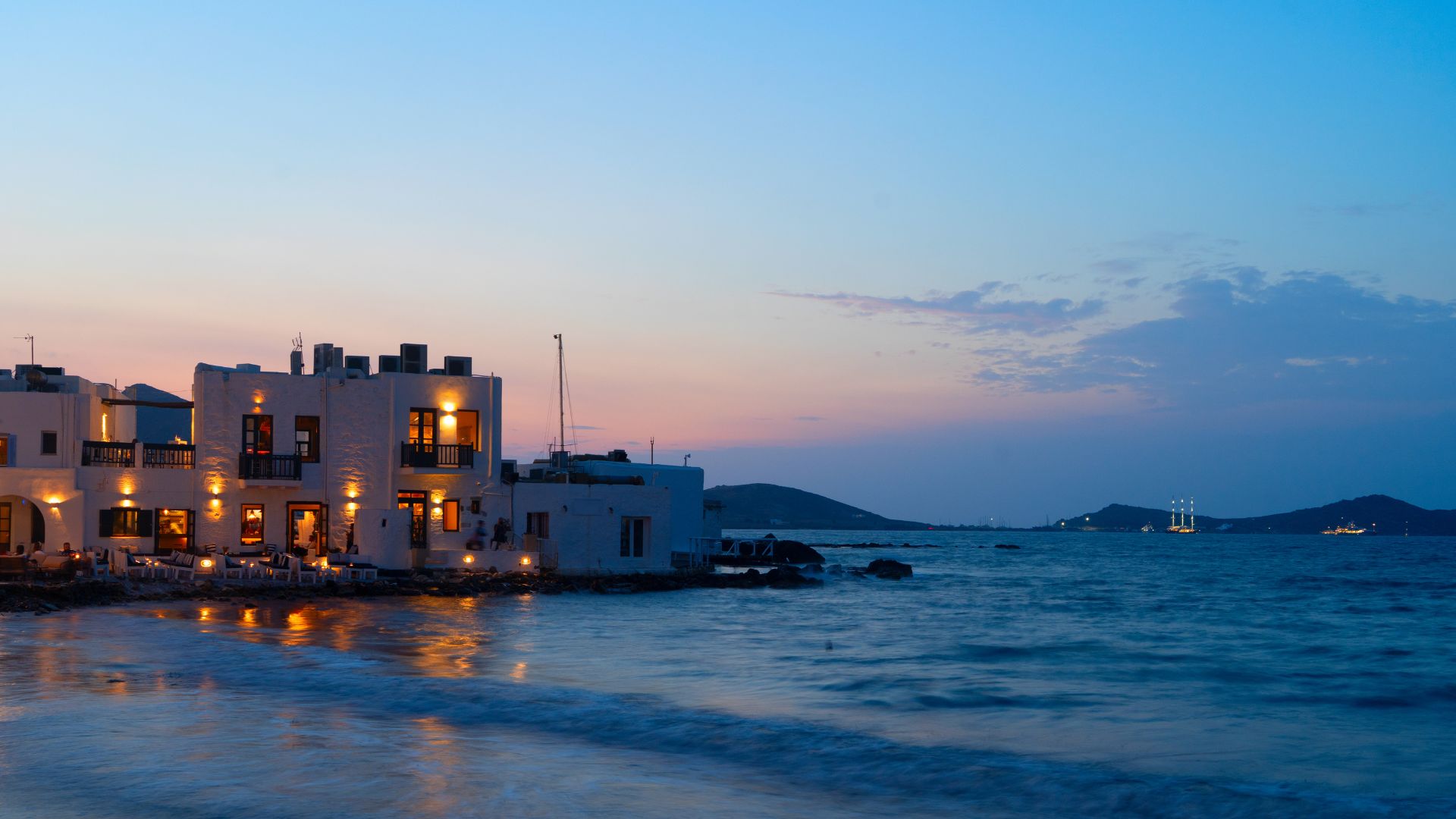
By late afternoon, you'll be tucked into the harbor at Naoussa on Paros's north coast—a working fishing village that's quietly become the most stylish address in the Cyclades without losing its nets-on-the-quay character. Tender in through the tiny inner harbor, past the half-submerged Venetian fort at the entrance, and up to the old stone windmill that sits at the mouth. That windmill is your sunset seat.
Naoussa rewards a slow walk before dinner. The lanes behind the harbor are narrow stone alleys lined with bougainvillea and small shops that have been there forever, plus a few new ones that have opened in the last decade as Paros has come into its own. The fishing boats still work the harbor at first light and tie up by mid-morning—the catch goes straight to the tavernas around the quay, which is part of why dinner here lives up to the reputation.
Dinner is ashore at Mario, one of the old-harbor tavernas with tables pushed up to the water—grilled fish, a bottle of local white, and boats coming in around you as you eat. Back aboard whenever you like; the boat is a five-minute tender ride away.
Day Highlights
Day 5 of 7 · Paros → Mykonos
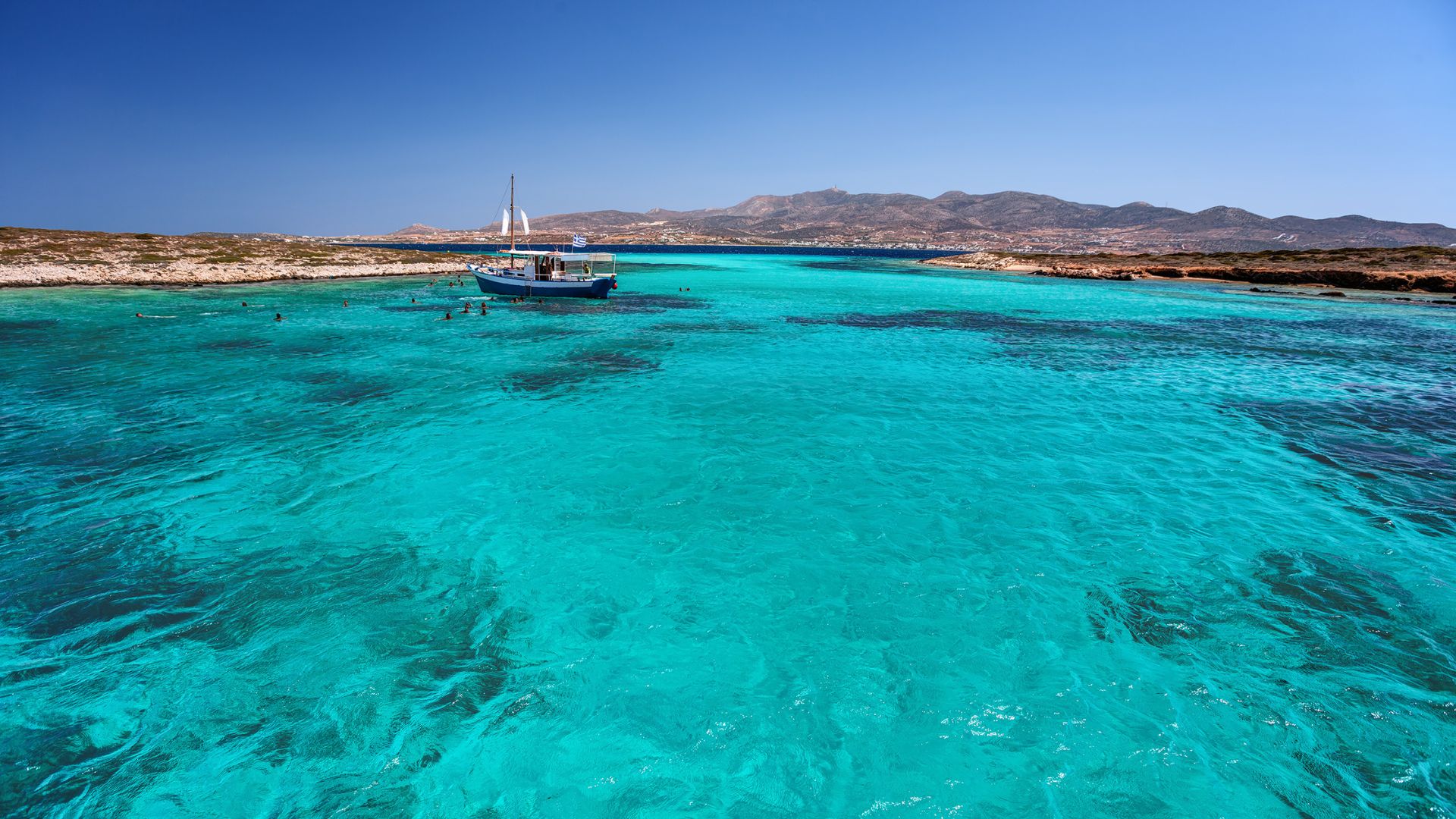
A short morning hop—five miles across the channel to Antiparos, the smaller, quieter sister island that sits off Paros's southwest corner. Your captain drops the hook off Sifneika Beach for a long swim in some of the clearest water on the route, or repositions south to the Blue Lagoon between Antiparos and the small uninhabited islet of Despotiko—a shallow, electric-turquoise channel where the swim platform stays down all morning.
After lunch on the hook, lines off for the thirty-mile northeasterly run to Mykonos. This is the first leg of the week where your captain holds the timing card. The channel between Paros and Mykonos can funnel the Meltemi into the high thirties on a loud day, and the entrance to the Mykonos anchorages gets uncomfortable in those conditions. The call is usually a lunchtime departure once the breeze has settled into its afternoon pattern. When it blows hard, your captain will adjust—that's what a crewed charter is for.
Anchorage tonight is Ornos or Platis Gialos on the southwest side of Mykonos, well away from the south-coast beach-club intensity. Super Paradise and the bachelorette-party stretch are the other direction—save those for somebody else's charter. Dinner aboard tonight, your chef working with whatever came off the boat at Naoussa.
Day Highlights
Day 6 of 7 · Delos & Mykonos
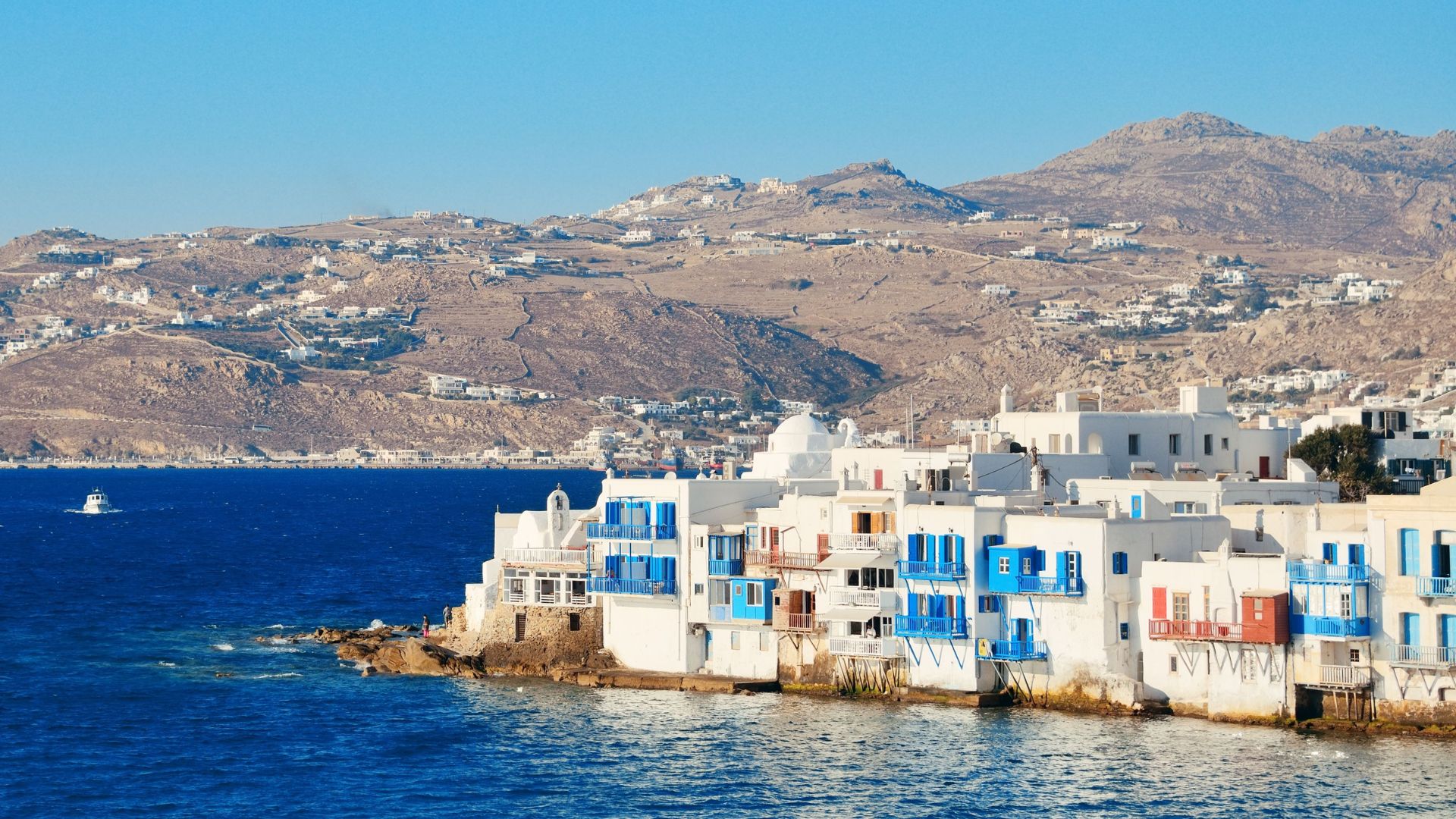
The Delos crossing is the second leg where your captain holds the timing card, and the call is usually an early start—lines off shortly after breakfast for the five-mile reposition to the Delos anchorage. The crewed-charter advantage on this stop is significant. Delos is a UNESCO World Heritage site and the largest open-air archaeological site in Greece, the sacred island of Apollo and once one of the most important religious centers of the ancient Mediterranean. Most Mykonos visitors do it as a thirty-minute ferry stop. You've got the morning.
Tender ashore, walk the ruins—the lion terrace, the House of Dionysus mosaics, the theater on the slope—and back aboard for lunch on the hook. Your captain will reposition to a quiet Mykonos anchorage in the early afternoon while the day-tripper boats are still working the south-coast beach clubs.
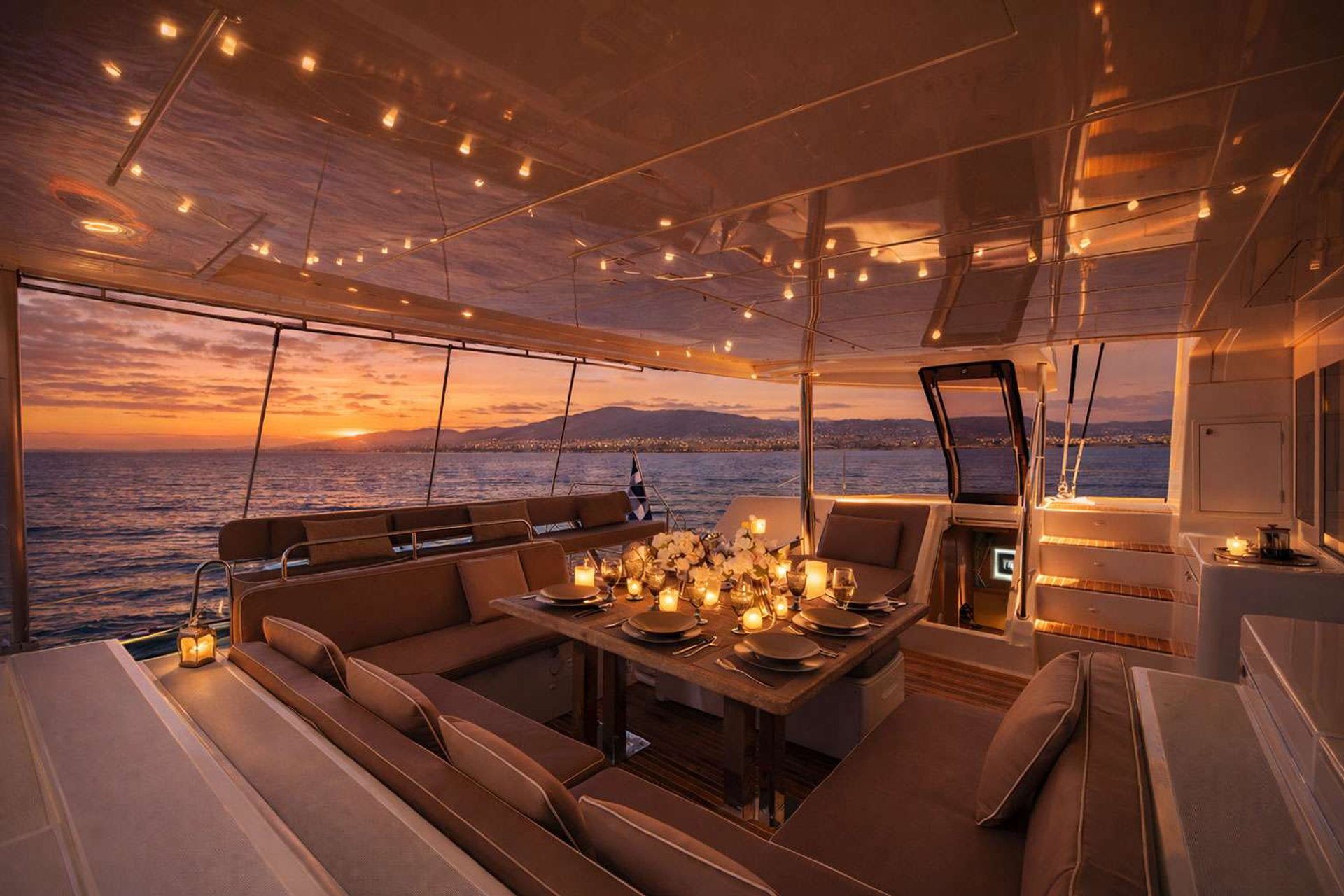
Late afternoon, the tender runs you into Mykonos town before the cruise-ship crowd is back on their boats. Walk the Chora's whitewashed lanes, find the famous windmills on the ridge above the harbor, and settle in at Little Venice—a row of old captains' houses on the western edge of town, built with their wooden balconies hanging directly over the sea. Pick a bar, grab a table at the edge, and watch the sun drop into the Aegean. Dinner aboard tonight—your chef pulls together a slow three courses on the aft deck with the lights of the town shimmering across the water.
Day Highlights
Day 7 of 7 · Mykonos
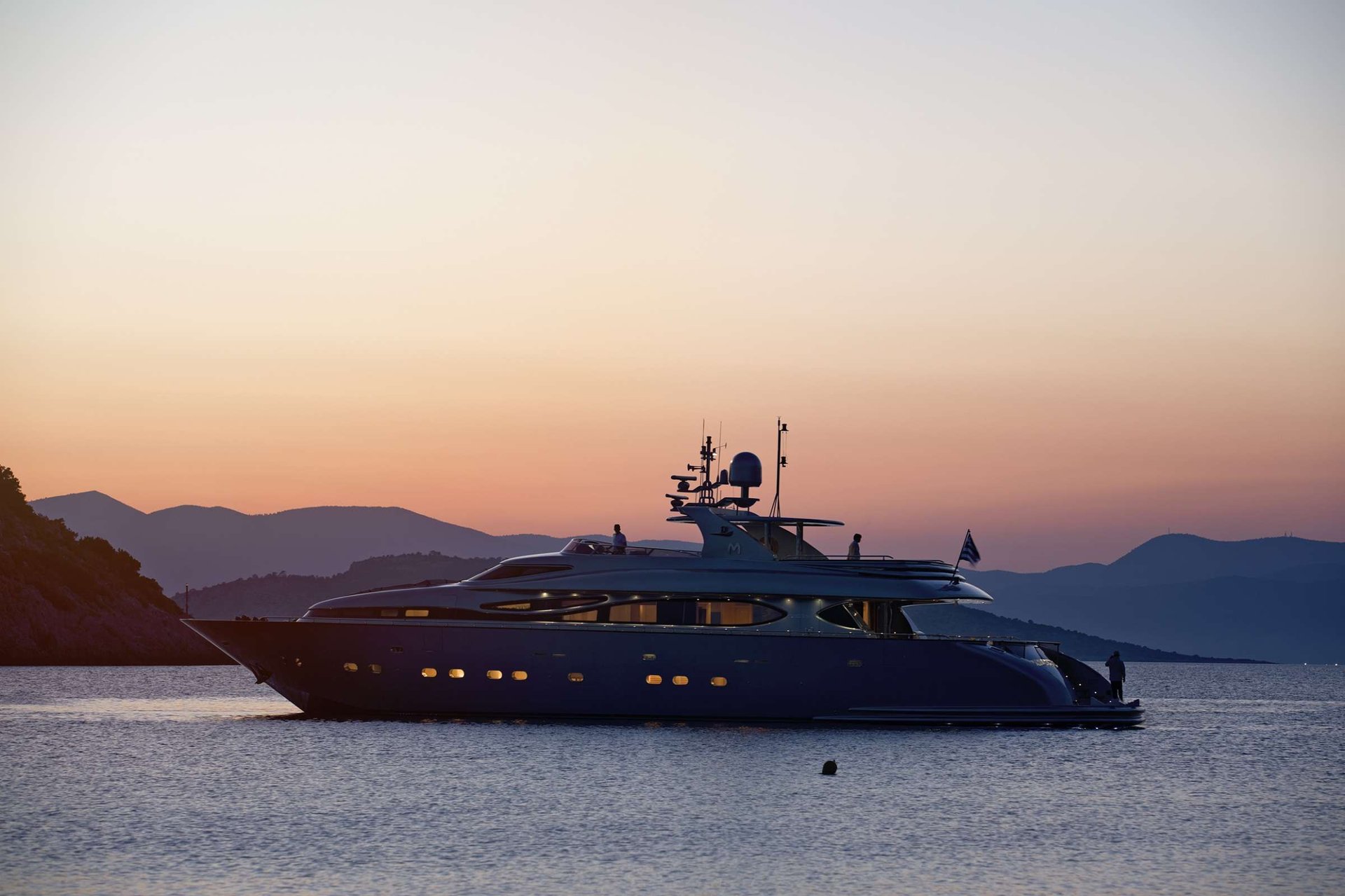
A no-passage day. Your captain holds station at a Mykonos anchorage—Ornos, Platis Gialos, or a reposition to Agios Sostis on the north coast if the Meltemi has settled and the swell on the north side is workable. Agios Sostis is the quiet swim stop most Mykonos visitors never find: a long sandy beach with a single taverna up the bluff and almost no boat traffic.
Otherwise the day is yours. Long swims off the back of the boat, paddleboards and kayaks for whoever wants them, the tender running guests ashore for an early evening walk through Chora before the sunset crowd shows up. Some charter parties ask the captain to thread back south for an extra night at Naxos or Paros if the timing works—he can run that call on the morning forecast.
The honest truth about Mykonos is that it's busy, especially in July and August. The crewed-charter advantage is that you don't deal with most of it. You're not fighting for a beach-club lounger at Nammos or a dinner reservation in Chora at peak hour. You're sitting on your own boat at a quiet anchorage with the breeze blocked by the headland, going ashore on your own schedule, and skipping the chunks of the island that are built for somebody else's vacation. That's the whole pitch for doing the Cyclades crewed instead of jumping island-to-island on ferries.
In the evening, your chef pulls out the stops for the farewell dinner—a slow, three-or-four-course plating on the aft deck, the boat sitting on its chain in the Aegean, the lights of Mykonos town across the water. The crew will be quietly resetting for tomorrow's morning departure while you linger at the table.
Day Highlights
Day 8 · Departure
Enjoy a final slow breakfast aboard, a last swim off the back of the boat if you're up for it, and a short tender ride to the old port for your mid-morning departure. Your crew handles every logistic—transfer to Mykonos Airport, onward flight to Athens or direct to most European hubs, a last photo with the yacht in the background. Step off with salt in your hair, a week of the Aegean behind you, and the sort of memories that tend to pull people back.
Want to share or come back to this voyage later?
Bookmark this voyage →Crewed Itinerary · Greece
If you've already done Mykonos and Santorini and want depth instead of spectacle, this is the Rhodes itinerary to book next. The Dodecanese strings out along the Turkish coast in the eastern Aegean, with two thousand years of layered history between the daily swims—a UNESCO hilltop monastery where John wrote Revelation, an active volcano you can walk into, the most photographed harbor in Greece, and the largest intact medieval walled city in Europe. It's a cultural week with the Aegean delivering the in-between sailing. Roughly 240 nautical miles round-trip from Kos with a one-way drop-off at Rhodes Airport.
The route is built around a Kos round trip with a final-day arrival into Rhodes—the practical move, since most charter guests want to fly home from Rhodes Airport rather than backtrack to Kos. Your professional captain and private chef handle the logistics of customs paperwork, harbor berths, and the inevitable schedule tweaks the Aegean weather will hand you. The Meltemi blows here in summer, but it's more spread out and less concentrated than in the Cyclades, and the Dodecanese sits far enough south to extend the season comfortably from May into October. The longer charter window, the cultural depth, and the sheer variety of what you sail through in a single week is why guests who've already done the Cyclades come back for this.
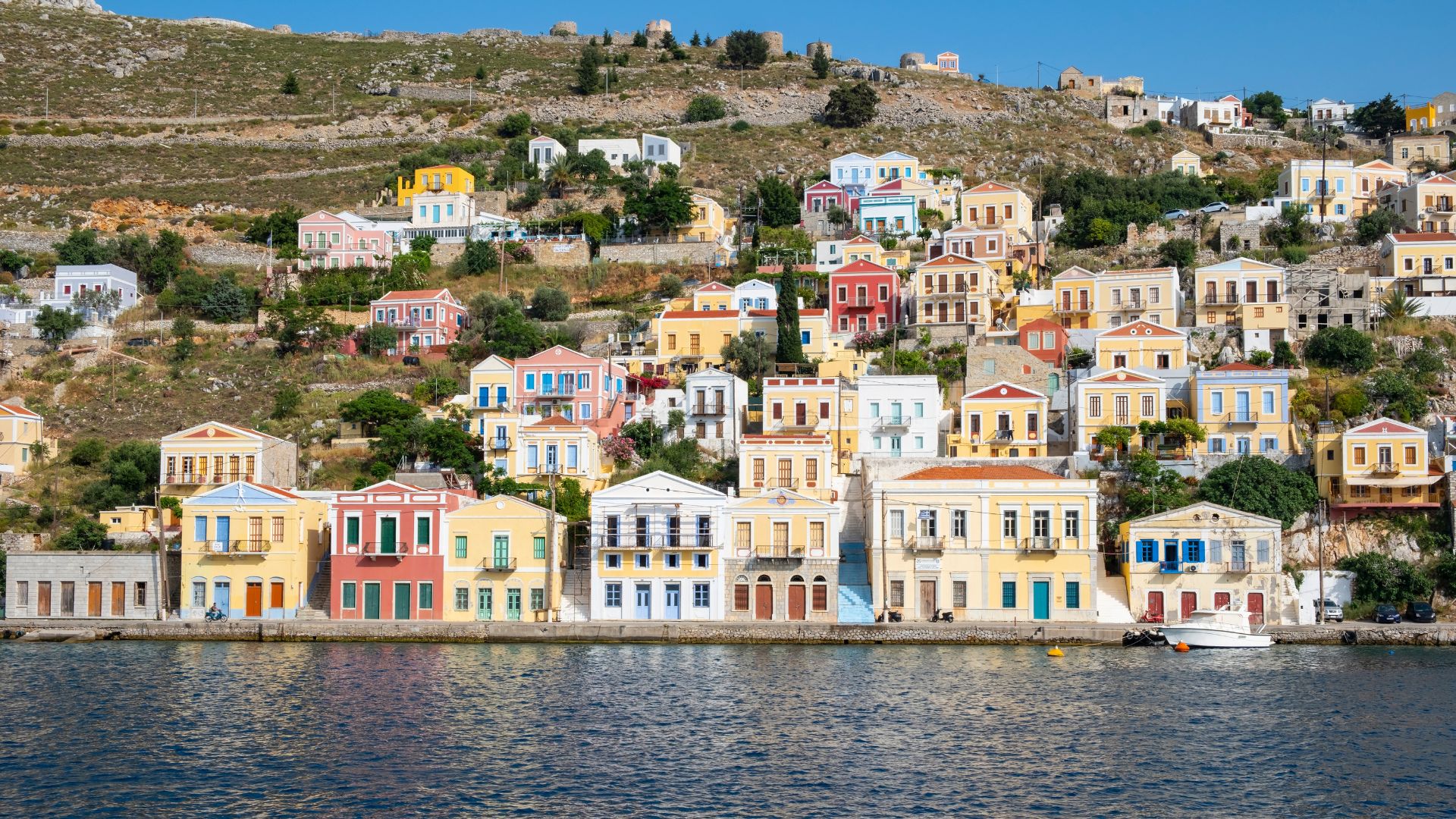
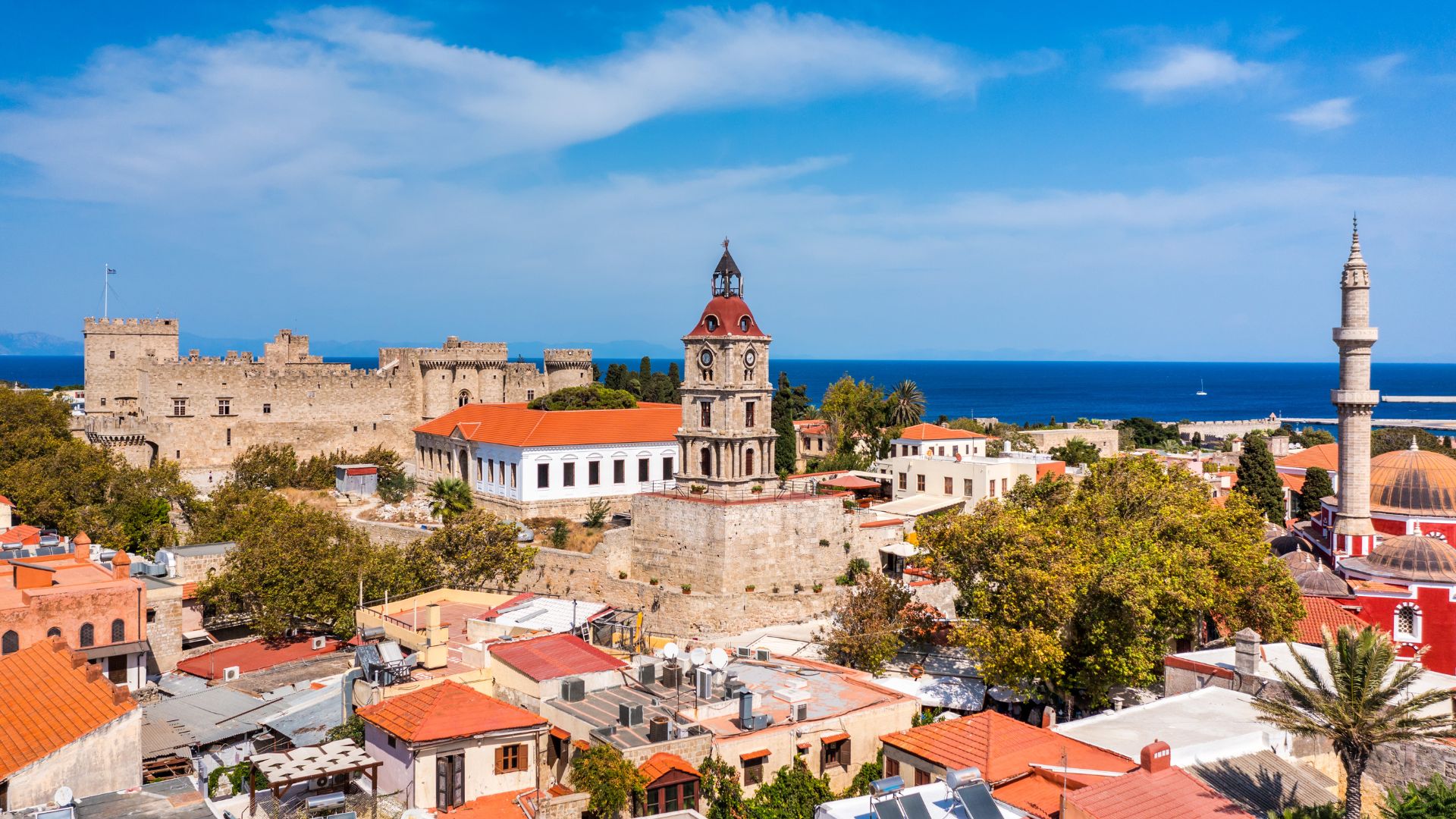
The Dodecanese is what guests book after they've done Mykonos and Santorini and want depth instead of postcards. UNESCO monasteries (Patmos — where John wrote Revelation), an active volcano you can walk into the caldera of (Nisyros), the most photographed harbor in Greece (Symi), and the largest intact medieval walled city in Europe (Rhodes). Two thousand years of layered Greek/Italian/Ottoman history between the daily swims.
About 240 nautical miles across the week — Kos pickup, Patmos, Lipsi, Leros, Kalymnos, Nisyros, Symi, with a one-way drop-off at Rhodes (most guests fly home from Rhodes rather than backtrack to Kos). The Meltemi blows here in summer but it's more spread out than in the Cyclades, so the season extends comfortably May through October. The Dodecanese is the Greek islands itinerary for charterers who want the cultural week.
Day 1 of 7 · Kos → Pserimos
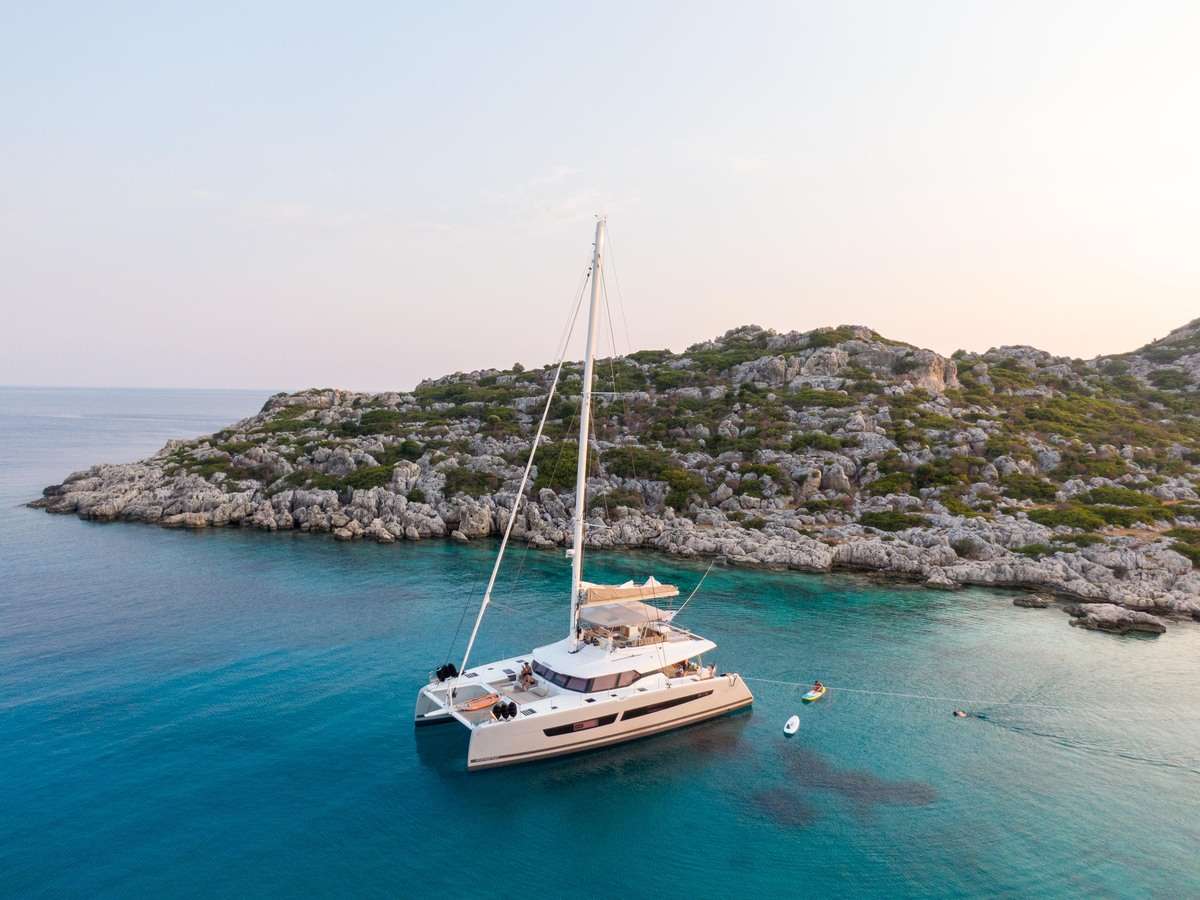
Your charter begins at Kos Marina on the eastern edge of Kos Town—a short transfer from Kos International and the main crewed base for the central Dodecanese. Your captain and chef meet you on the dock, walk you through the yacht, stow the luggage, and pour the first cold drink while they cover the route ahead. The Turkish mainland sits four miles off the bow on a clear afternoon, close enough that Bodrum's castle is visible across the strait. It is a useful reminder, on day one, of how close this corner of Greece is to Asia Minor and how much that proximity has shaped everything you're about to see.
Once everyone's settled, the captain slips lines for a short ten-nautical-mile shakedown north to Pserimos—a small island tucked between Kos and Kalymnos with a wide sandy bay, three or four tavernas along the waterfront, and almost nothing else. It's an easy first overnight, deliberately understated, designed to let the family find the quiet rhythm of the boat before the bigger days.
Dinner is aboard the first night, chef-prepared, while the day-trip boats from Kos clear out and the bay empties. Grilled fish off the morning's market, a Greek salad with Santorini tomatoes, a chilled bottle of Assyrtiko, and the lights of the village glowing a few hundred meters off the stern.
Day Highlights
Day 2 of 7 · Pserimos → Patmos
A thirty-nautical-mile run north to Patmos this morning—about three hours on a displacement motor yacht, less on a planing one—and the longest leg of the early week. The Aegean is usually friendly enough on this stretch in the morning, with the Meltemi yet to fill in, and the long flank of Leros builds slowly to port as the captain works north.
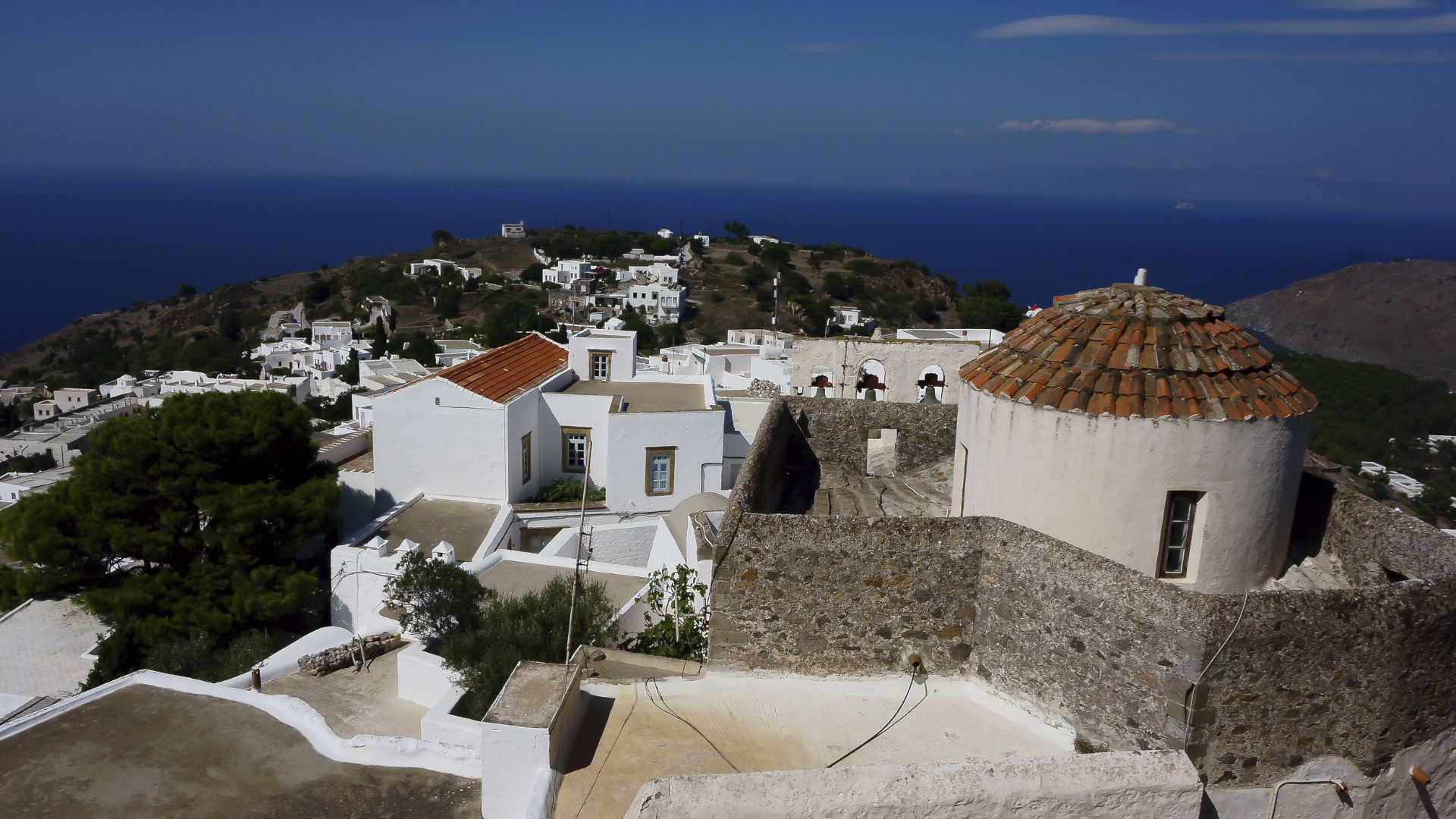
Patmos is the religious one. In a cave on the hillside above what is now Skala harbor, the apostle John is said to have written the Book of Revelation in the year 95. A monastery built around that cave became the nucleus of the village above—the Chora—and in the 11th century the larger Monastery of St. John was raised on the highest point of the island, walled like a fortress against the pirates that worked these waters for the next several hundred years. The whole hilltop complex is a UNESCO World Heritage Site, and a half-day ashore is enough to walk through both the monastery and the cave with a guide.
Your captain berths at Skala or anchors off, depending on the August traffic, and your chef builds the afternoon around a long lunch aboard before the climb up to Chora. Late afternoon is the right time to walk the monastery—the heat off the limestone has dropped, the cruise-ship visitors are mostly back on their tenders, and the light turns the Aegean below to pewter. Dinner ashore at one of the harborfront tavernas in Skala on the way back to the boat.
Day Highlights
Day 3 of 7 · Patmos → Lipsi
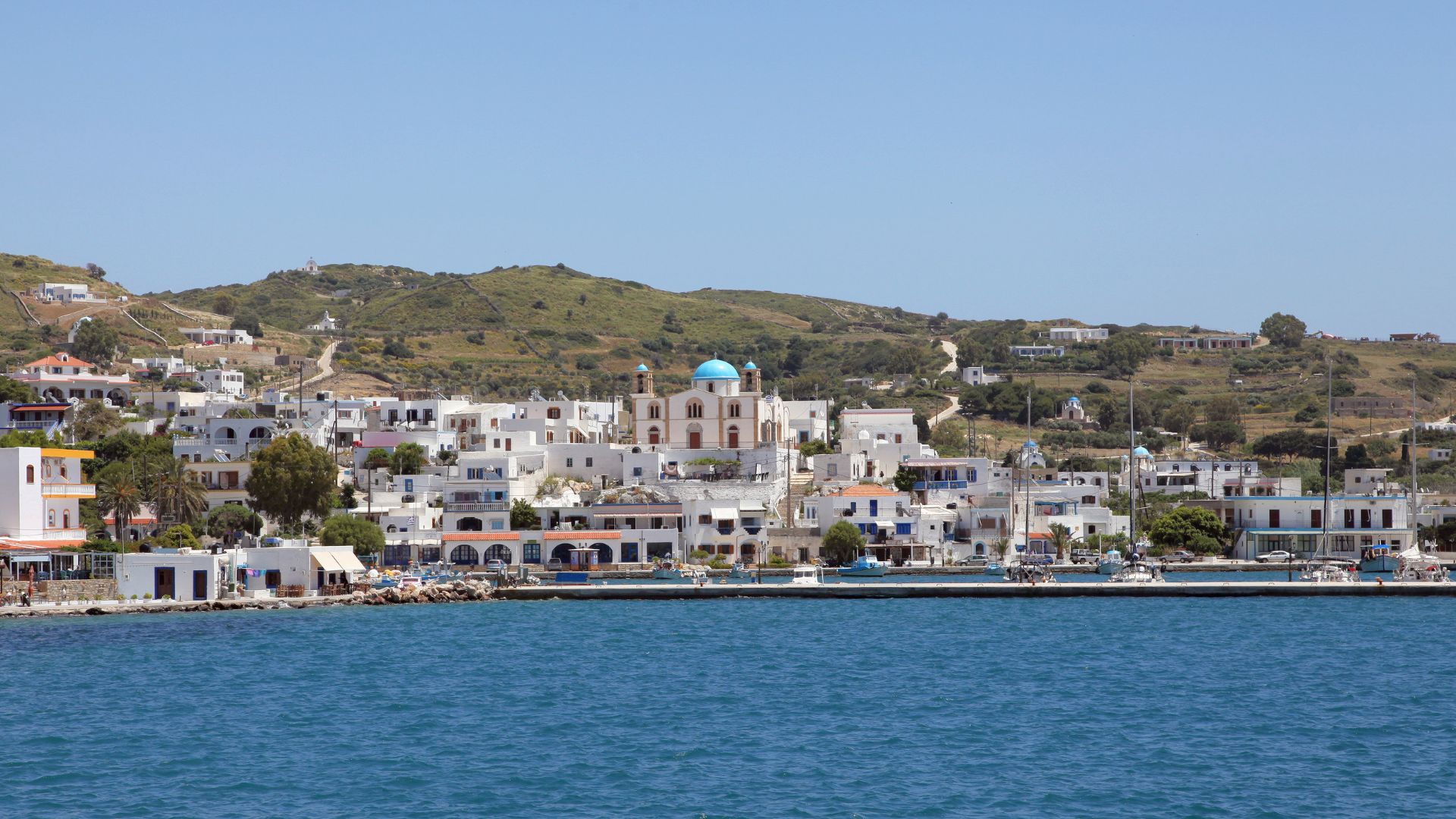
A short ten-nautical-mile hop south to Lipsi today—an hour or less under power, and the kind of leg you take after a slow breakfast on deck. Lipsi is small, undeveloped, and almost entirely overlooked by the bigger charter routes, which is why it earns a day on this one. The architecture is the white-and-blue Cycladic look most guests come to Greece expecting; the difference is the village isn't drowning in cruise tenders.
The captain anchors off Lipsi village in the morning and the day belongs to the water. Lunch aboard, then the tender runs you a few minutes around the headland to Plati Gialos—a shallow, sandy, almost lagoon-clear bay on the west side of the island that is the most photographed swim spot on Lipsi for a reason. The water is warm enough to stay in for an hour at a time, and the ridge line behind the beach is empty.
Dinner ashore in Lipsi village. Manolis is the longtime local pick—family-run, on the harbor, the kind of place where the menu is whatever came in on the day's boats. There are a half-dozen other tavernas along the waterfront if Manolis is full, all of them honest. The walk back to the dinghy at the end of the night is about a hundred meters past the fishing boats.
Day Highlights
Day 4 of 7 · Lipsi → Leros → Kalymnos
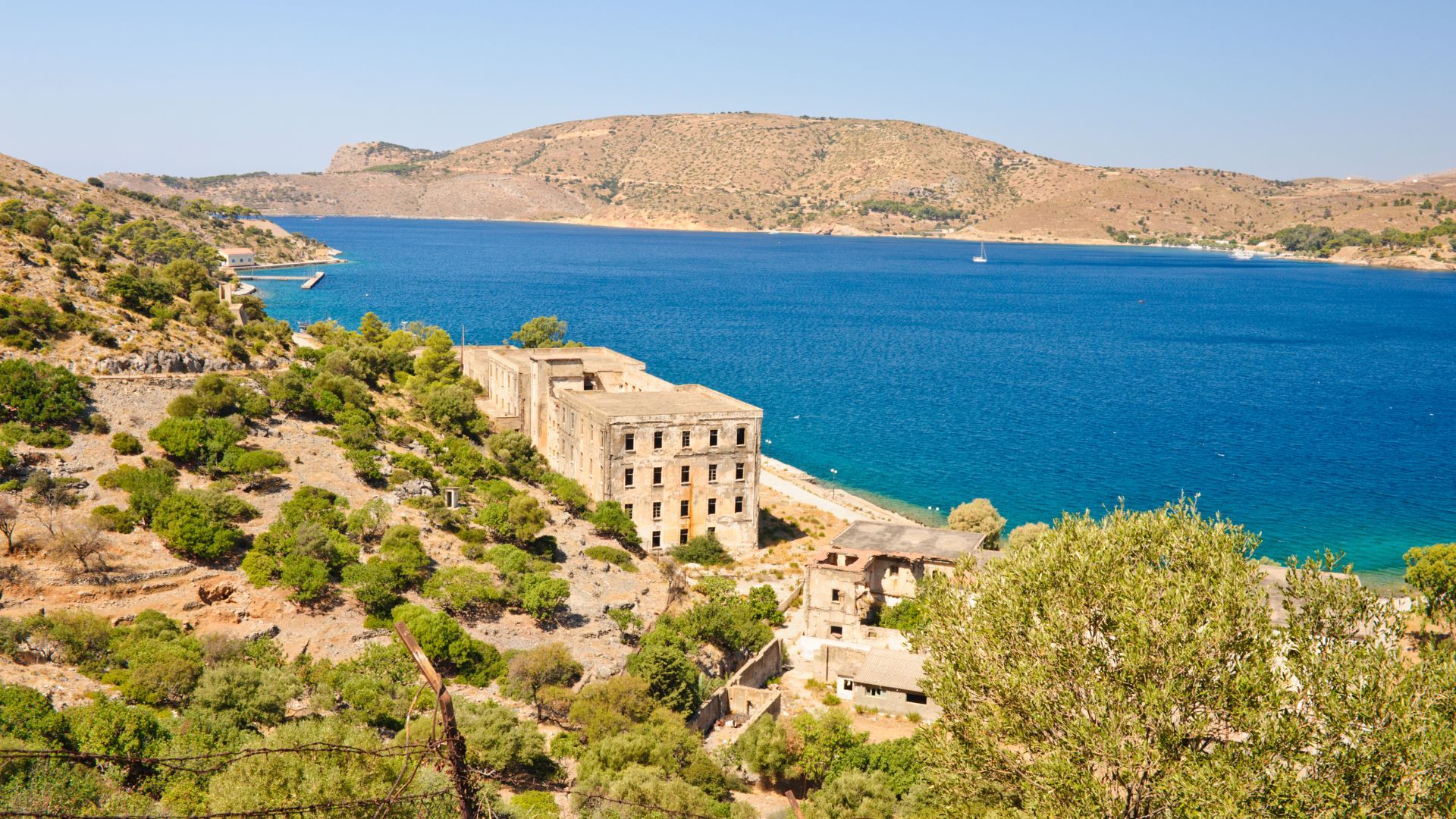
A two-stop day, roughly thirty miles total, with a midday break at Leros that almost nobody on a fast charter manages to fit in. The Italians ruled the Dodecanese from 1912 until the end of World War II, and Leros was their main naval base in the eastern Aegean. In the 1930s, under Mussolini, Italian architects laid out the port town of Lakki as a model rationalist city—broad straight avenues, an Art Deco market hall, a planned naval cinema, all of it built in stripped-down white concrete that was meant to project the new fascist order. The order didn't last. The architecture did.
Your captain ties up at Lakki for a couple of hours and your guide walks you through it. It's strange and quietly beautiful, and it's also the easiest way to make the layered colonial history of the Dodecanese suddenly legible—the Knights of St. John, the Ottomans, the Italians, the British, modern Greece, all of them having held this stretch of water in turn.
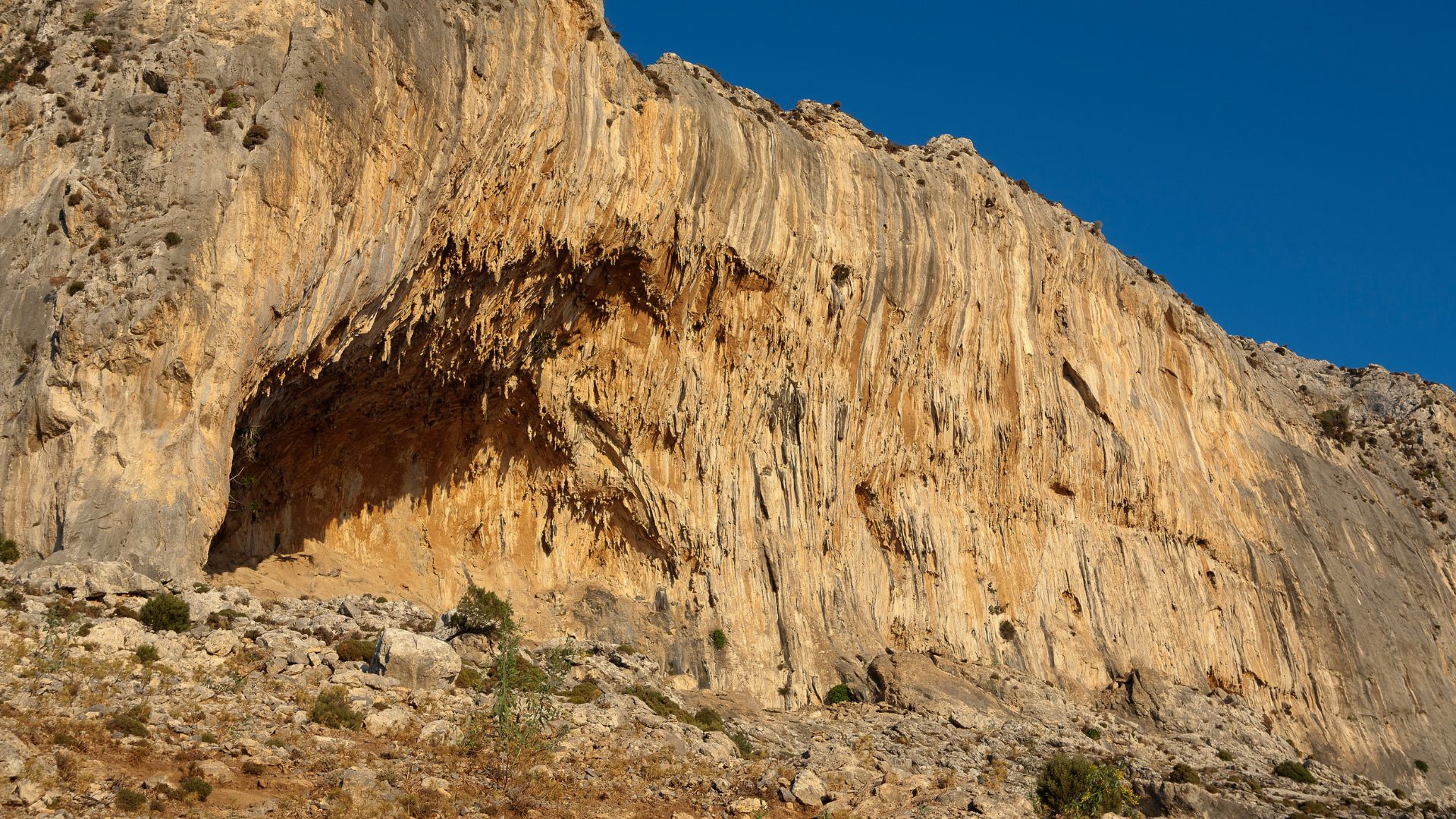
Late afternoon, lines off again for the fifteen-mile run south to Pothia harbor on Kalymnos. Kalymnos is the sponge-diving capital of Greece—divers from this island worked the eastern Mediterranean for centuries, and the trade is still part of the local identity even though the modern sponge fleet is a fraction of what it was. Today the bigger draw for outside visitors is the limestone: Kalymnos's vertical west-coast cliffs are some of the best sport-climbing rock in Europe, and the climbing season pulls a quiet international crowd from March through November. Anchor at Pothia, walk the waterfront promenade past the sponge shops, and have dinner ashore at one of the family-run tavernas above the harbor.
Day Highlights
Day 5 of 7 · Kalymnos → Kos → Nisyros
A flexible day of roughly forty miles total, structured around a half-day ashore in Kos Town and an evening arrival at Nisyros. Your captain leaves Pothia after breakfast for the short fifteen-mile run south to Kos, ties up at Kos Marina, and you head ashore with a guide for the morning. The headline stop is the Asklepion—the ruined ancient healing center on a hillside three miles outside town, the largest of its kind in Greece, and the place where a young Hippocrates was said to have studied medicine before founding the practice that takes his name. Down in town there is a plane tree in the central square that local tradition calls the Hippocratic plane—almost certainly not the actual tree he taught under, but ancient enough to make you not particularly want to argue the point.
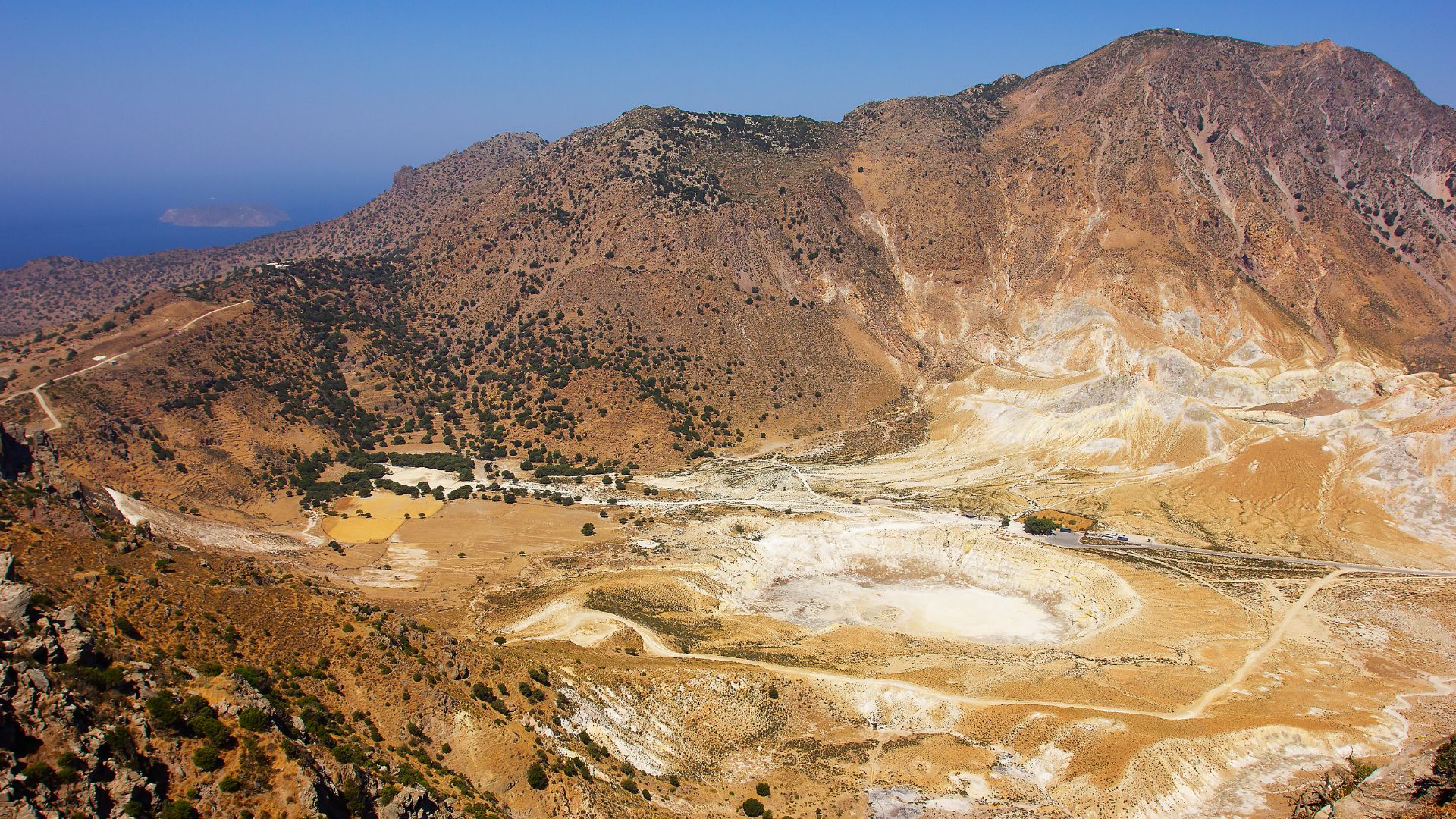
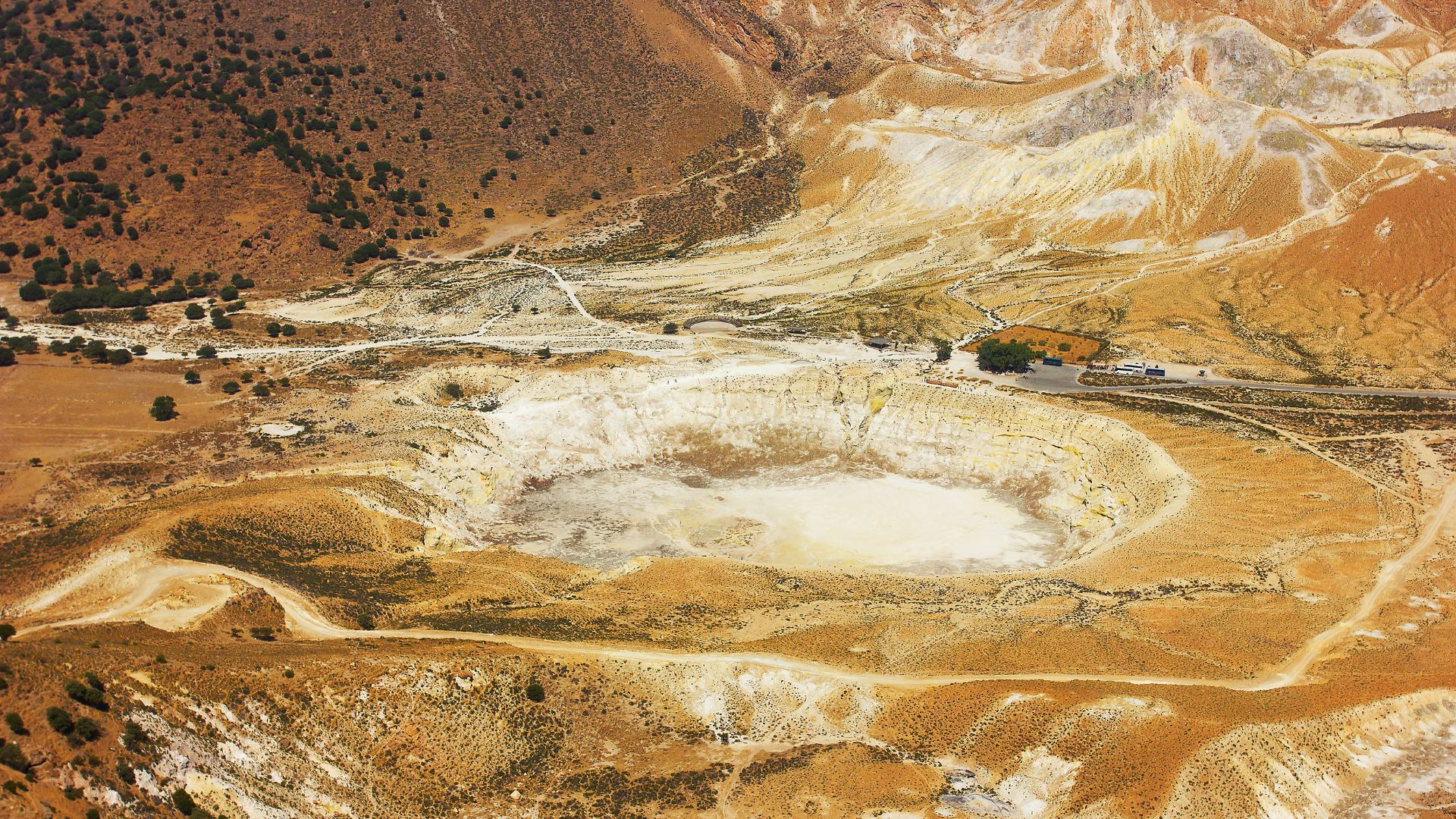
Lunch back aboard, then the captain points the bow southeast for the twenty-five-mile run to Nisyros. Nisyros is an active volcano that happens to also be an inhabited island—the entire interior of the island is a walk-in caldera, the floor of which is dry, cracked, hot to the touch in places, and visibly venting steam from yellow-rimmed fumaroles along the edges. There is a path that drops you straight down into the crater on foot. It is one of the few places anywhere in the Mediterranean where the geology is doing its work loudly enough that you can stand inside it.
Anchor or take a quay berth at Mandraki, the small port on the northwest side of the island, and your guide arranges the late-afternoon transfer up to the caldera rim. The descent into the crater takes twenty minutes; an hour inside is enough. Dinner back aboard at Mandraki, with the lights of the village climbing the volcanic ridge above the harbor.
Day Highlights
Day 6 of 7 · Nisyros → Symi
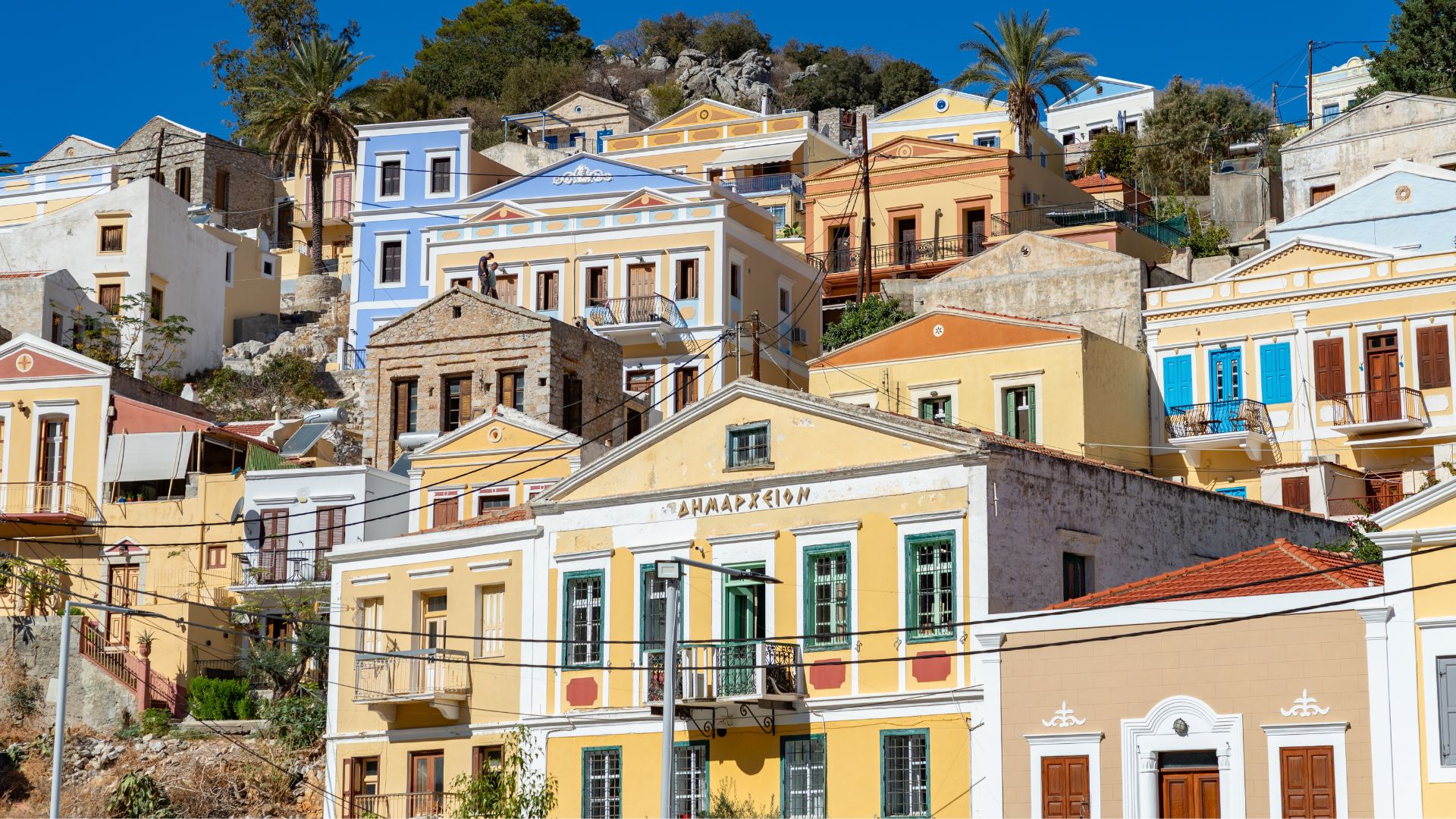
Twenty-five miles southeast from Nisyros to Symi, and this is the postcard day of the trip. Symi's harbor at Yialos is the most photographed harbor in Greece, and unlike a lot of things that get described that way, it earns it the moment you round the headland and the village comes into view: a tight horseshoe bay walled on three sides by hillsides absolutely crowded with pastel neoclassical houses—yellow, pink, ochre, blue, washed in honey-colored light at any time of day that isn't midday. The houses date to the 1800s, when Symi's sponge fleet was one of the wealthiest commercial operations in the Aegean. The merchants built like merchants. The result has been preserved by accident—the sponge trade collapsed early in the 20th century, the population dropped by ninety percent, and there was never enough money on the island to tear anything down.
Your captain anchors in the harbor or takes a quay berth in the inner basin, depending on the day's traffic, and the boat sits inside the photograph for the rest of the afternoon. Lunch ashore at Tholos or Sea Star, both on the water at the south end of the bay, both reliable for grilled octopus and a long bottle of white in the shade. The afternoon is for swimming, walking up the steps to the Kali Strata—the long stone staircase that climbs from the harbor to the upper village of Chorio—and getting the obligatory photographs from the top.
Sundowners at Roloi, the bar at the base of the clock tower on the north side of the harbor, with the bay turning gold and the lights coming up across the water. Dinner ashore at Manos or Mythos, both small, both family-run, both the kind of place that pulls the night-fishing boats' catch directly off the dock. Back aboard late.
Day Highlights
Day 7 of 7 · Symi → Rhodes
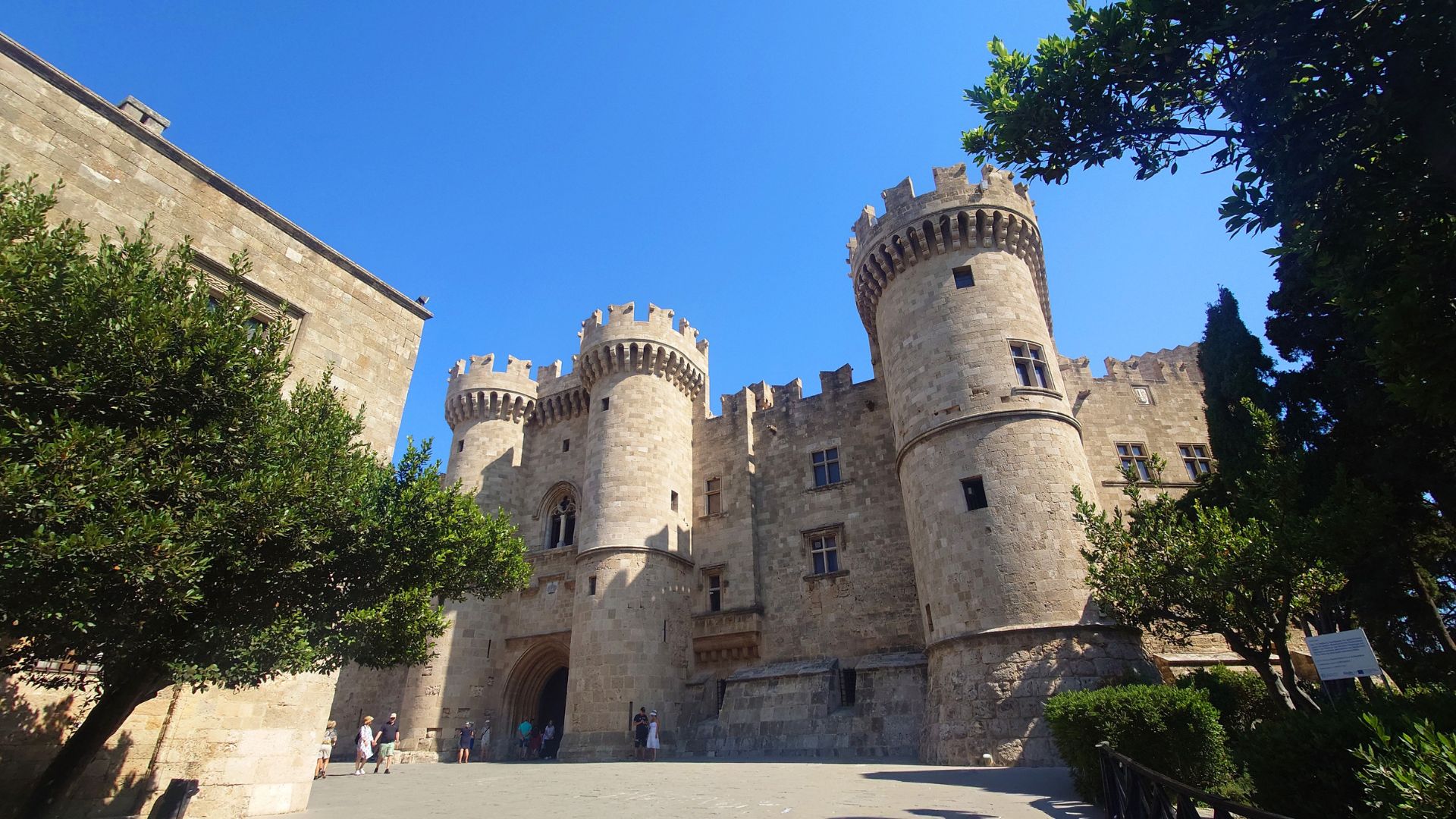
The final leg is twenty-five miles southeast from Symi to Rhodes, and your captain plans the arrival around an early-afternoon tie-up at Mandraki Marina or Kolona Harbour, both inside the old commercial port at the foot of the medieval city. The approach itself is the appetizer—the city walls of Rhodes Old Town climb out of the sea on the bow as you close the harbor entrance, and you get the same view that crusaders, Ottoman fleets, and Venetian galleys all pulled up to in turn.
Rhodes Old Town is the largest continuously inhabited medieval town in Europe, and the entire walled city is a UNESCO World Heritage Site. The Knights of St. John ruled from here from 1309 until Suleiman the Magnificent's six-month siege in 1522 finally broke the walls; the Ottomans then ran Rhodes for nearly four hundred years, then the Italians for thirty more, before the island returned to Greece in 1947. The layers stack up against each other inside the walls in a way that rewards walking with a guide. The Street of the Knights, the Palace of the Grand Master at the top of it, the Süleymaniye Mosque a few blocks over, the old Jewish quarter with its 16th-century Kahal Shalom synagogue—all of it is inside a fifteen-minute walk.
Final dinner ashore at Marco Polo Mansion or one of the courtyard restaurants tucked into the old-town side streets, where the tables are set under fig trees inside what used to be Ottoman-era family compounds. Back to the boat for a nightcap on deck under the lit-up walls.
Day Highlights
Day 8 · Departure
A last slow breakfast aboard at the marina, a short transfer to Rhodes International, and home. The Rhodes-end disembarkation is the practical move on this route—Rhodes has more flights than Kos and shorter connections to Athens and the major European hubs—and your captain will have lined up the airport timing days in advance.
A practical note on Turkey. Bodrum sits four miles off Kos and is a tempting day stop—it has its own castle, bazaar, and seafood scene—but a charter crossing requires Turkish customs paperwork and a formal entry at the Bodrum harbormaster, plus a return clearance back into Greek waters. Your captain handles the full process if you want it added to the route. Most charters skip Turkey on a seven-day window and save Bodrum for a separate Turkish charter; that is the easier call. Either way, the Greek-side itinerary alone is more than enough to fill the week.
Want to share or come back to this voyage later?
Bookmark this voyage →Crewed Itinerary · Greece
The Ionian is the gentle side of Greece. If you've been reading about the Cyclades and wondering whether forty-knot Meltemi gusts and a week of pinned-down days sound like a vacation, this is the itinerary that answers no. The islands off Greece's northwestern coast sit in the lee of the mainland, out of the Meltemi entirely, with thermal breezes that build politely by mid-afternoon and drop again by dinner. Seven days, roughly 130 nautical miles, short hops of ten to twenty-five nautical miles a day, warm lee-shore anchoring, and a village-walk taverna every single night.
This is the well-trod classic family week in the Mediterranean, and we run it as a fully crewed charter out of Gouvia Marina on Corfu so the grown-ups get the wine list and the kids get a rotating cast of beaches, ruins, and harbor ice cream. Your professional captain and private chef handle the rest. It's the trip where the kids, honestly, come back happier than the parents.
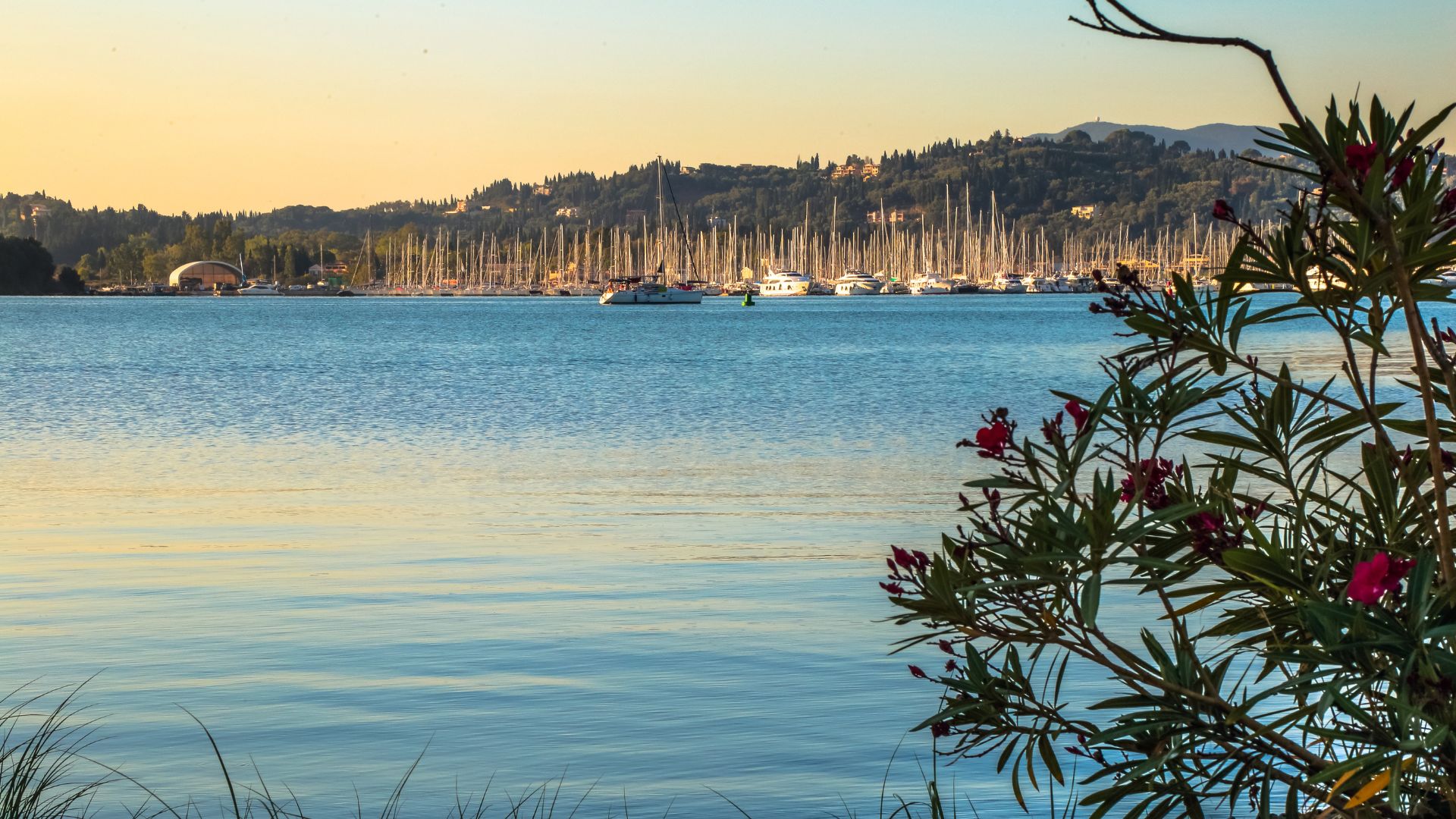
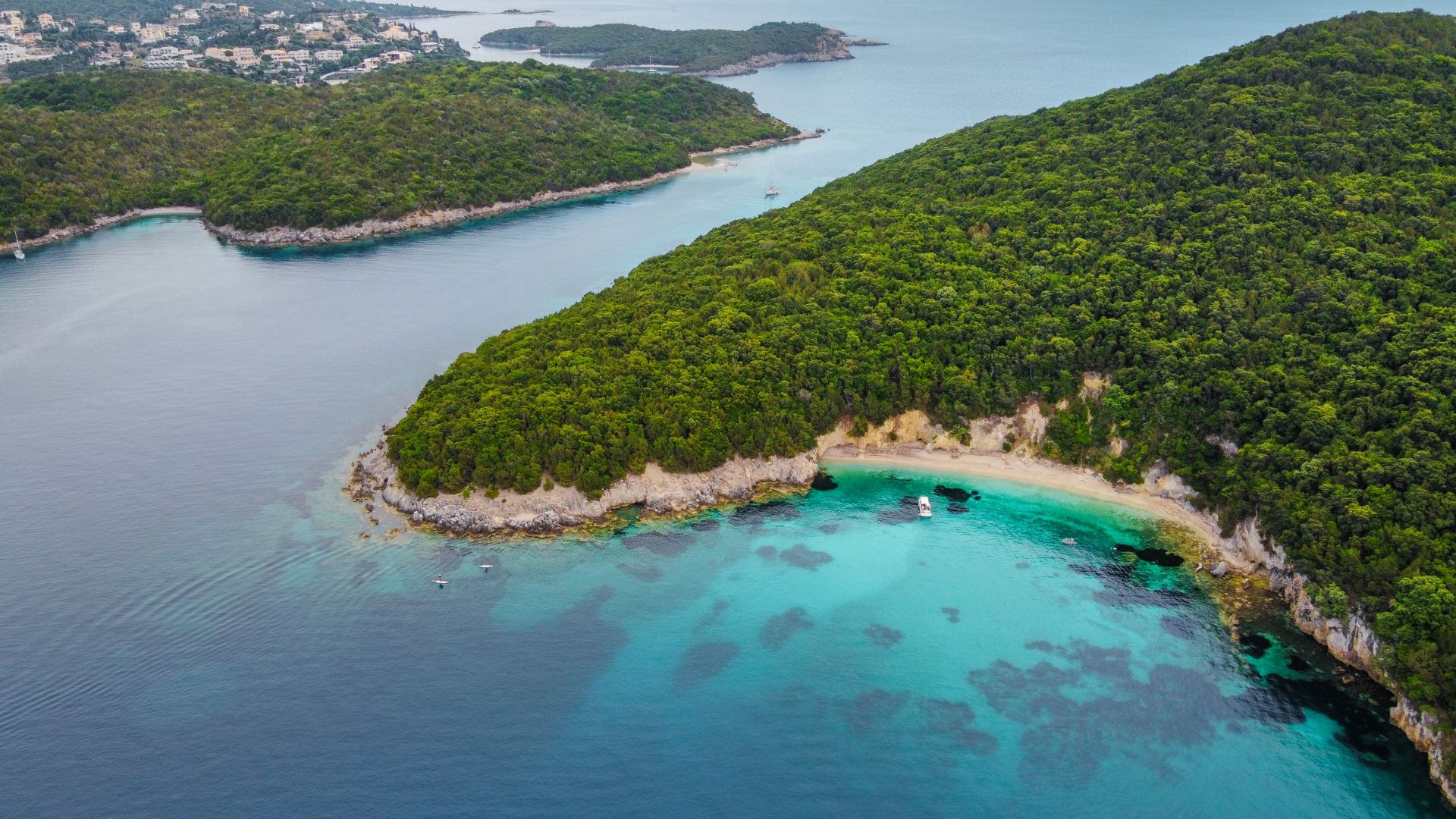
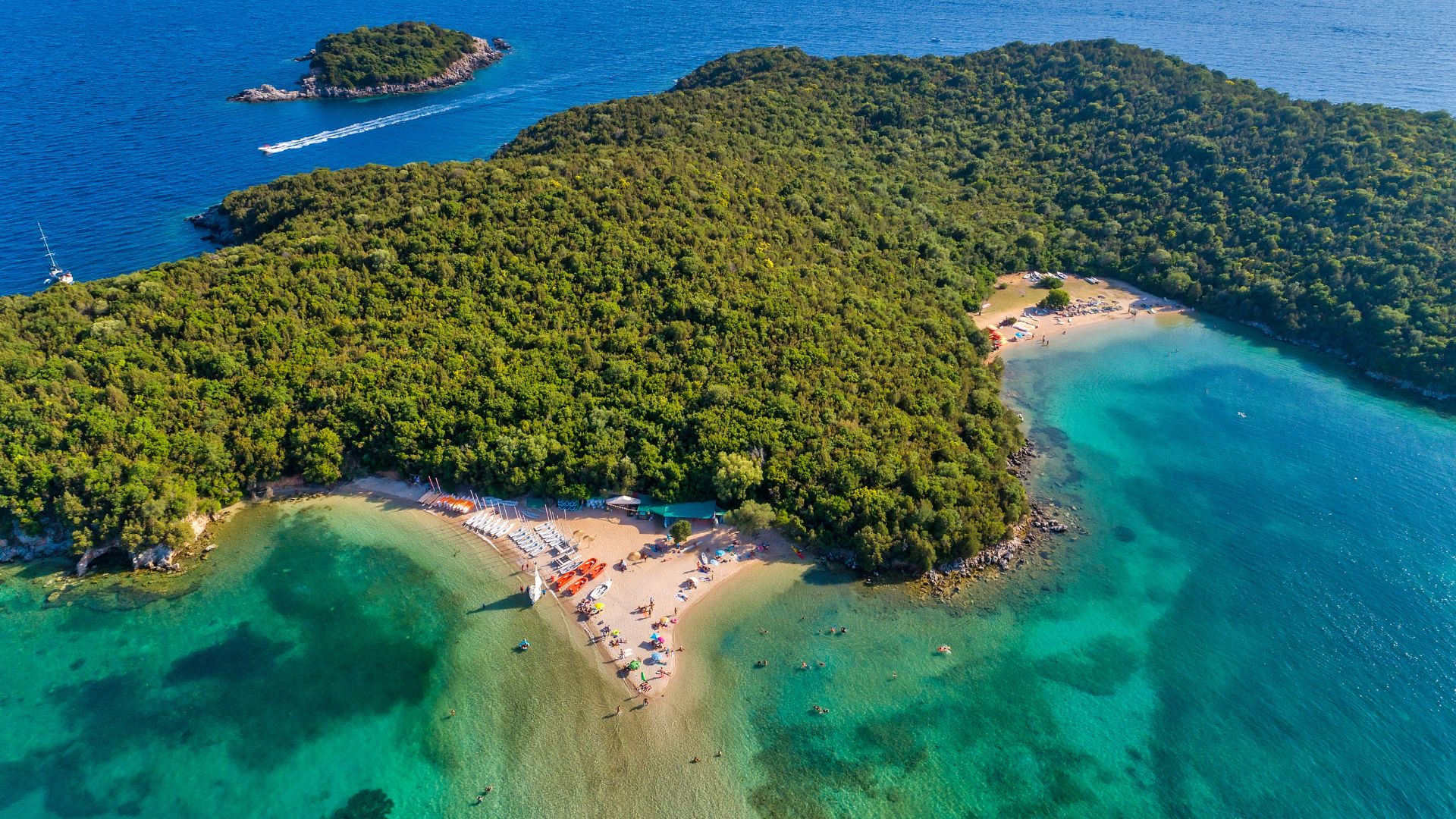
The Ionian Islands sit in the lee of the Greek mainland, completely out of the Meltemi corridor. That single fact reshapes the whole sailing week — gentle thermal afternoons instead of pinned-down 35-knot mornings, lee-shore anchoring (no need to side-tie stern-to a quay every night), and short 10–25 nm legs from one taverna village to the next. This Ionian Islands itinerary covers Corfu, Paxos, Antipaxos, Parga, Meganisi, Ithaca, and Kefalonia in seven days from Gouvia Marina.
About 130 nautical miles total. The Ionian is the Greek islands week we send first-timers, families with young kids, and multigenerational groups — it's the trip where the eight-year-olds and the seventy-year-olds both come back happier. Crewed yacht with captain + chef so the grown-ups get the wine list and the kids get the ice cream.
Day 1 of 7 · Gouvia → Syvota
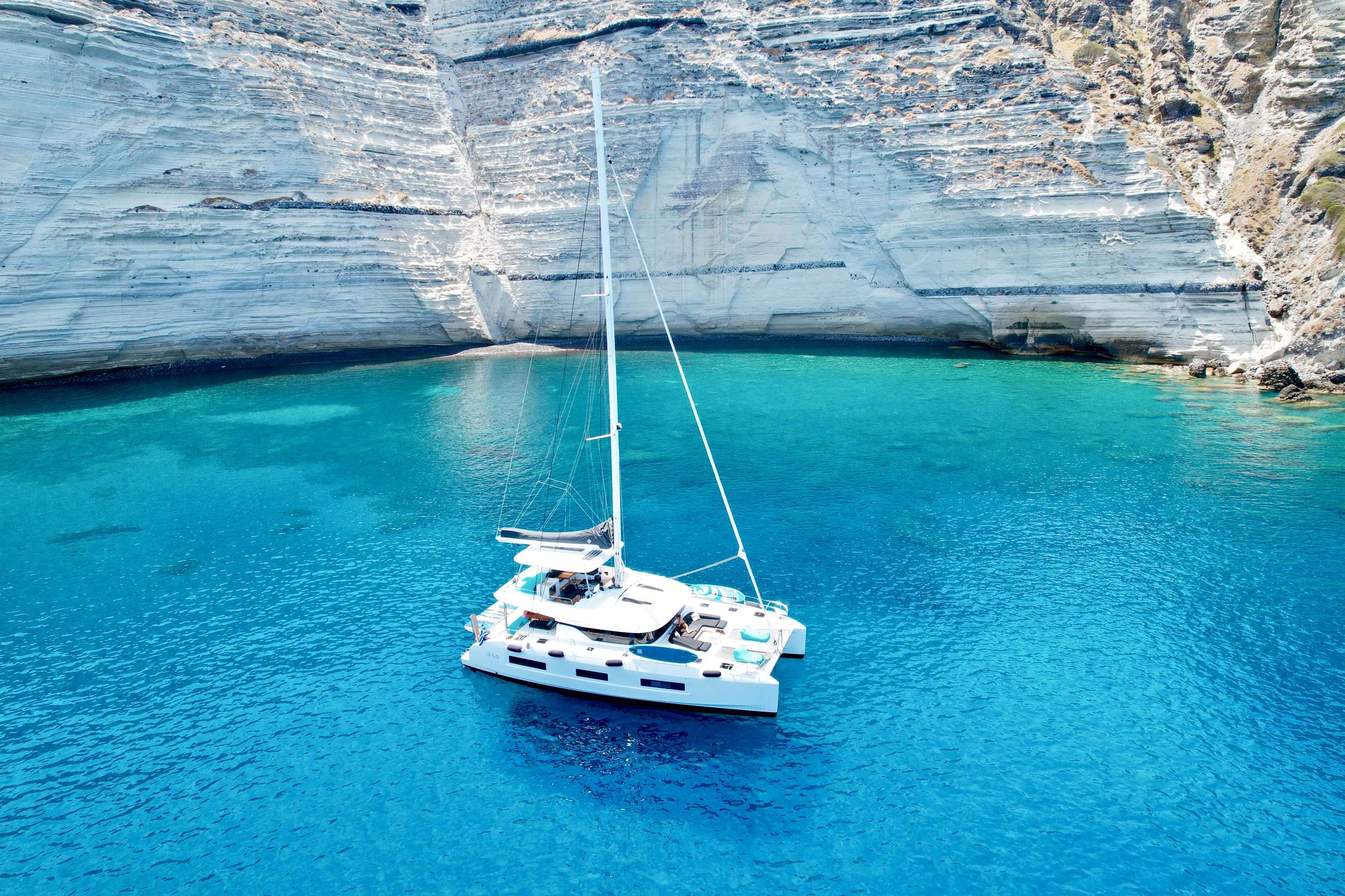
Your charter begins at Gouvia Marina on Corfu's east coast—a short transfer from Corfu International and the main crewed base for the northern Ionian. Your captain and chef meet you on the dock, walk you through the yacht, stow the luggage, and pour the first cold drink of the week while they cover the chart for the days ahead. There's no rush. The afternoon breeze on this coast rarely builds before one o'clock, and it almost always drops by sunset.
Once everyone's settled, the captain slips lines for the short southeast run across to Syvota on the mainland coast—about twenty nautical miles on a beam reach, the kind of easy first sail that lets you find your sea legs without really trying. Syvota is a cluster of small green islands tucked against the mainland, and the water between them is shallow, glass-clear, and almost impossibly turquoise. The Blue Lagoon anchorage lives up to its name. Bella Vraka Beach—a sandbar you can wade across at low water—is a five-minute tender ride away and is the sort of spot kids remember for years.
Dinner is aboard the first night, chef-prepared, so everyone can unpack at their own pace. Grilled local fish, a Greek salad the way it's actually meant to be made, a chilled bottle of Assyrtiko, and the lights of Syvota village glowing a half-mile off the bow.
Day Highlights
Day 2 of 7 · Syvota → Paxos
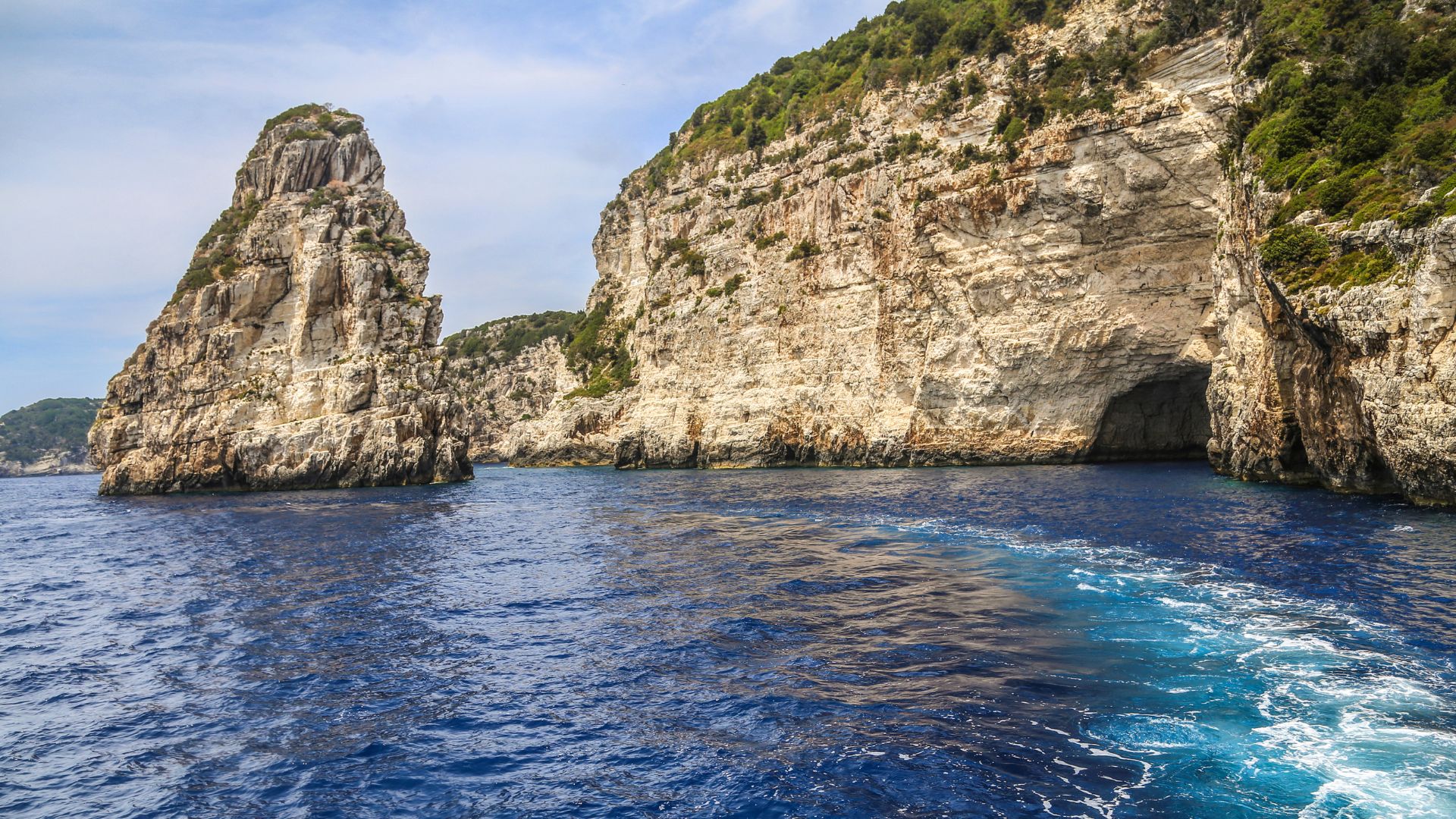
After a slow breakfast aboard, your captain points the bow south for the fifteen-mile hop down to Paxos. This is a short, easy sail—Paxos's green profile is visible the entire way, the breeze fills in on the beam by mid-morning, and the whole passage feels less like a passage and more like moving the living room. Drop anchor in Lakka Bay on the north end of the island: a perfect horseshoe, sandy-bottomed, ringed by pine, and shallow enough that the water glows the color of a swimming pool.
Lakka village is a short tender ride across the bay—whitewashed houses, bougainvillea, a handful of cafes on the waterfront, and a bakery that will change your opinion of spanakopita. Spend the afternoon in and out of the water. The kids can swim to shore. The grown-ups can read on the foredeck. Nobody needs to be anywhere.
By late afternoon, your captain will reposition the yacht a few miles down the east coast to Loggos, one of the prettiest small harbors in the Ionian. Dinner tonight is ashore at Vassilis—a taverna that's been feeding sailors for longer than most yachts in the harbor have existed. Order whatever's fresh, pour the house white, and walk the hundred yards back to the tender when you're done.
Day Highlights
Day 3 of 7 · Antipaxos & Parga
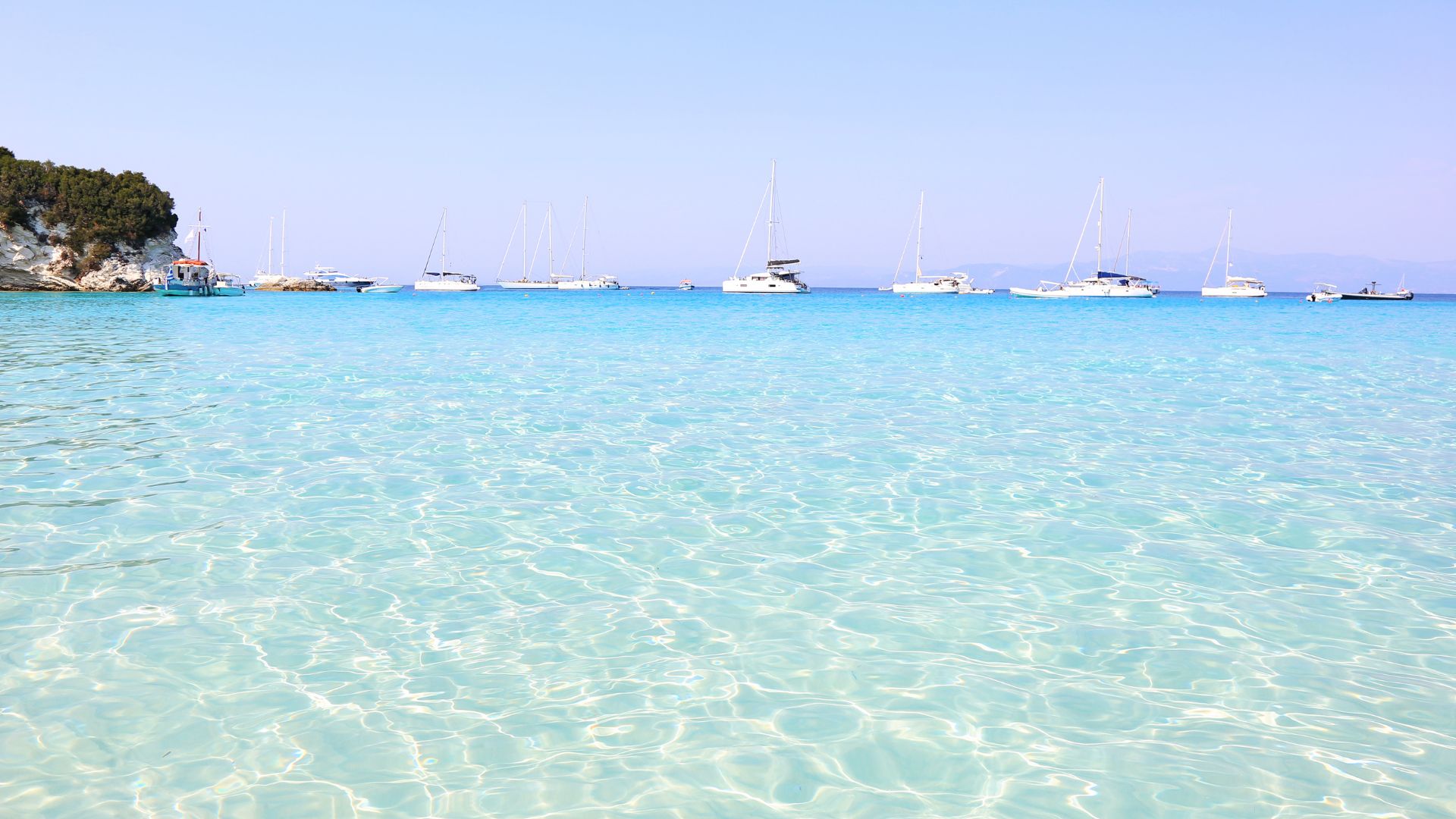
Today is a beach day, and it's the day that surprises people the most. Your captain will sail the yacht two miles south from Paxos to Antipaxos—a tiny sister island with maybe a hundred year-round residents, a scatter of vineyards, and two beaches that genuinely do not look like they belong in the Mediterranean. Voutoumi and Vrika are the ones you've seen in drone shots: turquoise water over white sand, chalk cliffs behind, and a depth gradient so gentle you can wade out for a long way in water no deeper than your waist. This is the Caribbean-in-Europe moment of the week.
Anchor off Voutoumi for the morning. There's a small taverna up the stairs from the beach that serves grilled fish and cold beer, and the short climb earns one of the best views on the trip. In the afternoon, reposition a hundred meters north to Vrika, a sandier cove with a second taverna and easier tender access. Spend the day rotating between the two. The water barely moves.
By late afternoon, your captain will cross back northeast to Parga, a twenty-mile sail to a town that looks, frankly, ridiculous. A Venetian castle on a headland, a pastel old town stacked up the hillside, and a crescent harbor that lights up after dark. Anchor in the bay or take a mooring off the town quay, tender ashore for a walk up through the castle, and have dinner at a taverna with the castle lit up above you.
Day Highlights
Day 4 of 7 · Parga → Meganisi
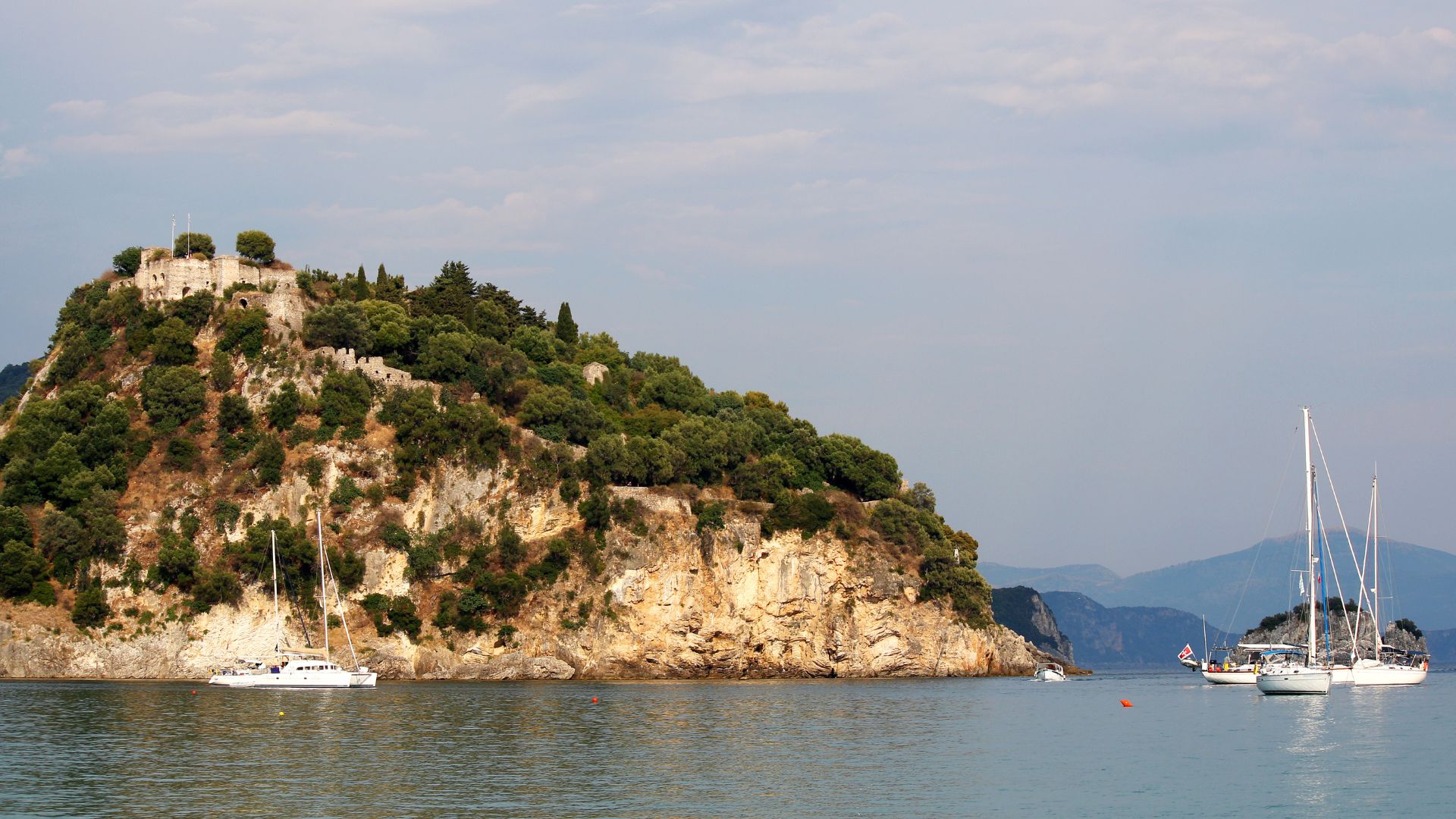
Day four is the longest sail of the week at about thirty-five nautical miles, and it's still an easy one. South down the mainland coast, past the cliffs of Lefkas and through the narrow passage between Lefkas and the mainland, your captain will bring the yacht into the cluster of small islands south of Lefkas that the big charter fleets treat as their home waters. Meganisi is the first real stop: a quiet island of three villages and dozens of deep, protected bays cut into its coastline.
Anchor first at Porto Spilia, the small harbor on the island's north side, and tender in for a walk up to Spartochori—a whitewashed hillside village that's about a ten-minute climb above the water. The view from the top, back across the channel to Lefkas, is one of those unassuming Ionian moments that tends to end up as somebody's screensaver.
In the afternoon, your captain will move the yacht around to Rossa Bay on the south side of the island—a long, deep inlet with water the color of mint and almost nobody else in it. This is a swim-and-float afternoon. Break out the paddleboards, run the tow toys behind the tender if you've got kids aboard, and stay in the water until the light goes soft. Dinner aboard tonight, quiet at anchor.
Day Highlights
Day 5 of 7 · Meganisi → Ithaca
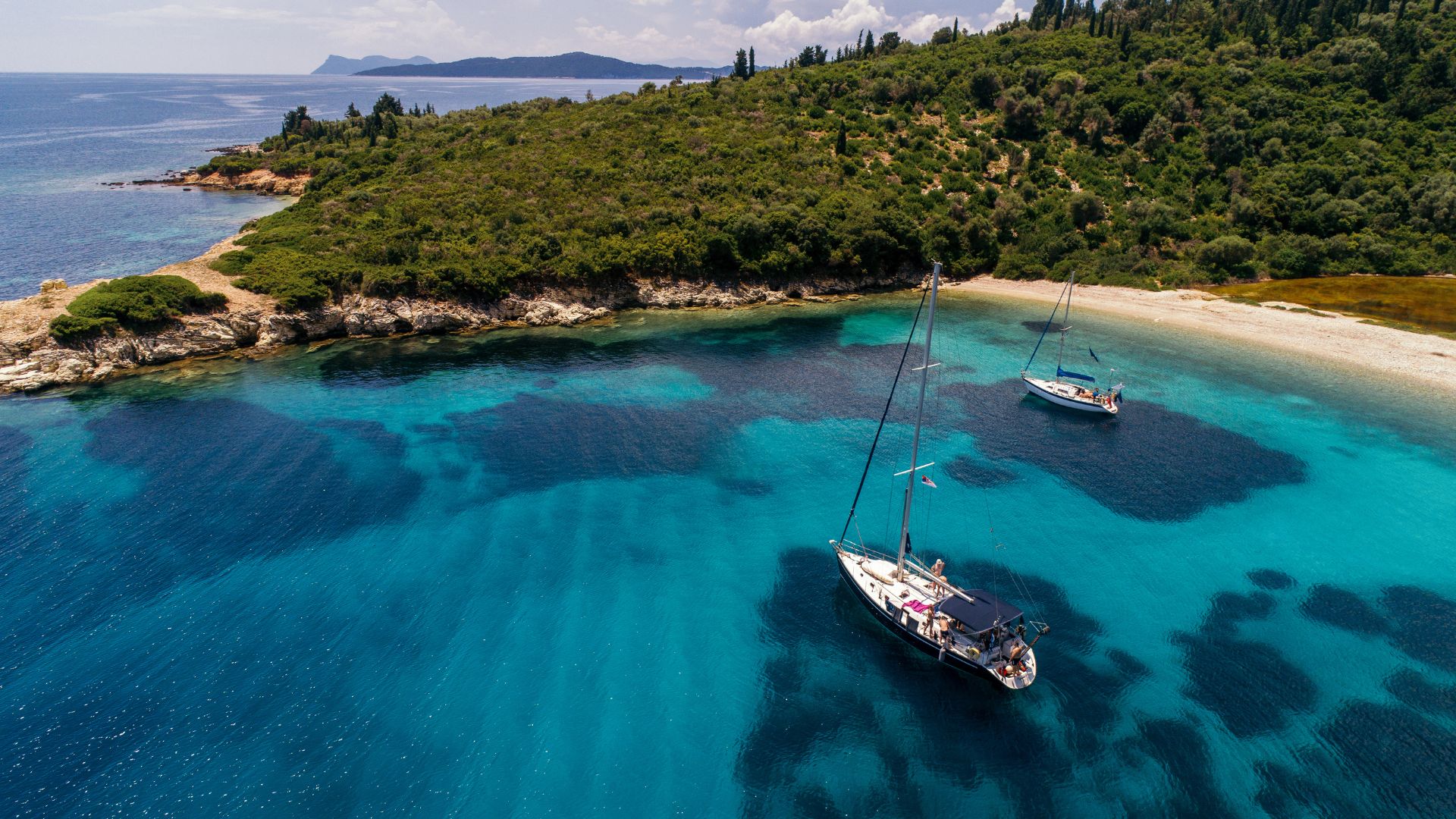
A short fifteen-mile sail south today brings you to Ithaca—Odysseus country. Your captain will bring the yacht into Kioni, a small harbor on the northeast coast that consistently shows up on best-villages-in-Greece lists and genuinely deserves it. Three old windmills stand on the headland above the bay, the houses are pastel and stacked into the hillside, and the whole harbor reads like a set that somebody built and then forgot to dismantle.
Anchor or take a town quay berth, tender into the village, and spend a couple of hours walking the harbor and climbing up to the windmills. There's a bakery. There's ice cream. There are cats. It is, by the standards of Greek villages, almost aggressively charming.
In the late afternoon, your captain will move the yacht two miles around the headland to Frikes, a smaller and slightly scruffier harbor that happens to have some of the best tavernas on the island. Dinner ashore tonight. Order the grilled octopus. The walk back to the tender takes ninety seconds.
Day Highlights
Day 6 of 7 · Ithaca → Fiskardo
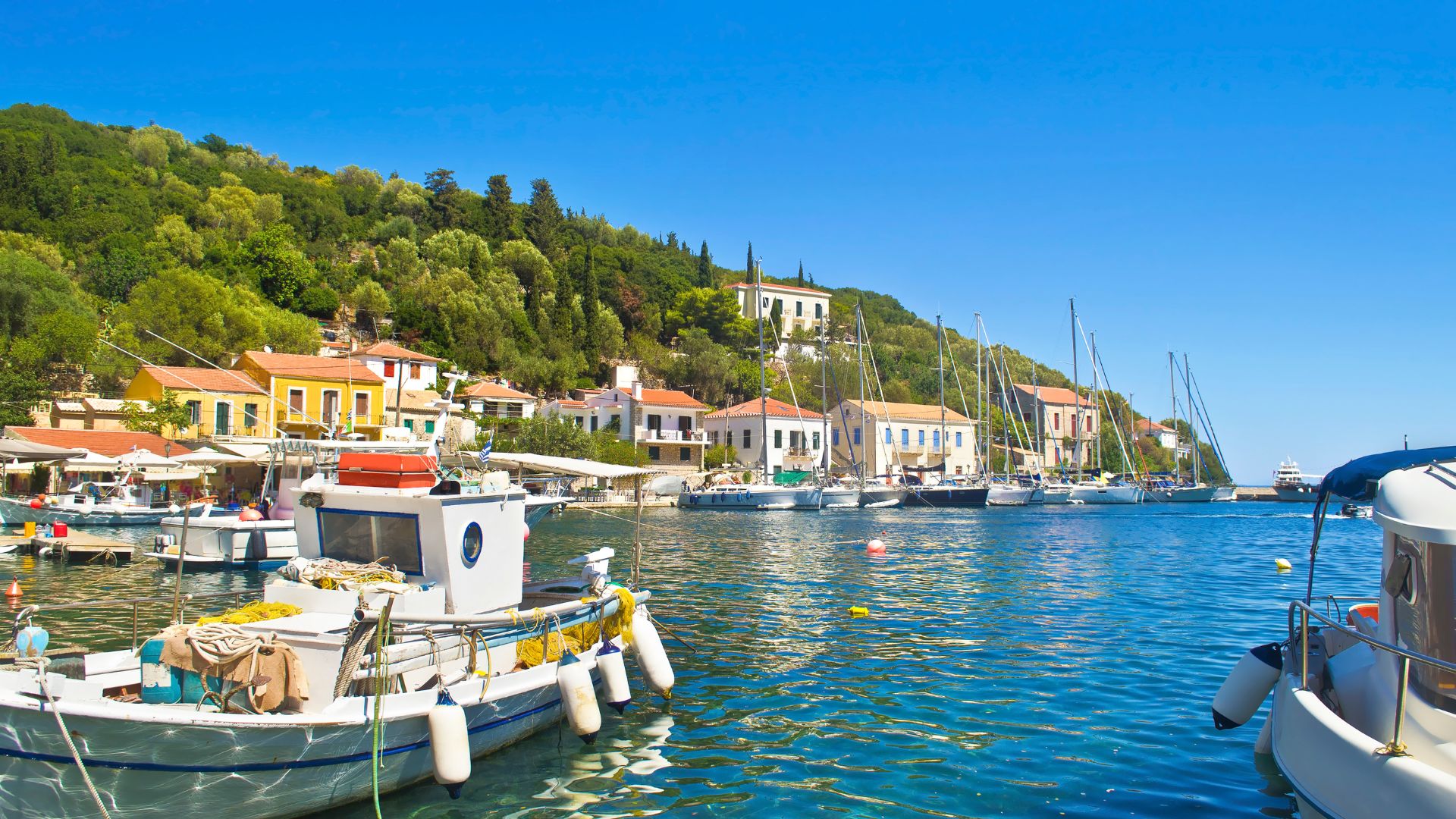
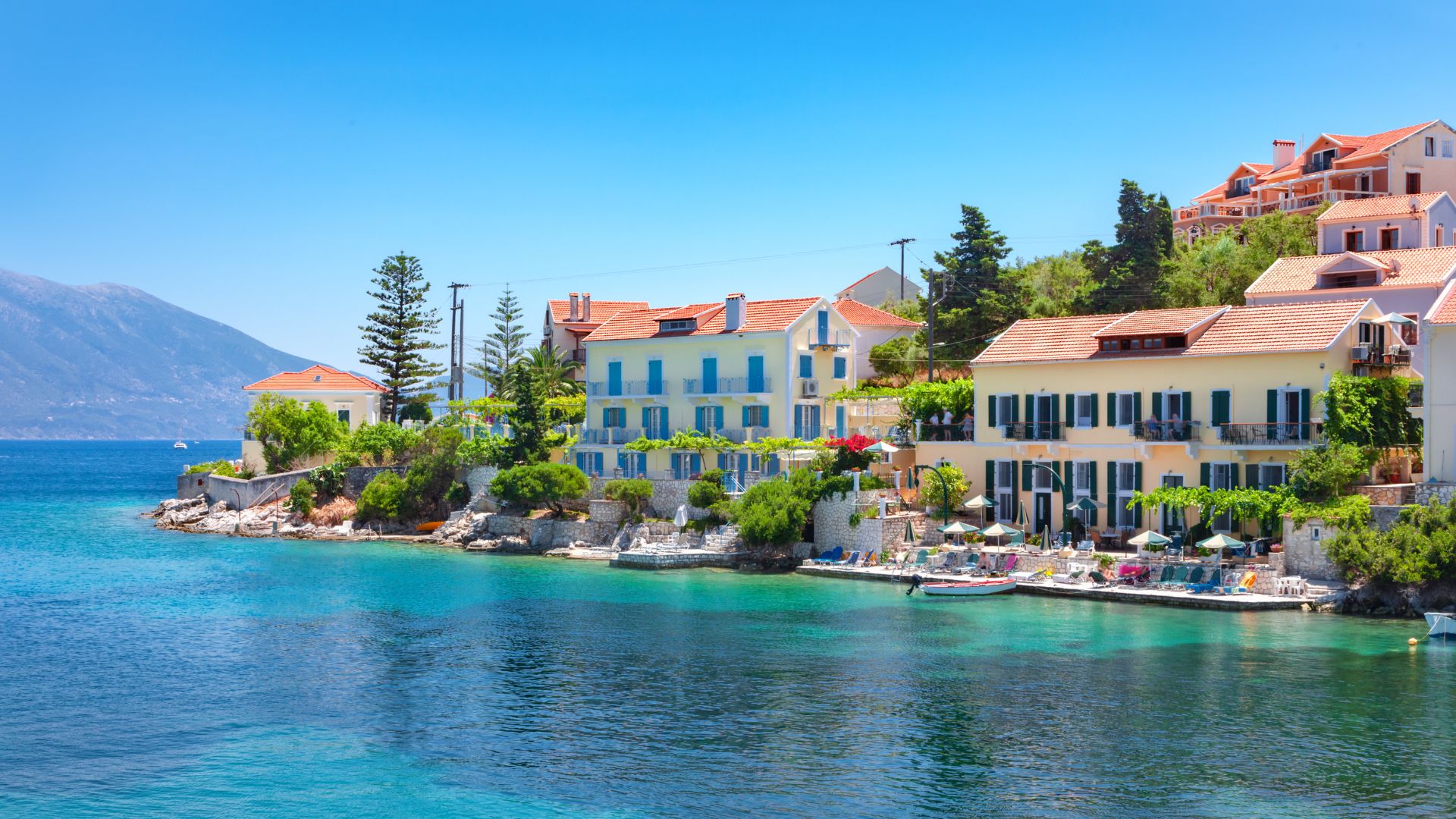
After breakfast, your captain points the bow west for the ten-mile crossing over to Kefalonia and into Fiskardo—the village that, improbably, survived the 1953 earthquake that leveled almost everything else on the island. The pastel Venetian waterfront is still original, and it shows. This is the prettiest harbor in the Ionian, and most seasons it's also the busiest, so your crew will aim for a late-morning arrival to get a good spot on the town quay.
Fiskardo is a walking village. Waterfront cafes, a handful of boutiques, and a back-street network that's maybe four blocks deep and still worth an hour. Lunch ashore today—casual, waterfront, somewhere with a view of the harbor.
In the afternoon, the tender will take you a mile up the coast to Emblisi Beach: white pebbles, clear deep water right off the shore, and the kind of lighting that makes phone cameras work overtime. Swim until you're tired. Back aboard for a nap, a shower, and dinner ashore tonight at Tassia—Fiskardo's most serious restaurant, and a good enough meal that it's worth booking a table while you're having lunch.
Day Highlights
Day 7 of 7 · Greatest hits sail
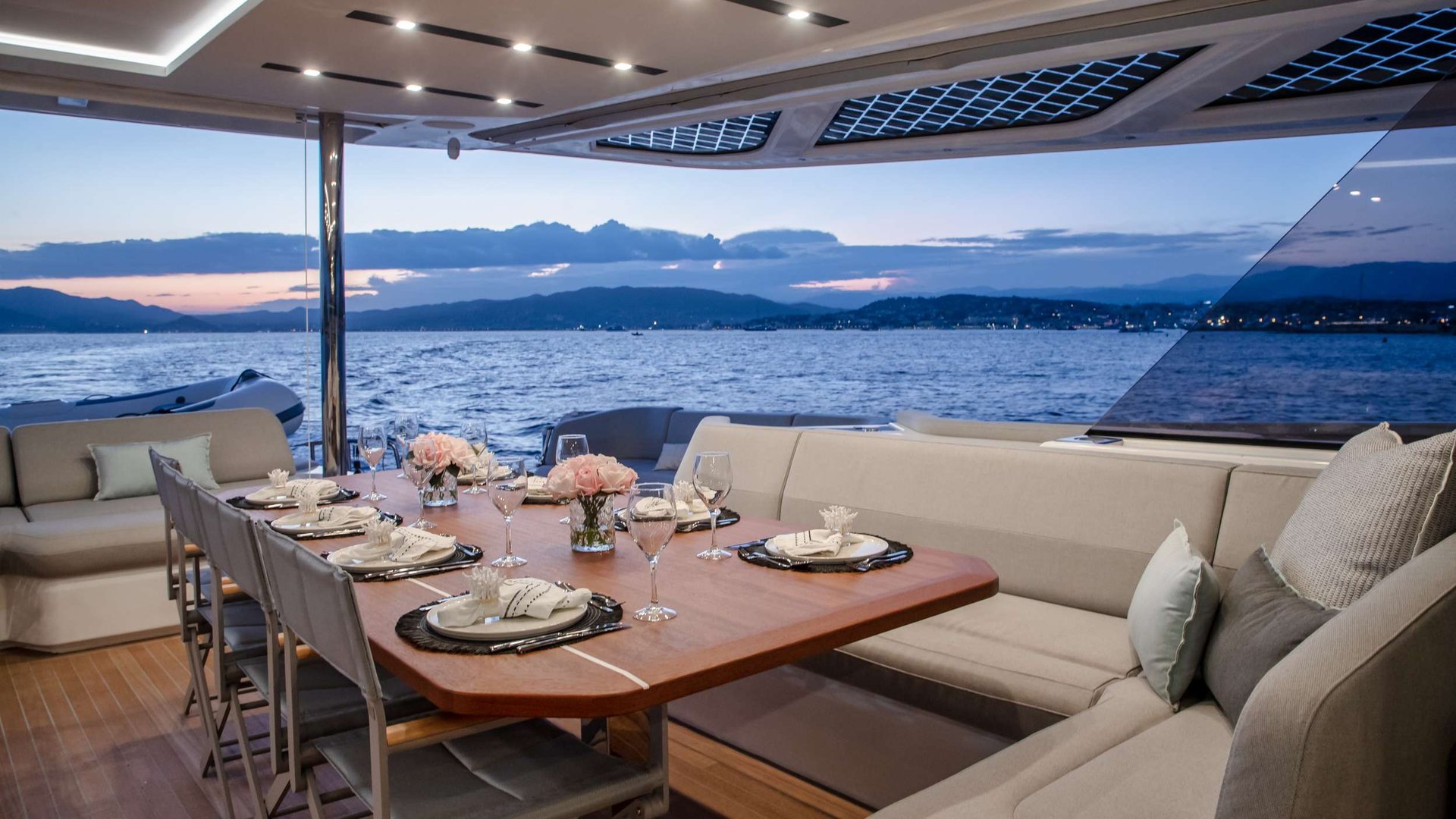
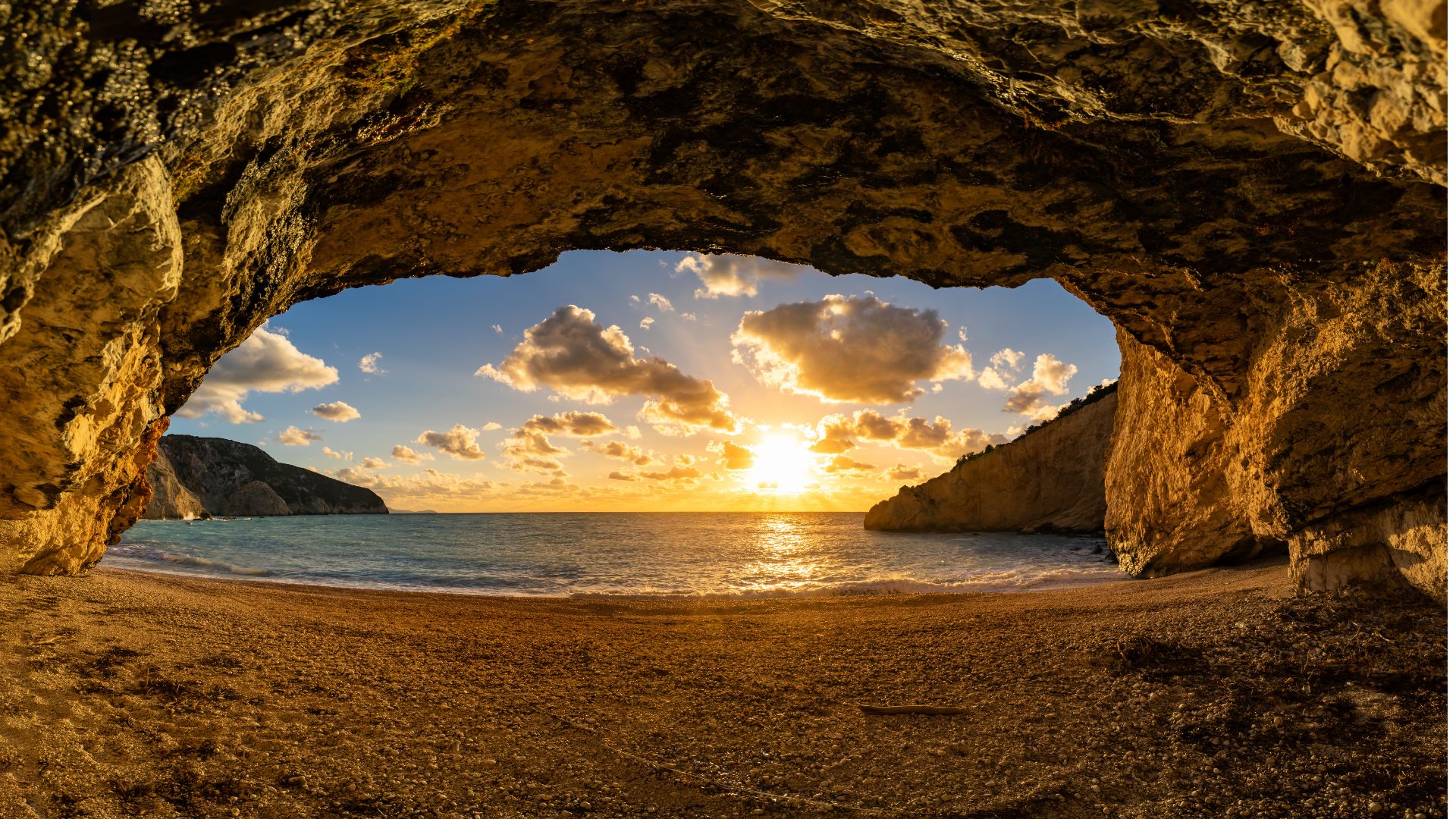
Your last full day is the greatest-hits sail. Your captain will leave Fiskardo after breakfast and run south along Kefalonia's west coast to Assos, a tiny village built on an isthmus below the ruins of a Venetian fort. The anchorage is deep and often glassy, and the village itself is a twenty-minute walk of a half-dozen pastel houses, a church, and a cove of clear water. Swim. Eat a spanakopita from the bakery. Get back on the boat.
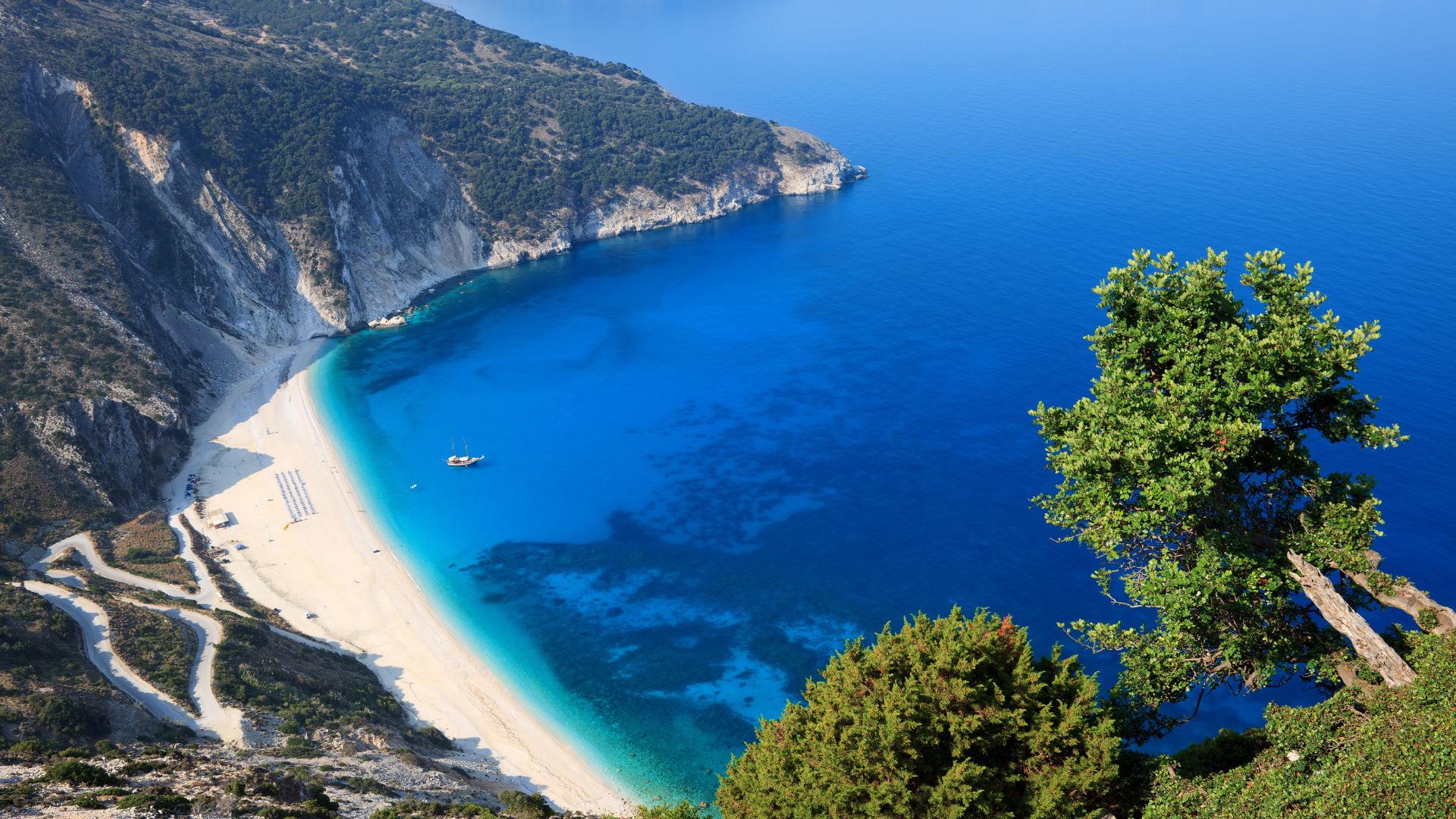
A couple of miles south is Myrtos—the white-cliff, Caribbean-blue beach you've seen on every Kefalonia postcard. The beach itself is hard to access from shore and easier by boat, which is one of the small privileges of arriving by yacht. Anchor off, swim in, and take the sort of photographs that make the group chat jealous.
From Myrtos, your captain has a choice to make based on the breeze and the time. The classic move is a twenty-five-mile run north toward Lefkas—and if conditions cooperate, one more swim stop at Porto Katsiki, the cliff-backed cove on Lefkas's southwest coast that tends to get the magazine covers. From there it's either a final overnight motor back to Gouvia, or a same-day disembarkation at Preveza on the mainland if your flights favor that airport. Either way, your crew handles the logistics.
Day Highlights
Day 8 · Departure
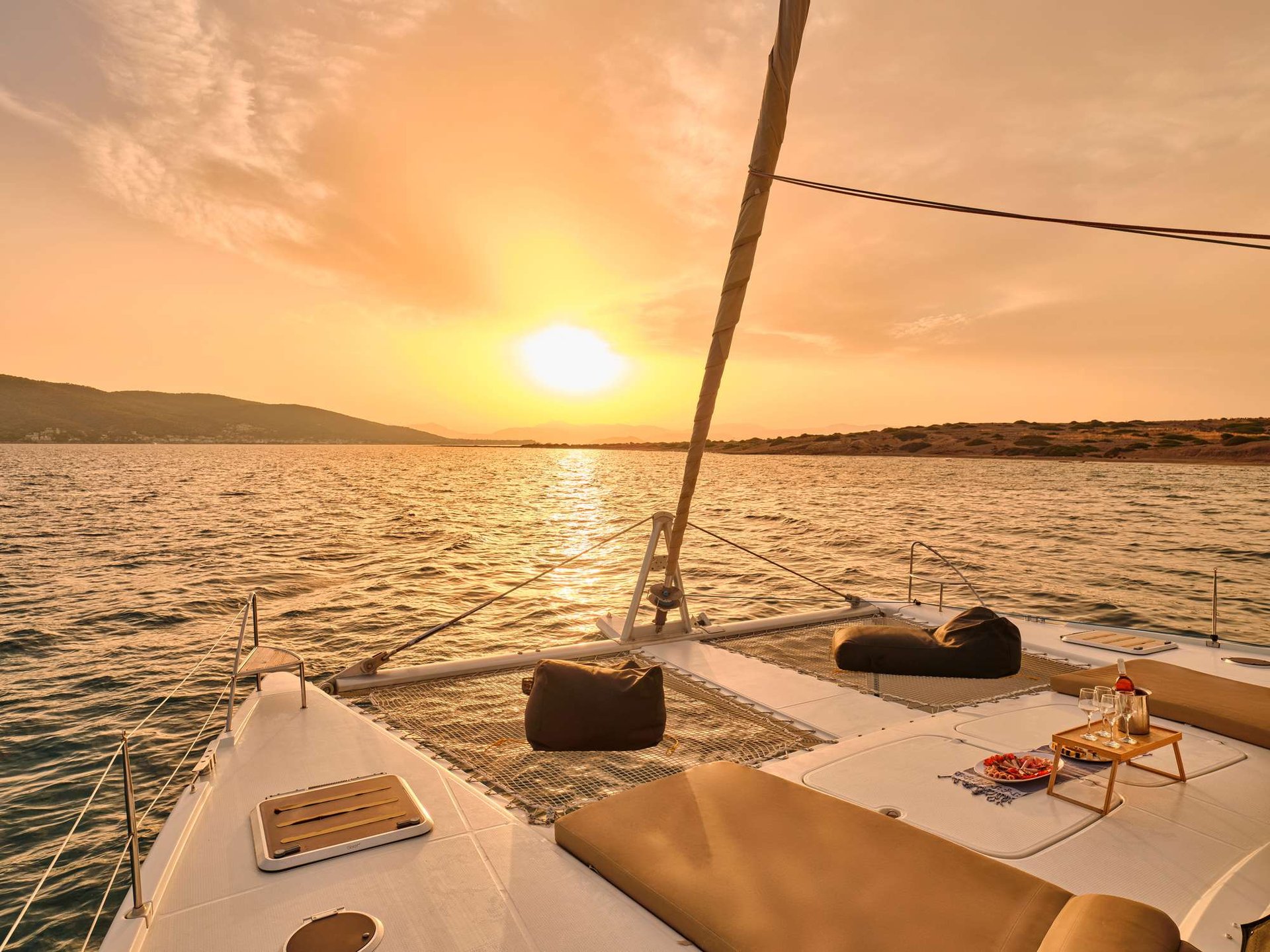
Enjoy a last slow breakfast aboard, a last swim off the stern if the anchorage allows, and a relaxed disembarkation—either back at Gouvia Marina on Corfu or, if it works better for your flights, at Preveza on the mainland coast. Your crew will handle the transfers. Most charter guests on this route fly home through Corfu, Preveza, or Athens, and your captain will have lined up the logistics days in advance.
A last honest note: this is the itinerary where the kids come back happier than the parents. Short sails, warm lee-shore anchoring, zero Meltemi, village harbors small enough for an eight-year-old to handle on their own, and swim stops every single day. We run more technically interesting routes in the Cyclades and more bucket-list routes in the Caribbean. For a family week in the Mediterranean, this is the one.
Want to share or come back to this voyage later?
Bookmark this voyage →Crewed Itinerary · Greece
If this is your first Greek charter, this is the Greek islands itinerary to book. The Saronic Gulf is Greece without the chaos—sheltered from the Meltemi by the Peloponnese mainland, dense with cultural marquee stops, and just 15 to 20 nautical miles between anchorages. From Alimos Marina you'll be at a 2,500-year-old Doric temple by lunchtime on Day 1, drop the hook in a car-free National Heritage town for the afternoon, and watch a play in a 4th-century BC UNESCO theatre under the stars before the week is out. With your professional captain and private chef running the yacht, the only real decisions you need to make are how long to linger over a shaded lunch in Hydra and which taverna gets dinner.
Most guests who book the Saronic are first-timers in Greece, families with kids, or multigenerational groups picking the trip the eight-year-olds and the seventy-year-olds will both remember. The gentle daily mileage, the lee-shore anchoring, and the proximity to Athens (fifteen minutes from the airport to the boat) make this the Greek week to start with. The route is a 7-day round trip of roughly 140 nautical miles, and prime season runs May through October with the shoulder months very much viable.
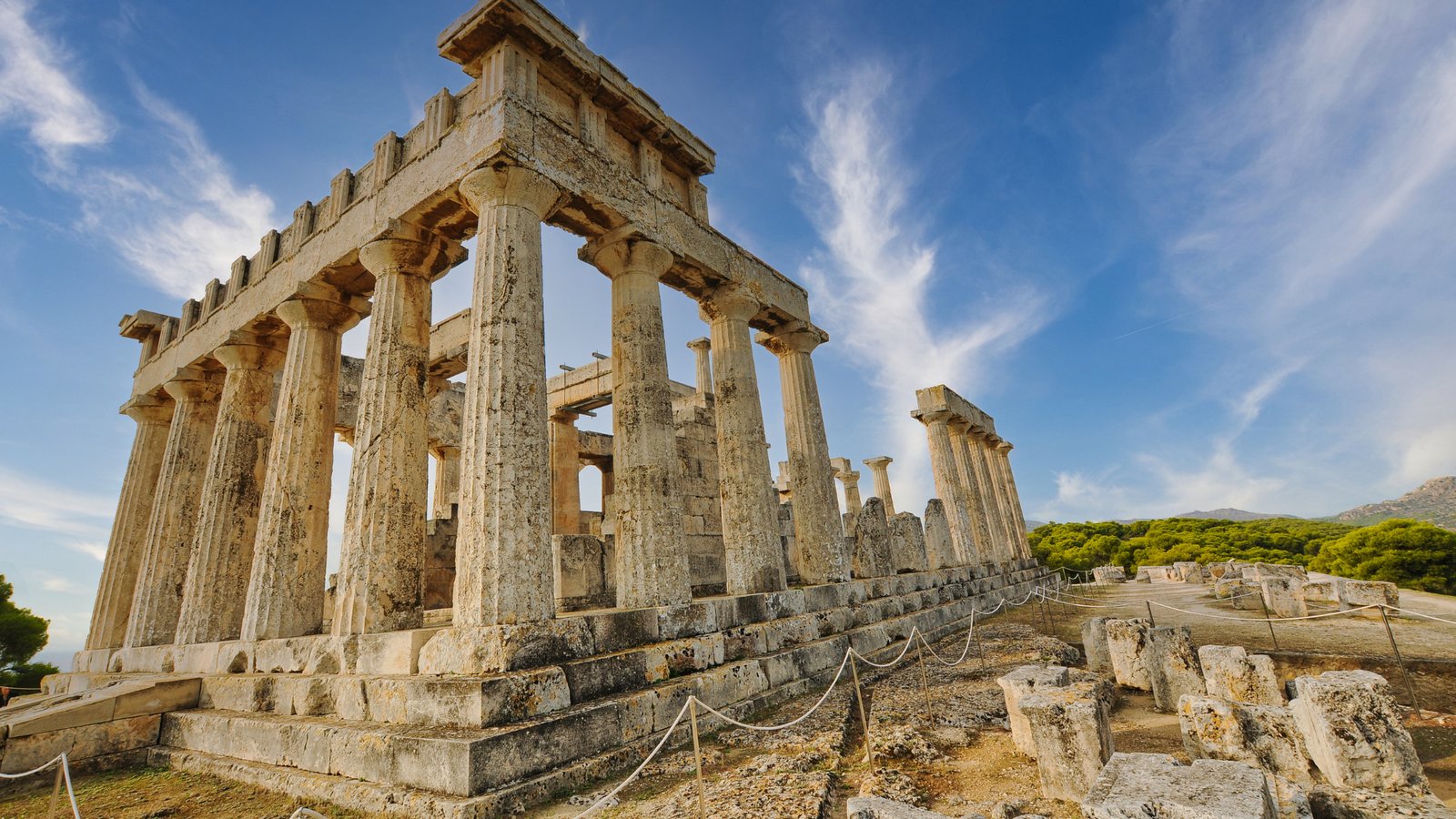
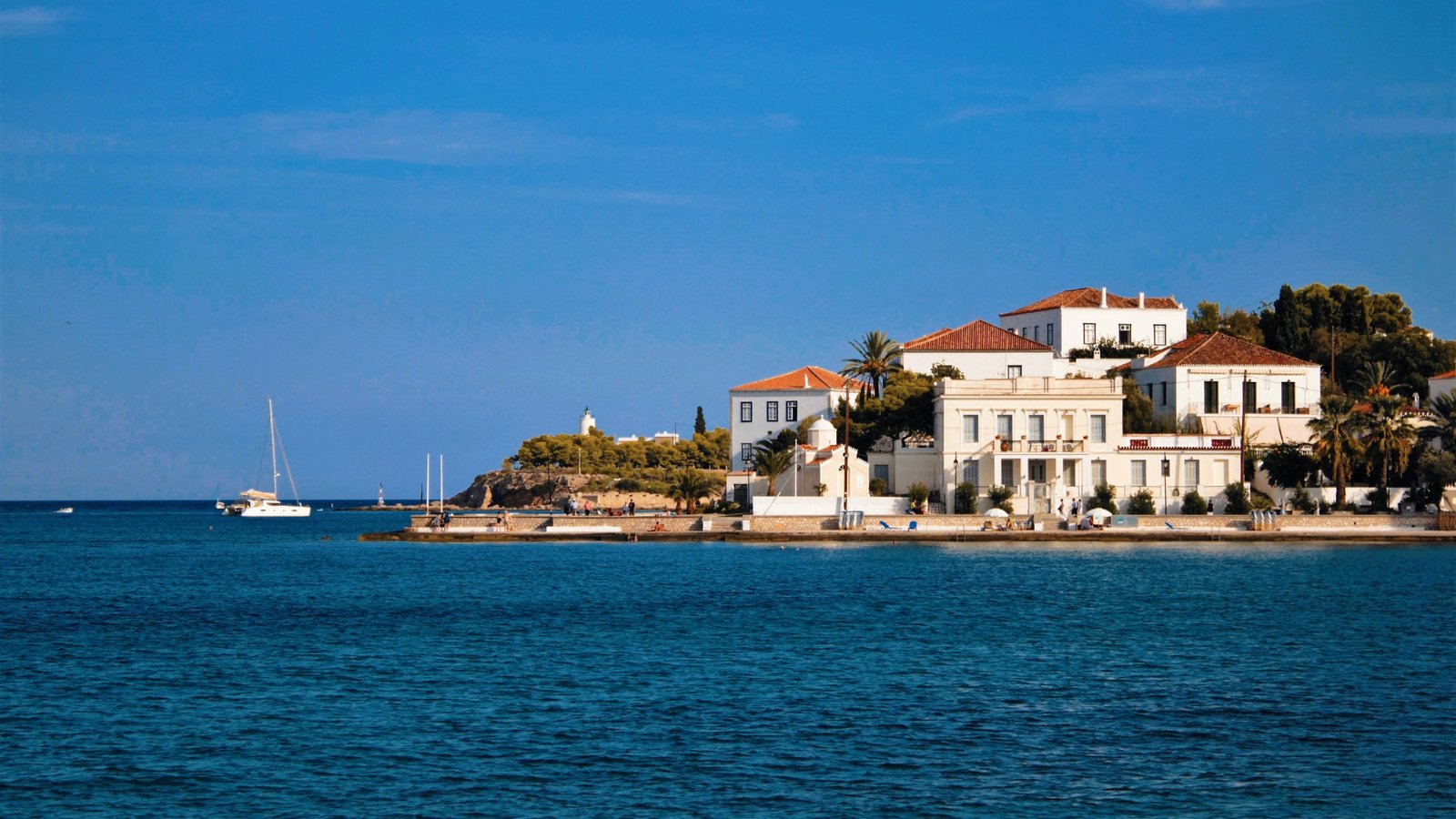
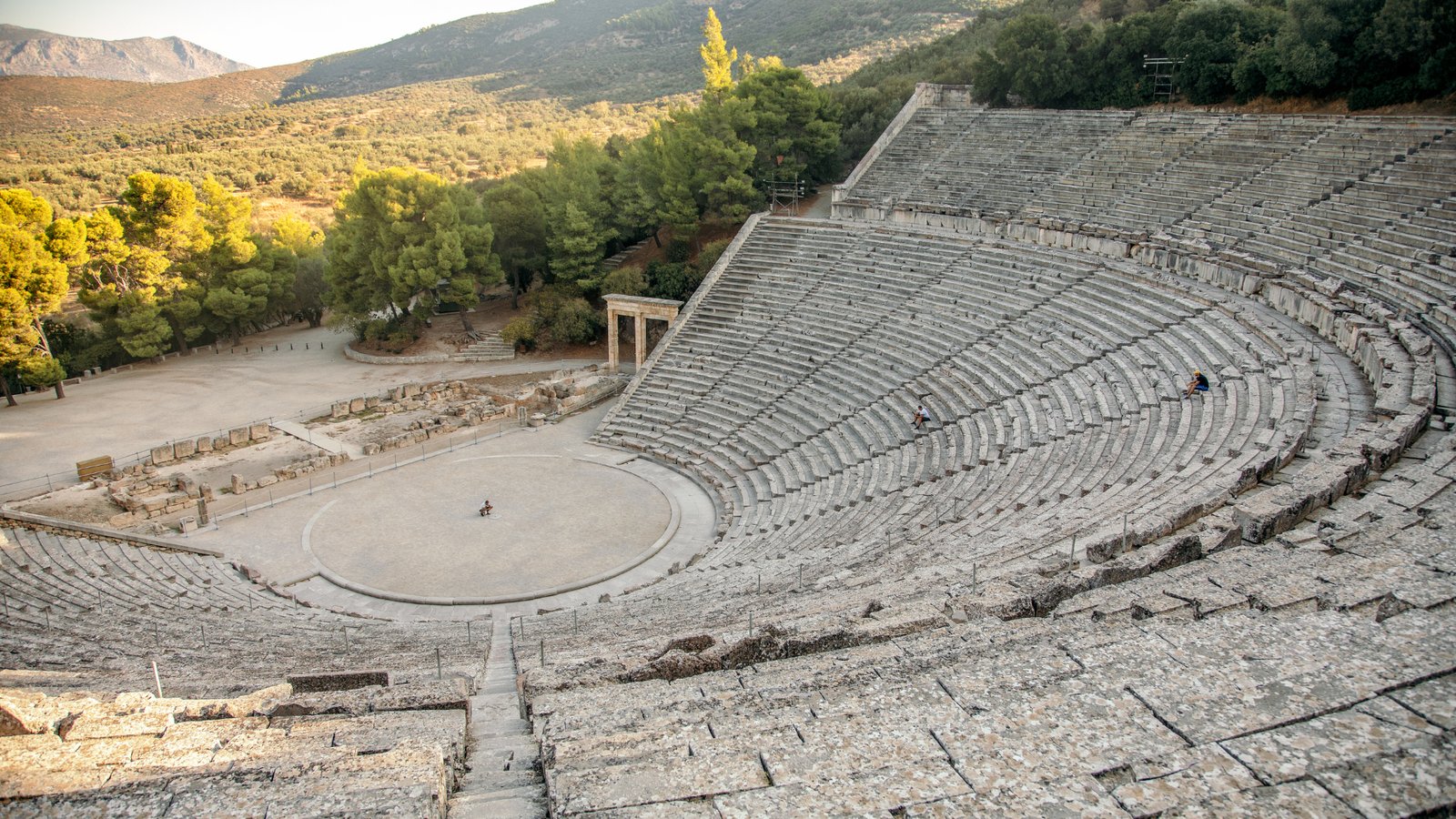
The Saronic Gulf is sheltered from the Meltemi by the Peloponnese mainland — that's the one geographic fact that reshapes everything. No 35-knot Aegean gusts, no pinned-down days waiting for the wind to drop, no 50-mile slogs. This Greek islands itinerary covers Aegina (Doric temple by Day 1 lunch), Poros, Hydra (car-free National Heritage town, donkey transport only), Spetses, the UNESCO theatre at Epidaurus, and Ermioni — all within 15-20 nm of each other.
About 140 nautical miles round-trip from Alimos Marina (15 minutes from Athens airport). The Saronic is the Greek charter we send first-timers, families with young kids, and multigenerational groups — same logic as the Ionian, but with denser cultural stops and shorter delivery legs from Athens. Crewed yacht with captain + chef so the wine list and the tavernas are both somebody else's job.
Day 1 of 7 · Alimos → Aegina
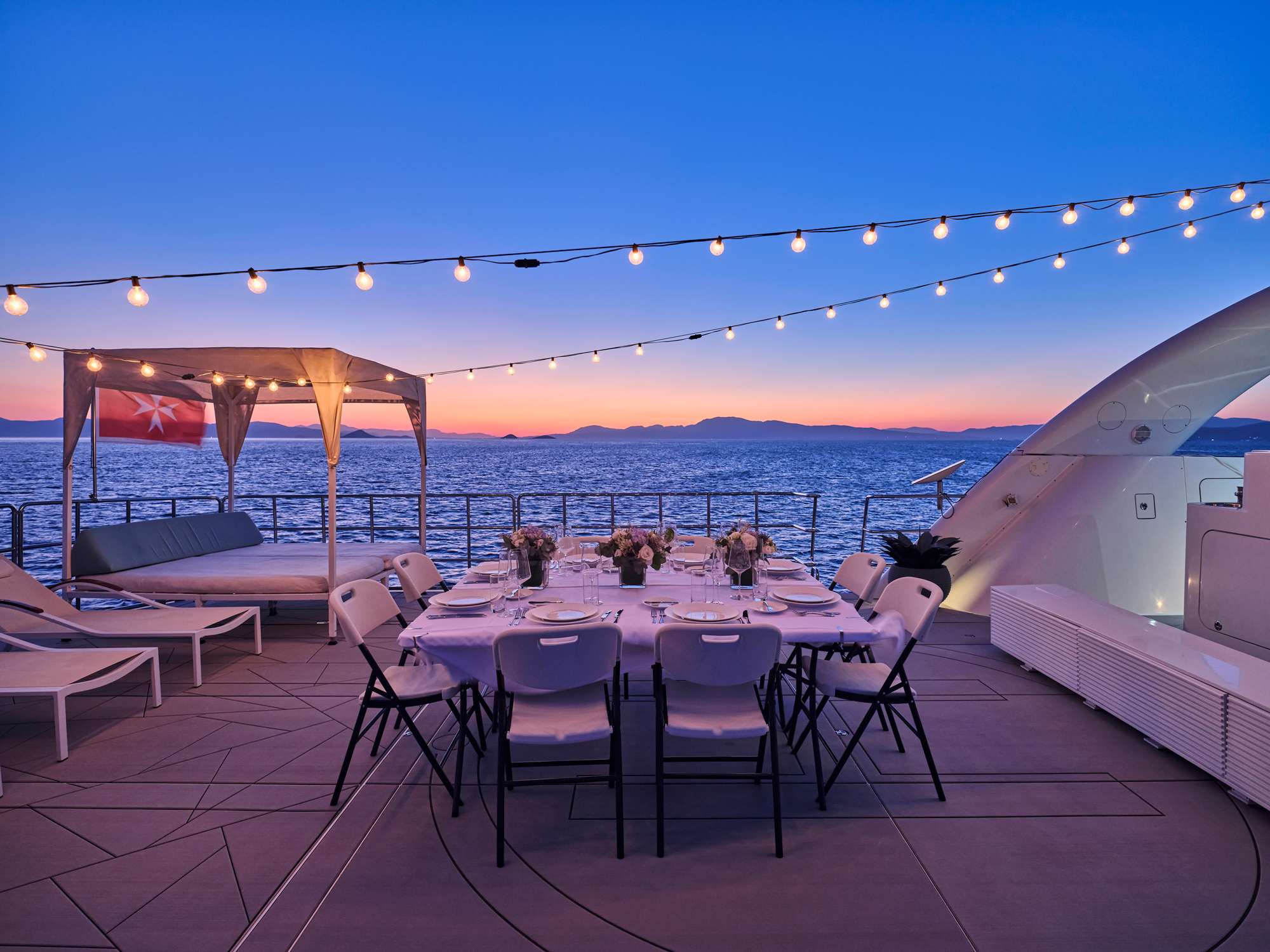
Your week begins at Alimos Marina on the Athens Riviera, the largest charter base in Greece and a 25-minute transfer from the airport. Your professional crew meets you at the slip with cold drinks and a chart briefing that frames the week ahead, settles your bags into cabins, and walks you through the boat while the chef finishes provisioning. By late morning the captain is slipping lines for the gentle 17-nautical-mile southwest hop to Aegina—the closest of the Saronic islands and the place most Athenians go for a long weekend.
The first afternoon belongs to a quiet upwind reach across the gulf with the silhouette of the Acropolis falling off the stern and the dome of Aegina's Agios Nikolaos church growing on the bow. It's the kind of opening leg that resets your nervous system inside an hour—warm air, blue water, the city already gone.
Aegina is famous for two things: pistachios, which grow in groves on the dry hillsides above town and end up in everything from pastries to the local liqueur, and the Temple of Aphaia—one of the best-preserved Doric temples in Greece, built around 500 BC and predating the Parthenon by a generation. Your captain can arrange a short taxi up to the temple in the late afternoon, in time to watch the limestone catch the last of the sun. Dinner is harborside at Skotadis, a fish taverna that has been on the Aegina quay since 1958, where the catch comes in off the boats next door.
Day Highlights
Day 2 of 7 · Aegina → Poros
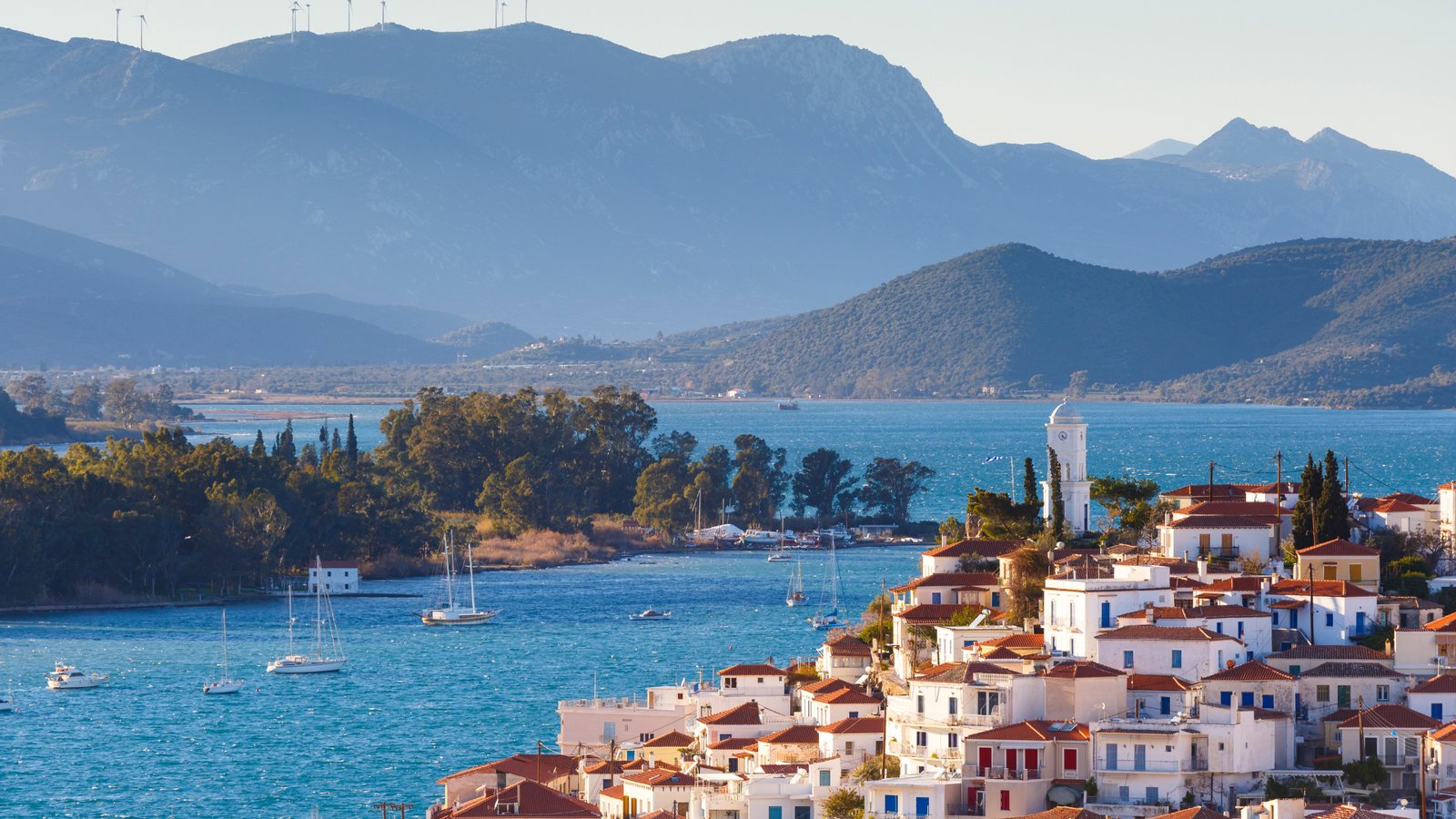
A short 15-nautical-mile run south takes you from Aegina to Poros, the second of the Saronic islands. The morning is usually a slow reach in light air, with Methana's volcanic peninsula building off the starboard bow and the long green flank of Poros opening to port. By early afternoon the captain is threading the narrow channel between Poros and the Peloponnese mainland—two pieces of land barely 200 meters apart, with whitewashed houses on one side and pine forest on the other.
Poros Town stacks up the hill from the waterfront, capped by the white clock tower that's been the island's calling card for a hundred and fifty years. The walk up takes 20 minutes and gives you the best view of the channel from above—worth doing at golden hour with a chilled drink waiting at a kafeneio on the way back down. The harbor itself is one of the most sheltered berths in the gulf, and the town is small enough that everything is on foot.
Dinner is a choice. Karavolos, tucked off the main waterfront in a stone alley, is the local secret for the slow-cooked rabbit and a long list of Greek wines you won't see on a Mykonos menu. Or the seafront table at Taverna Platanos, set under the giant plane tree that gives the place its name—simpler food, bigger view, exactly the right speed for a second-night dinner.
Day Highlights
Day 3 of 7 · Poros → Hydra
Today is the marquee day on the Saronic islands themselves: a 20-nautical-mile run south to Hydra. Your captain leaves Poros early for one specific reason. Hydra is the most-visited island day-trip from Athens—four ferries a day in summer, each one delivering a wave of camera-ready tourists into the small harbor—and the trick to enjoying the place is to arrive ahead of them. The crew aims to drop the hook off Mandraki or Hydra Town by mid-morning, while the harbor is still quiet and the donkeys are shuffling cargo up the lanes in the cool air.
Hydra is the only Greek island where motor vehicles are banned—not just in town, but on the whole island. Donkeys carry the luggage, mules carry the building materials, and the entire town is a National Heritage site of preserved 18th-century captains' mansions stacked up the rocky amphitheater of the harbor. There's no concrete blight, no hotel high-rise, no scooter noise. The result is a place that looks the way an Aegean port is supposed to look, and very nearly nowhere else still does.
The plan from your crew: a long lunch swim at Bisti Bay or Mandraki, then the tender into Hydra Town in the late afternoon once the day-tripper ferries have gone. Walk up the lanes to the cannons above the harbor, past the captains' mansions of the Boudouris and Tombazis families, both of whom funded warships for the Greek Revolution and built the houses on the proceeds. Drink a cold one at Sunset Bar (literally the name) on the rocks west of town, and stay aboard for a chef-prepared dinner under stars in the bay—or take a table at Omilos for one of the better dinners on the island.
Either way, you wake up the next morning still tied to the Heritage town, with the donkeys back at work and the day-trippers still on the ferry from Piraeus. That is the whole reason a crewed yacht wins on Hydra: most visitors get four hours and a sunburn. Guests staying aboard get the early morning when the harbor is silent and the late evening when the lanes are lit by café spill rather than camera flashes.
Day Highlights
Day 4 of 7 · Hydra → Spetses
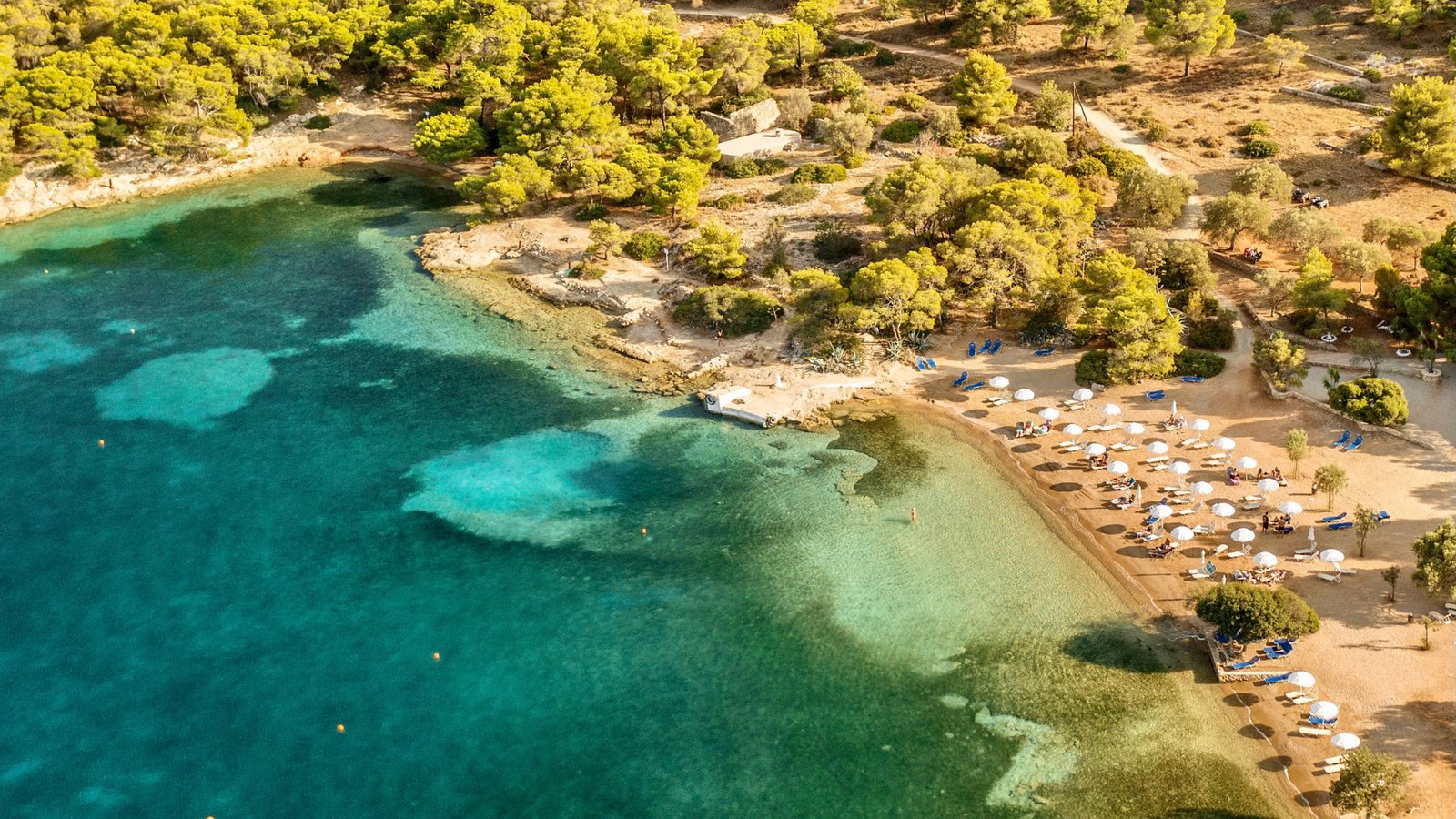
A 15-nautical-mile southwest leg today takes you from Hydra to Spetses, the most chic of the Saronic islands and the southernmost stop on this round trip. The morning sail rounds the western tip of Hydra and crosses to the Argolic side of the gulf, usually in a clean afternoon breeze that gives the captain a proper reach with the wind on the quarter. Before pushing into Spetses Town, the crew tucks the boat into Zogeria Bay on the northwest coast—a deep, pine-rimmed cove that's the locals' beach and one of the best lunch swims on the route. Anchor in clear water, swim ashore, and let the chef put out a long lunch on deck.
Spetses Town has a different feel from Hydra. Where Hydra is austere and stone-grey and very nearly silent after dark, Spetses is genteel—tree-lined streets, neoclassical mansions in pastel ochres, the Belle Époque grandeur of the Poseidonion Grand Hotel above the Old Harbor. There are no cars in the town center either, but here the substitute is horse-drawn carriages clopping along the seafront. The island is small enough that an afternoon walk gets you the full circuit—Dapia square, the Old Harbor, Bouboulina's House (a small museum dedicated to Laskarina Bouboulina, a heroine of the 1821 Greek War of Independence who funded her own warship), and a long stretch of waterfront tavernas.
Dinner is on the water at Patralis on the western edge of town—a fish taverna that has been pulling lobster, sea bream, and the day's red mullet straight off the local boats for three generations. Or Akrogialia closer to the Old Harbor, with the same approach and a slightly livelier crowd. Both are the kind of waterfront table where the bottle of Assyrtiko stays cold and the meal lasts past dark.
Day Highlights
Day 5 of 7 · The quiet day
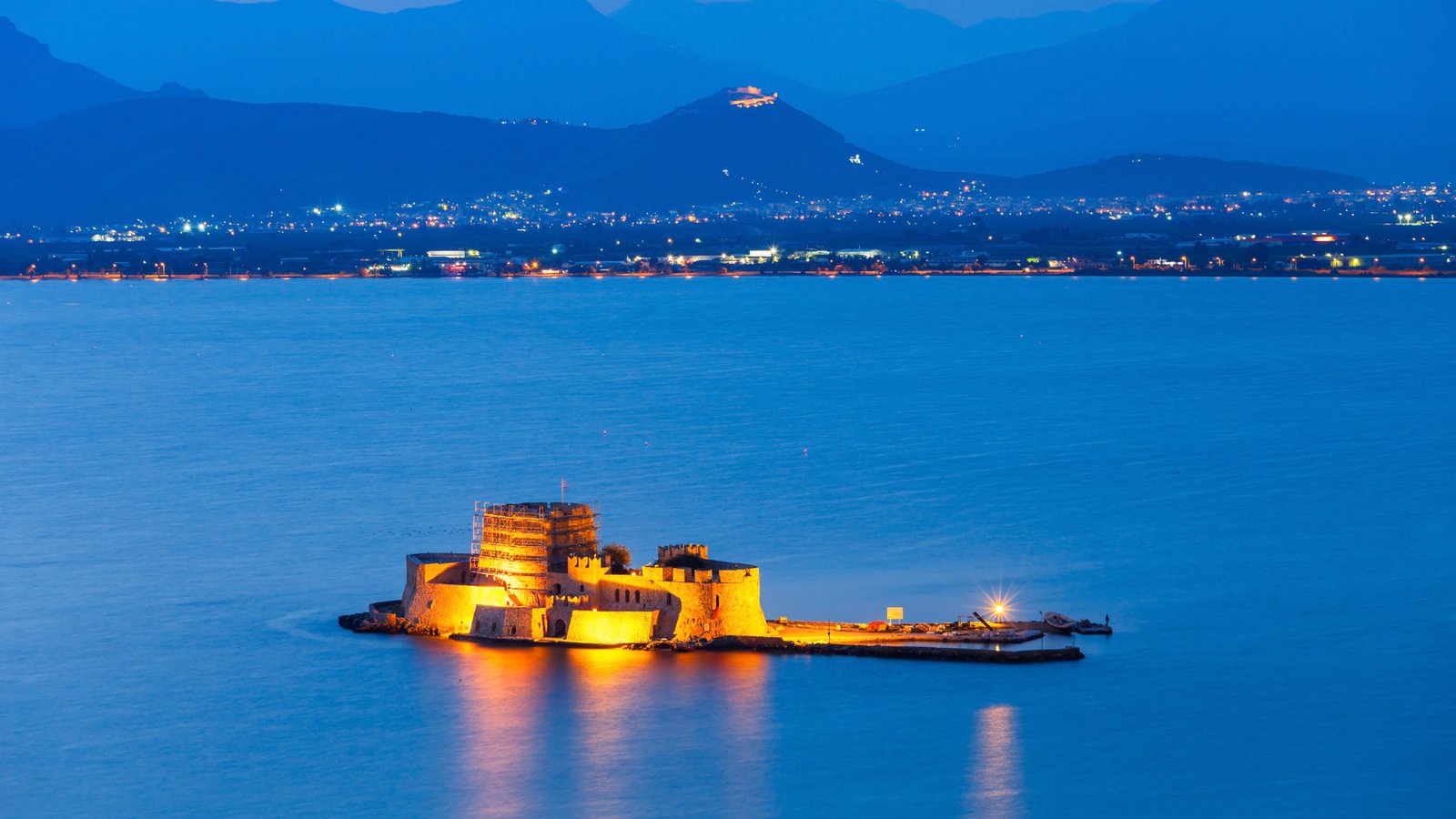
A short 10-nautical-mile hop north today crosses the channel onto the Peloponnese mainland, to the small fishing town of Ermioni. After three days of island stops, this is the deliberate quiet day on the route—a place most charter itineraries skip in favor of another night on Hydra or Spetses, and exactly the better call once you've already had those.
Ermioni sits on a narrow peninsula with a working harbor on one side and a pine-shaded promenade on the other. The town has a small set of tavernas, a few cafés, and a couple of bakeries, all walking distance from the quay. Once the boat is tied up, the crew can run the dinghy out to Bourtzi—a small islet just off the harbor entrance—for a swim in clear water that's a few degrees cooler than the inner anchorage.
Dinner is ashore at one of the harbor tavernas, where the menu is whatever came in that day and the wine is whatever the owner is pouring out of the back room. There is no Carpe Diem on Ermioni, no rooftop nightclub, and that's the point. After three days of island energy, a quiet evening with cicadas in the pines and a chef-prepared breakfast on deck the next morning is exactly what the rest of the week is built around.
Day Highlights
Day 6 of 7 · The marquee day
This is the longest leg of the week and the centerpiece of the trip: roughly 25 nautical miles north along the Peloponnese coast to Palea Epidavros, the small port town that sits below the Ancient Theatre of Epidaurus. The captain has the option of a swim stop at Korfos halfway up—a deep bite of a bay with clear water and a small pine-back hamlet for an anchored lunch—or pushing straight through if the breeze is making for a fast morning. Either way the crew has you anchored off Palea Epidavros by mid-afternoon.
From the quay it's a 20-minute drive up into the hills to the Sanctuary of Asklepios and the theatre itself—a UNESCO World Heritage site, built in the 4th century BC and famously regarded as the most acoustically perfect ancient theatre still standing. A coin dropped on the round stone stage is heard from the back row, more than 50 meters away, with no microphones and no electronics. Guides will demonstrate it on a daytime visit, and the demonstration never gets old.
If you sail in July or August, the bigger draw is the Epidaurus Festival. The theatre still hosts performances of classical Greek drama—Sophocles, Euripides, Aeschylus—performed in the original ancient Greek, on the same stones audiences sat on in the 4th century BC. Your captain can arrange tickets in advance and the transfer up from the boat. Dinner ashore at the small taverna on the Palea Epidavros quay before the evening performance, then a slow walk to your seat under the stars. It is the rare crewed-charter experience where the marquee moment is not a beach or a sunset but a 2,500-year-old play in a 2,400-year-old theatre.
A note on logistics: the festival schedule is published in the spring for the summer ahead, performances are weekend-weighted, and tickets do sell out for the marquee productions. If a Greek-drama evening is a priority for your charter, build the trip around the calendar—your broker can sequence the week so that Day 6 lands on a performance night, and your captain takes care of the tickets, the transfers, and the timing of dinner before the curtain.
Day Highlights
Day 7 of 7 · Final reach
The last full day is a 25-nautical-mile reach northeast back across the Saronic, a passage that closes the loop the week opened on day one. The Acropolis comes back into view on the bow somewhere around mid-afternoon. If a Meltemi has filled in, it's a fast, tail-on-the-quarter sail; in lighter air the captain takes the long way around to keep the boat moving and stretch the day on the water as long as guests want it.
There is one optional detour worth flagging. The Methana peninsula, which the boat passes on the morning's outbound leg, is one of the few volcanic landscapes in the Aegean and it has a small thermal spa fed by sulfur-rich hot springs at sea level. The water is warmer than the surrounding gulf and the chemistry is unmistakable—not for everyone, but for guests who like the curiosity of swimming in a hot spring at the edge of the sea, the captain can drop the anchor for an hour.
The crew aims to have the boat anchored either off the north coast of Aegina or in the bay of Vouliagmeni on the Athens Riviera by sundown, in time for a chef-prepared farewell dinner on deck and a quiet last night at anchor. Vouliagmeni is the tighter call for an early disembarkation: the bay sits 15 minutes from Alimos by water, and you wake up close enough to the marina that breakfast aboard runs late without anyone having to rush.
Day Highlights
Day 8 · Departure
A last slow breakfast on deck at anchor, a final swim off the stern if the morning is warm enough, and the short transfer your crew arranges straight to Athens International Airport or to a shoreside hotel if you're extending in the city—the Acropolis and the Plaka are an easy half-day from Alimos. Your captain and chef will step off the boat already talking about when you're coming back, which is usually how the good ones end.
Want to share or come back to this voyage later?
Bookmark this voyage →Crewed Itinerary · Greece · Motor Yacht
This Santorini itinerary is the bucket-list Greek charter—the version of Greece most people picture before they've ever been. The Santorini caldera at sunset. The lunar volcanic shoreline of Milos. The sea-cave arches at Kleftiko. Sifnos for the food. The Naxos Portara as a 6th-century BC sunset frame. All strung together in roughly 310 nautical miles of open Aegean water on a 7-day round trip out of Alimos Marina just south of Athens. With your professional captain and private chef running the yacht, you step aboard and let the route reveal itself—the photograph that ends up framed on the wall is almost certainly going to be from this week.
Be honest with yourself before you book this one: the southern Cyclades is a motor-yacht itinerary. Three hundred and ten nautical miles in seven days—with two legs over fifty miles and the Santorini-to-Milos run pushing seventy—is too much ground for a sailing yacht to cover in daylight legs without compromise. This route assumes a fast vessel that can plane and a captain who can move the schedule around the Meltemi. If you're chartering a sailing catamaran, our Northern Cyclades route keeps the Mykonos, Naxos, and Paros loop comfortable on a slower boat and skips the Santorini run that motor yachts do better.
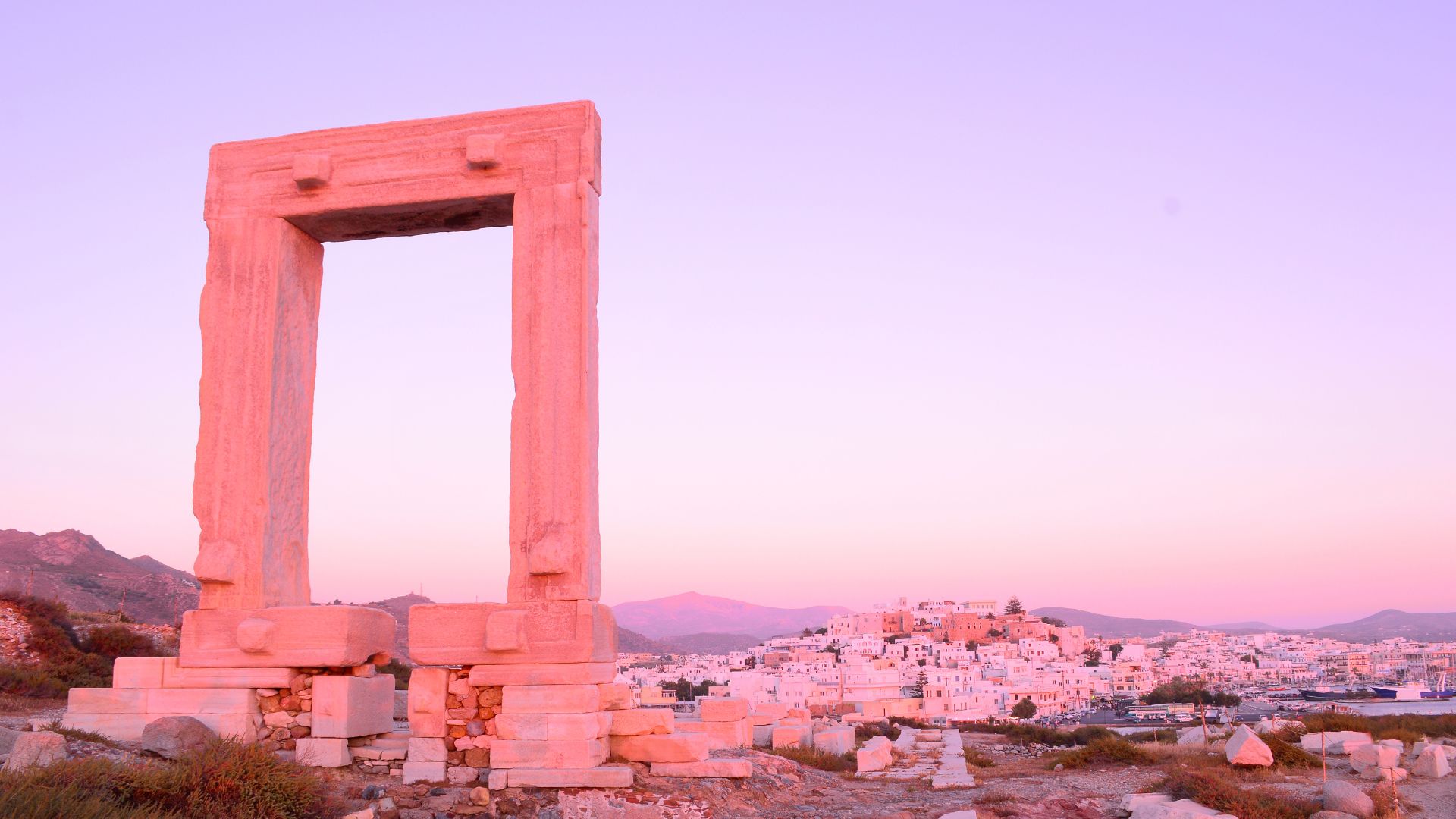
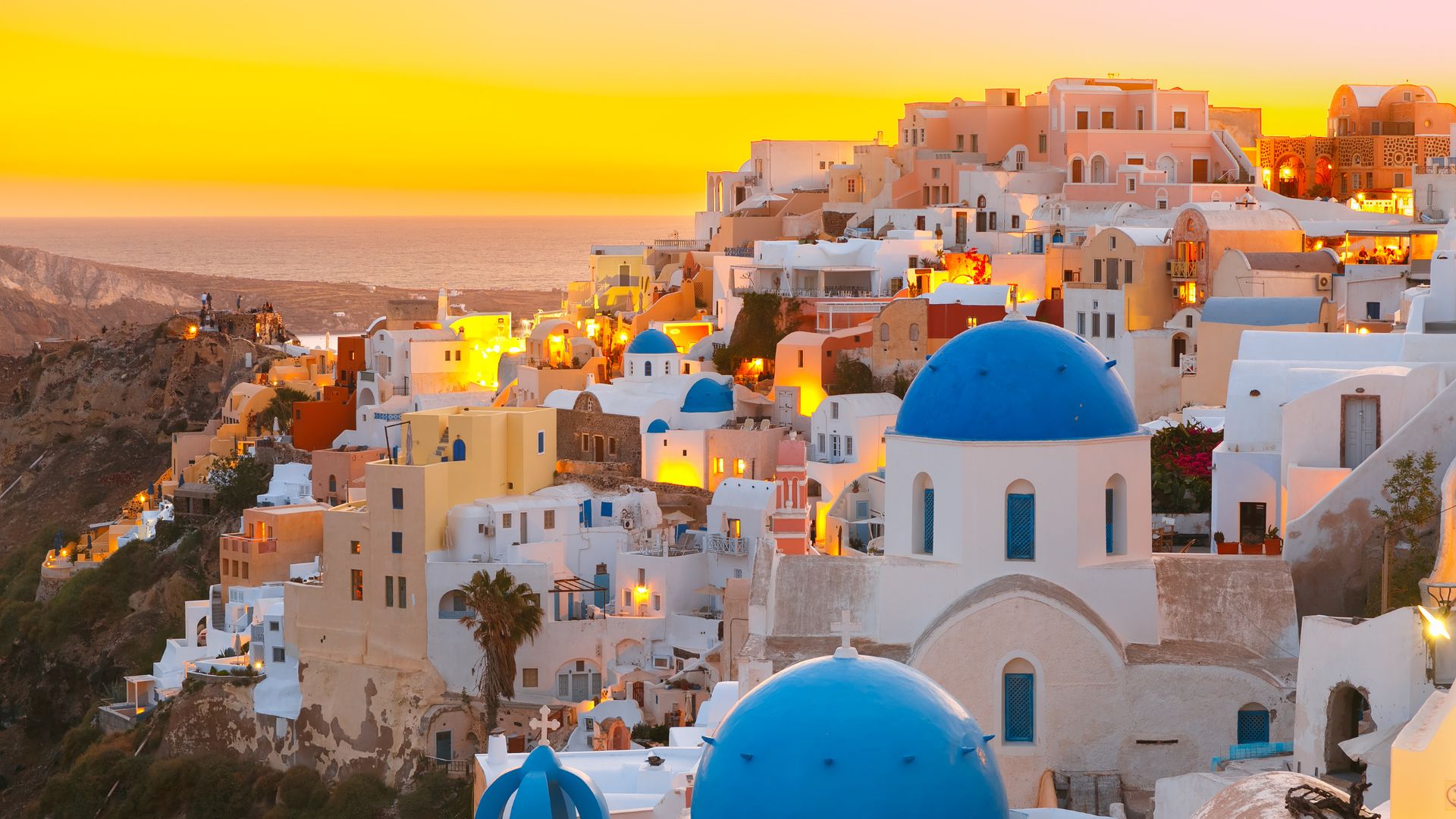
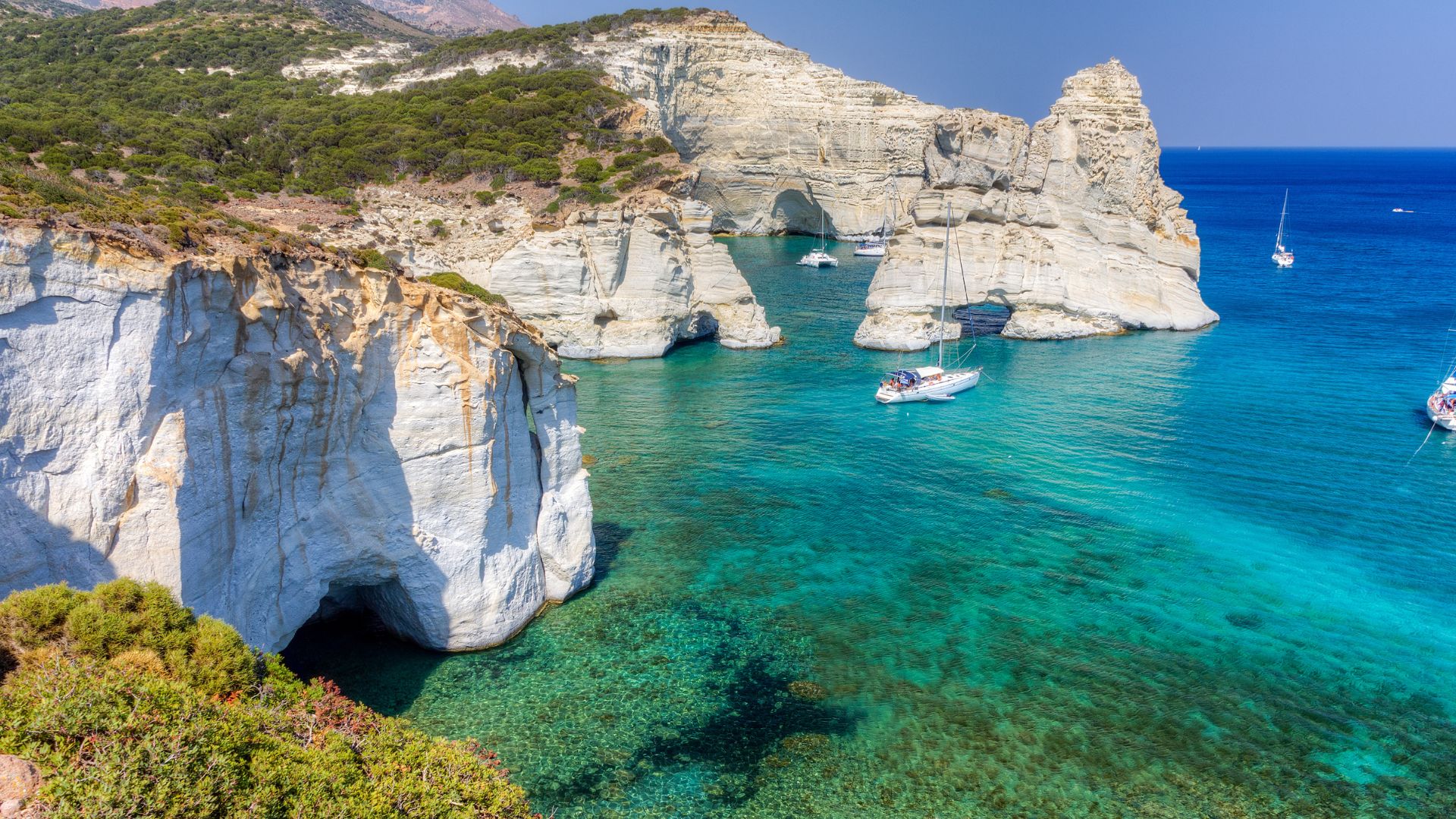
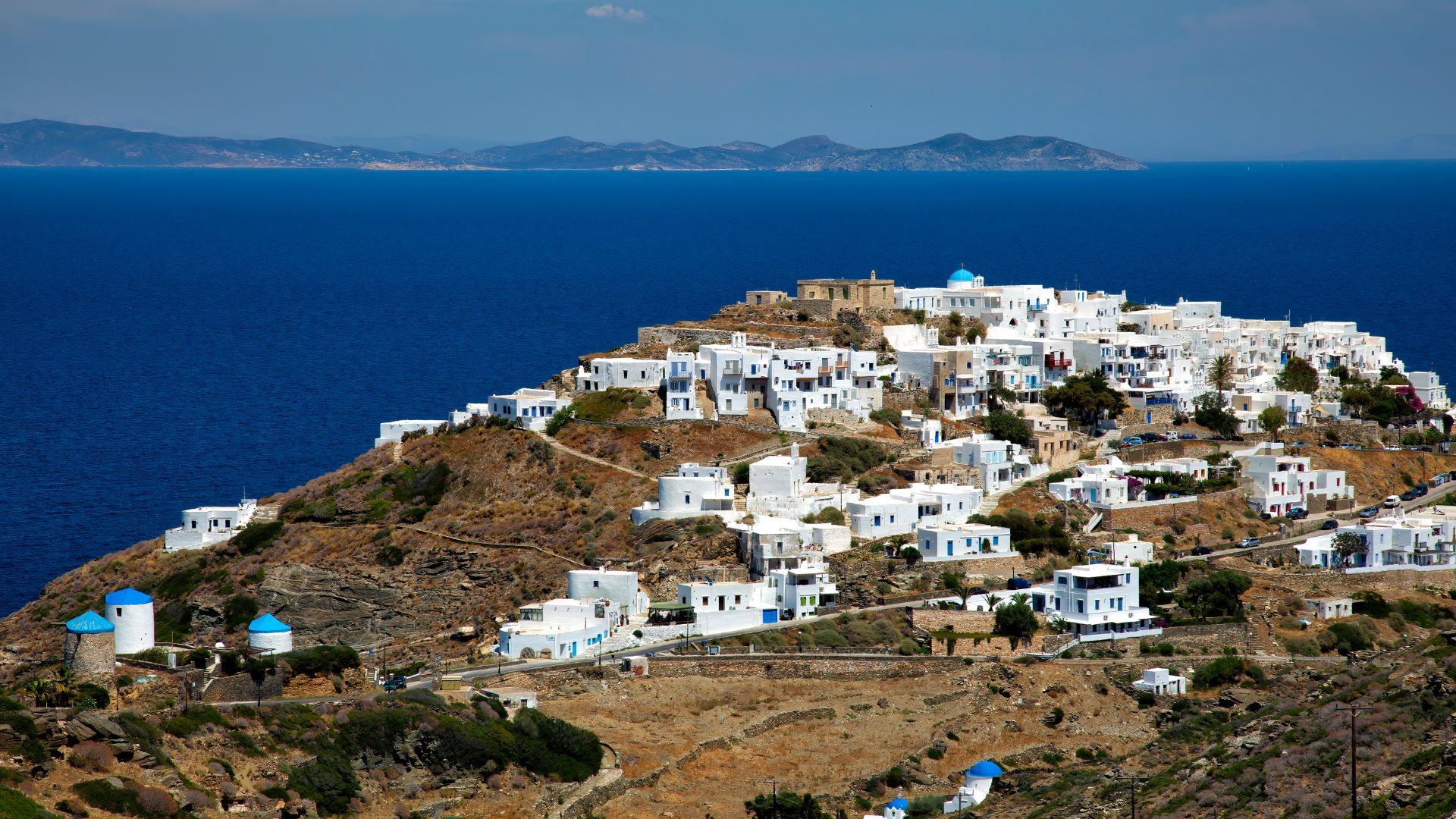
Santorini is the photograph that ends up on the wall, and this is the only Cyclades itinerary that gets you there cleanly. The Santorini caldera at sunset, Milos's Kleftiko sea-cave arches, the Naxos Portara framing a sunrise, Sifnos for the food, and Mykonos's Little Venice on the way back. About 310 nautical miles round-trip from Alimos Marina near Athens.
It's a Greek islands itinerary built deliberately for motor yachts — two legs are over 50 nm and the Santorini-to-Milos run pushes 70. A planing motor yacht clears those in 3–5 hours; a sailing catamaran would burn whole days on them. The route assumes a captain who can move the schedule around the Meltemi (the Aegean summer northerly that gusts to 35+ knots in July/August). If you want the same archipelago on a sailing yacht, our Northern Cyclades itinerary covers Mykonos/Naxos/Paros without the Santorini run.
Day 1 of 7 · Alimos → Kea
Your week begins at Alimos Marina on the Athens Riviera—the largest marina in Greece and the logical base for any serious Cyclades charter. After the short transfer from Athens International, your professional crew welcomes you aboard with cool refreshments and a chart briefing that frames the week ahead. Stow your gear, get the lay of the saloon, and take a few minutes on deck while the city hum fades behind the breakwater.
By early afternoon, your captain slips lines for the forty-nautical-mile crossing to Kea, the closest Cycladic island to the mainland. It's the gentlest leg of the week, and we do it first on purpose—fresh guests, an easy passage, and the bigger water saved for the days ahead. Cape Sounion's Temple of Poseidon will be off to starboard for the first hour if the light is right, and the boat settles into its cruising stride as the mainland drops away behind you.
Your crew drops the hook in Vourkari, a small U-shaped harbor on the northwest corner of the island lined with whitewashed tavernas and fishing boats. Tender in for dinner at Aristos, the seafood place everyone sends you to for a reason—grilled octopus, a cold bottle of assyrtiko, and the sun going down behind the church on the hill. A chef-prepared nightcap back aboard, and the trip has officially started.
Day Highlights
Day 2 of 7 · The Delos crossing
Today is the first long run of the week—about seventy nautical miles southeast from Kea to Mykonos, and the kind of leg that explains why this route wants a planing yacht under your feet. A fast hull will cover that distance in a comfortable morning's run; a sailing yacht would be on the water from dawn to dusk. Your captain watches the Meltemi forecast, picks his start time, and points the bow into the heart of the chain.
By early afternoon, the long, low profile of Delos shows up off the bow, and your captain has a choice to make. If the day has been cooperative and there's appetite for it, an afternoon stop at Delos is the rare crewed-charter advantage almost no one uses—a UNESCO open-air archaeological site, the largest in Greece, on what was one of the most important sacred islands in the ancient Mediterranean. The day-tripper crowd from Mykonos is gone by 3 p.m. and the ruins are almost yours.
From Delos it's a short hop east to Mykonos, where your captain drops anchor in the lee of the island—Ornos or Platis Gialos on the southwest side, well away from the south-coast beach-club intensity. Late afternoon, the tender takes you into Mykonos town for sunset at Little Venice, the row of old captains' houses on the western edge of Chora built with their wooden balconies hanging directly over the sea. Pick a bar, grab a table at the edge, and watch the sun drop into the Aegean with the famous windmills on the ridge above. Dinner ashore, a slow tender ride back to the boat, and a chef-prepared nightcap on deck.
Day Highlights
Day 3 of 7 · Mykonos → Naxos
An easier day on the water—about thirty nautical miles south to Naxos, the largest island in the Cyclades and a different kind of place from Mykonos. Naxos has mountains in the middle, an agricultural interior that grows half the meat and cheese on the island chain, and a working town that doesn't reorganize itself around the day-tripper schedule. After the short morning run, your captain anchors off Naxos town and the day belongs to you.
Late afternoon is for the Portara. On the small rocky islet just north of the harbor stands a single freestanding marble doorway, all that was ever built of a temple to Apollo started in the 6th century BC. The temple was abandoned mid-construction; the gate stayed standing. It has framed the sunset here for two and a half thousand years. Walk out along the causeway as the light drops and stand under the marble. The Cyclades is full of postcard moments, but this one earns the cliché honestly.
Earlier in the afternoon, the tender can run you down to Agia Anna on the southwest coast for a long, flat beach walk and a swim in water that gets shallow forever. It's the kind of beach where you wade out fifty meters and the water is still at your waist, the sand soft underfoot, the wind blocked by the headland. A good hour to spend before the evening kicks in.
For dinner, the move is Popi's, a grill house in Naxos town that locals will tell you has the best lamb souvlaki on the island. Order a second round, sit at the outside tables, and let the evening stretch. If you have any appetite left, the small distillery shops along the back streets sell kitron, the local citrus liqueur grown only on Naxos, and your captain will probably know which one is the good one.
Day Highlights
Day 4 of 7 · Into the caldera
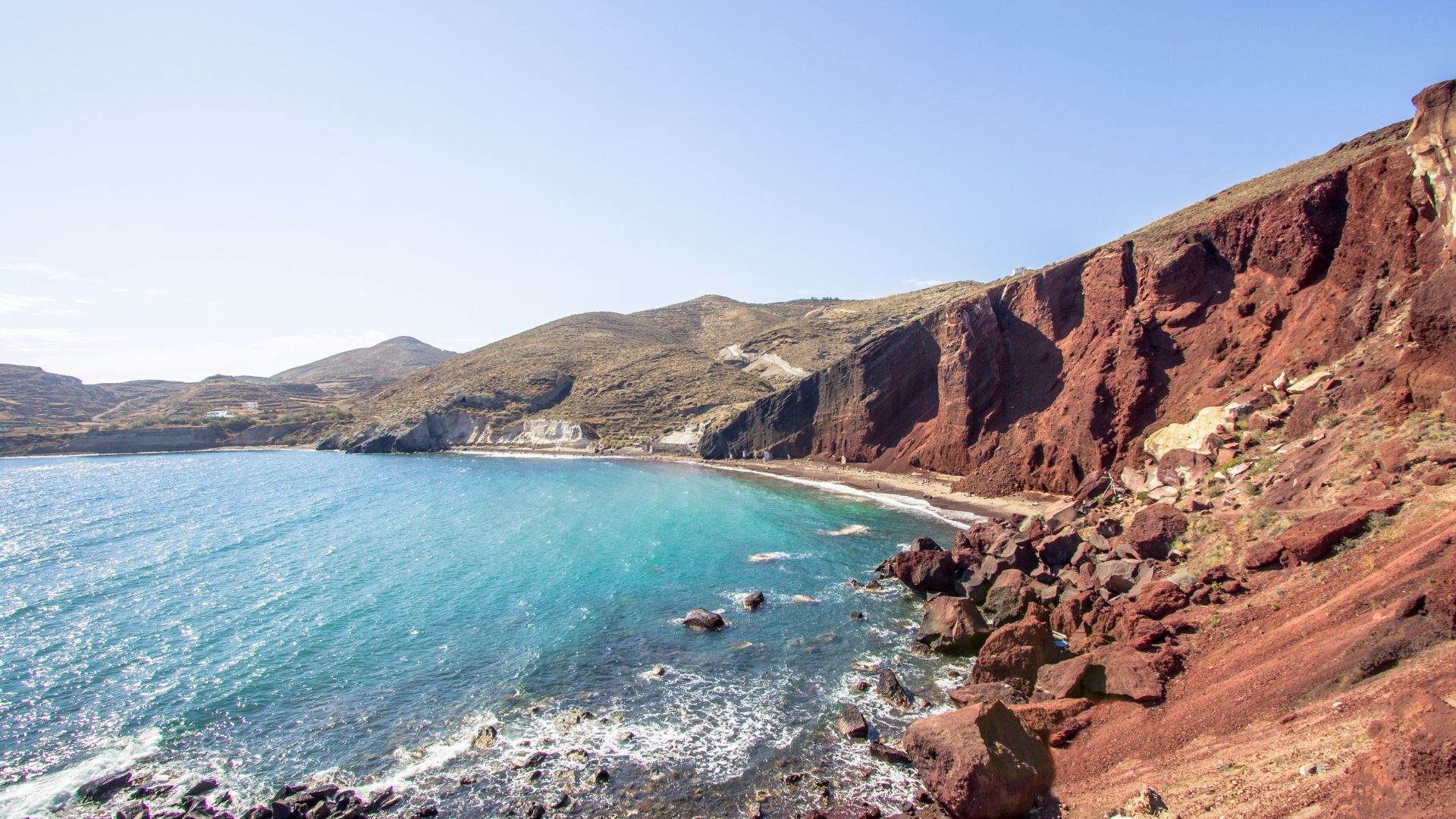
Today is the day this itinerary is built around. Fifty-five miles south from Naxos, the long, mountainous profile of Santorini grows on the horizon, and your captain brings the boat in around the south end of the island. From there, you turn north and run up the inside of the caldera—the rim of a drowned volcano with cliffs rising eight hundred feet straight out of the water on your starboard side and the white-and-blue villages of Fira and Oia clinging to the top like frosting. There is nothing else in the Mediterranean that looks like this.
A note on the anchorage, since it's worth being honest about: the caldera is deep. Most of the bottom inside the rim drops past two hundred meters, which means almost no yacht actually anchors here in the traditional sense. The standard move is to pick up a mooring buoy off Ammoudi at the base of Oia, or to hold position with the engines while guests run ashore. Your captain will work the logistics; you don't have to think about it. Before settling in for the evening, the crew makes two tender stops on the south shore—Red Beach and White Beach—both only reachable by boat or a long scramble over volcanic headlands. Rust-colored cliffs, dark sand, warm water.
Late afternoon, the tender runs you into Ammoudi. Two options, and most guests do both: take your time with an early dinner at one of the fish tavernas on the water, octopus drying on the line above your table, the cliff face going gold above you. Then climb the three hundred steps up to Oia for sunset—or take the donkey if your knees object. Find a spot on a stone wall as the sun drops behind the far rim of the caldera. The light turns the whole village gold for about twenty minutes. Nobody talks much while it's happening.
Day Highlights
Day 5 of 7 · The signature offshore leg
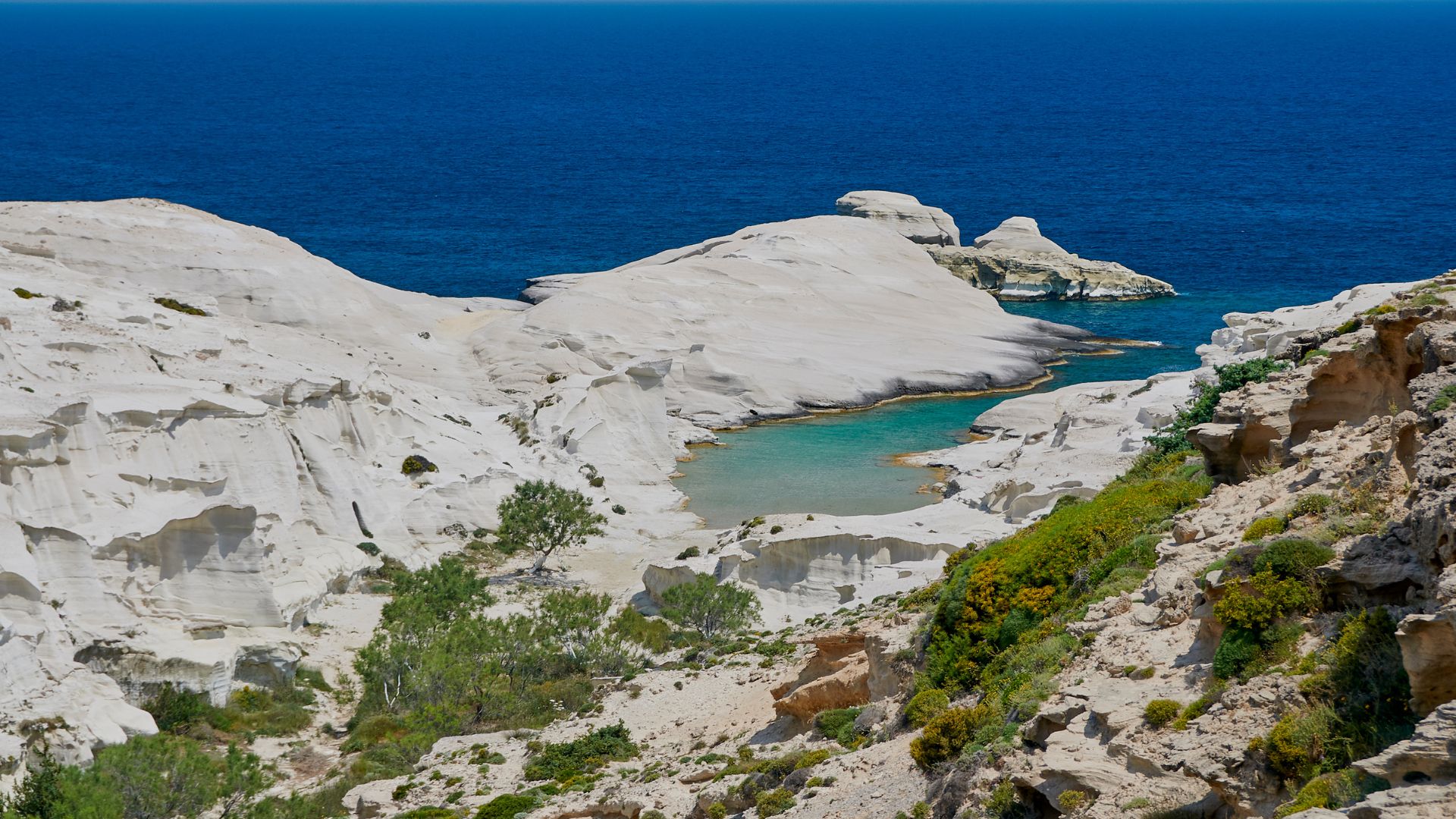
Today is the longest open-water leg of the week—about seventy nautical miles southwest from Santorini to Milos, and the run that demands the planing-yacht setup most. There's no convenient island in the middle to break it up. Your captain picks his window, and on a fast boat you cross before lunch. On a sailing yacht in a typical July Meltemi, that same passage would be a long upwind grind into a short Aegean chop. This is the leg that decides what kind of vessel makes sense for the route.
The arrival is worth every mile. Your crew brings the boat around the southwest tip of Milos to Kleftiko Bay, a stretch of coastline carved by wind and wave into white volcanic sea-cave arches, pinnacles, and underwater swim-throughs. Santorini gets the calendar photos in the Aegean; Kleftiko is where you actually want to be in the water. Anchor offshore, take the tender deep into the caves, and spend an hour swimming through arches and rounding pinnacles in clear, turquoise water.
Late afternoon, the boat repositions to the north coast for a stop at Sarakiniko Beach—a moonscape of white volcanic rock, no vegetation anywhere, geology so strange it looks staged. Walk the rock formations, swim off the low cliffs, and let the sun finish dropping. For dinner, the tender takes you into Adamas village on the harbor—a working Cycladic town that runs at human speed, with octopus drying on every taverna line and ouzo on every table. Order both. A chef-prepared nightcap back aboard, and the boat is quiet by midnight.
Day Highlights
Day 6 of 7 · The food island
A short twenty-five-mile northeasterly run today, the kind of morning the boat handles in an easy ninety minutes and you barely have time to finish breakfast. Sifnos sits between Milos and Serifos in the western Cyclades, and it's the food island of the chain—a hilltop interior of white-and-blue villages built around clay-pot cooking, herb gardens, and the kind of small tavernas that have been making the same lamb dish for four generations.
Your captain anchors in Vathy Bay on the southwest coast—a deep, sheltered, sandy-bottomed bay ringed by a classic Cycladic blue-and-white village climbing the slope. It's the kind of anchorage that resets the trip, especially after the offshore push from Santorini. Spend the afternoon swimming, paddleboarding, or running the tender along the rocky shoreline. There's no schedule on Sifnos and there shouldn't be.
Dinner is the reason you're here. The Cycladic specialty is mastelo—lamb cooked low and slow in a sealed clay pot with dill and local wine, a dish you only find done well on Sifnos. The two restaurants worth booking are Omega 3 in Platis Gialos, a small place run by a fisherman who takes the catch off his own boat in the morning, and Tselementes in Apollonia, named after the Sifnian chef who wrote the cookbook that taught modern Greek kitchens to write recipes down. Your captain will book whichever one suits the night. Either way, you eat well.
After dinner, walk the stone alleys of Apollonia or Kastro—the older hilltop village on the east coast, built directly on the foundations of an ancient acropolis with a small white chapel hanging over the sea. There are no scooters, no day-trippers, and almost no signage. Sifnos is the island that makes guests start asking how to extend the trip.
Day Highlights
Day 7 of 7 · Last swim + home
The final full day on the water is a thirty-mile run northwest to Kythnos for one last swim stop, then the longer leg back to Alimos. Your captain plans the morning around getting to Kolona by lunch—a thin tongue of white sand connecting Kythnos to a small offshore islet, with open sea on one side and a protected bay on the other. You swim between two different seas. It is one of the most photographed anchorages in the Cyclades and it earns the attention.
The crew drops anchor off the lee side, sets up the swim platform, and the afternoon turns into water toys, a long lunch aboard, and not much else. Most weeks, this is the day guests don't want to come back from. The Meltemi affects this leg the way it affects every leg in the Aegean—if it's blowing hard out of the north, your captain may shift the timing or push the homeward run later. That's the captain's call, and it's the right one.
Mid-afternoon, lines come up for the final passage back to Alimos Marina. It's a quiet hour or two on deck with the Athens shoreline growing on the bow, the week tallying itself in your head. Your chef has a farewell dinner planned on board for the last evening at the dock—a slow three courses on the aft deck, the lights of the marina coming on around you, the boat sitting still after seven days of motion.
Day Highlights
Day 8 · Departure
Enjoy a last slow breakfast aboard at Alimos, a final coffee on deck, and the short transfer your crew arranges straight to Athens International or to your shoreside hotel if you're extending in the city. Your captain and chef will step off the boat already talking about when you're coming back, which is usually how the good ones end.
Want to share or come back to this voyage later?
Bookmark this voyage →
When to go, what it costs, and how to get there — the practical answers guests ask before booking a Greece crewed yacht charter.
July and August are the highest-volume booking weeks of the Greek season. Daytime temperatures sit in the high 80s to low 90s, water temperatures peak in the high 70s, and the Meltemi blows hardest — often 25–35 knots through the central Cyclades, which is why the Northern Cyclades sailing route is built downwind and why the Southern Cyclades caldera run requires a motor yacht. The Ionian and Saronic stay sheltered from the Meltemi and run quietly through these weeks. The best yachts and crews go 9–12 months in advance for July and August, and rates run 25–40% higher than the shoulders. Charterers who want the energy of high-season Greece pay for it; charterers who want quieter water and easier reservations book the windows on either side.
May, June, September, and October are the best balance of the year. The Meltemi softens through May and June, returns in late June, and tapers again through September. Water temperatures reach swimming range by late May and stay there through October. Daytime highs sit in the upper 70s to mid-80s — comfortable rather than hot. Tavernas have tables, the islands feel local again, and rates fall 20–30% from peak. June and September are when many Greek-charter regulars book — the heat softens, the islands quiet, and the route's flexibility opens up. May and October are workable for guests who can travel before the school calendar kicks in or after it ends, with slightly cooler water and lower rates.
$30,000–$100,000 per week
Crewed yacht charters in Greece typically run from $30,000 to $100,000+ per week base rate, depending on yacht size, build year, and crew. Greece operates on the Mediterranean plus-expenses model — not the all-inclusive default of the Caribbean. The base rate covers the yacht and crew only. Food, beverages, fuel, marina dockage, harbor fees, port taxes, water and electric, and any cruising taxes are paid through an Advance Provisioning Allowance (APA) pre-funded at 30–35% of the base rate and reconciled at trip end. Greek charter VAT runs 12% on the base rate (a reduced rate, separate from the country's 24% standard VAT) and is added at booking. Crew gratuities run 10–15% in the Mediterranean — lower than the Caribbean's 15–20% — paid directly to the captain on disembarkation. Charters in Greece run Saturday to Saturday as standard; the seven-day week is built around the country's consolidated turnaround day.
About chartering in Greece.
Field-tested guides, itineraries, and tips — written from years of chartering these waters.

Greece or Croatia? Compare destinations, sailing style, and pricing to choose the right Mediterranean charter for your trip.

Discover the best summer yacht charter destinations during hurricane season—explore the Grenadines, Exumas, or the Mediterranean this summer.
We charter across the Eastern Mediterranean. Here are some other excellent alternatives.

Stone harbors and pine-rimmed coves down the Dalmatian coast — Roman ruins inside medieval walls, cold Pošip on a stern-to quay in Hvar, the Adriatic the way it was written about.

The Mediterranean week that looks like nowhere else in Europe — medieval walls dropping straight into the water, a baroque church on an island made from sunken ships, and the Sveti Stefan silhouette at the offshore anchor. The Adriatic week most guests book the second time they come.

Yalıkavak's celebrity-chef quay, Maçakizi's pontoon at sundown, Kekova where the sunken city of Simena sits below your anchor — the Mediterranean the Turks have mostly kept for themselves, and the lowest charter VAT in the Med.
Fill out our quick form and we'll dive into your unique preferences — from adventure-packed itineraries to pampered escapes. Whether you're a seasoned voyager or new to charters, we'll tailor recommendations just for you.
With over fifteen years of experience, we'll match you with the yacht that fits your style, group, and itinerary. We work directly with the captains and crews across our list — so the recommendation is built around the right boat-and-crew fit for your week, not whatever's easiest to book.
Once your yacht is booked, we'll take care of logistics: paperwork, reminders, and personalized resources to help you plan. From arrival planning to must-visit spots, we'll make your charter as seamless as it is unforgettable.

What to Expect on a Private, Crewed Yacht Charter
Learn what makes crewed yacht charters extraordinary: personalized service, gourmet dining, and endless opportunities for adventure and relaxation.

How Does the Booking Process Work?
Our team handles every detail of your crewed yacht charter booking, ensuring a seamless experience from your first inquiry to setting sail.

Crewed Yacht Charter Pricing Explained
Understand what a crewed charter costs, the types of pricing, and what is included / not included.

Logistics: Proven Travel Plans for a Stress-Free Start
Plan your journey to your crewed yacht charter with ease. Tips on flights, transfers, and logistics for a stress-free start to your vacation.
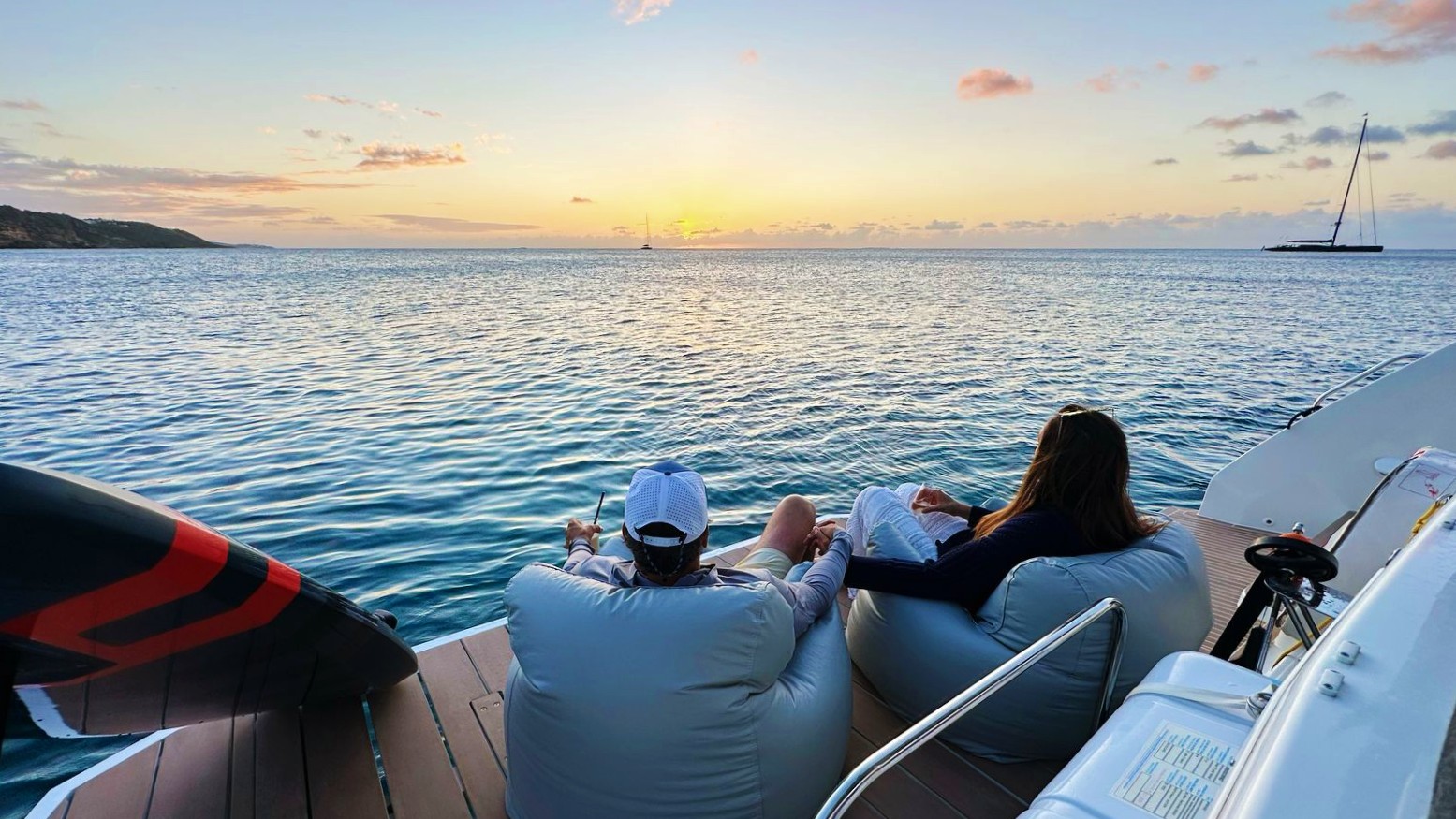
Honeymoon Yacht Charters
Start your marriage on a private yacht. Explore secluded beaches, gourmet dining, and unforgettable sunsets in the Caribbean.
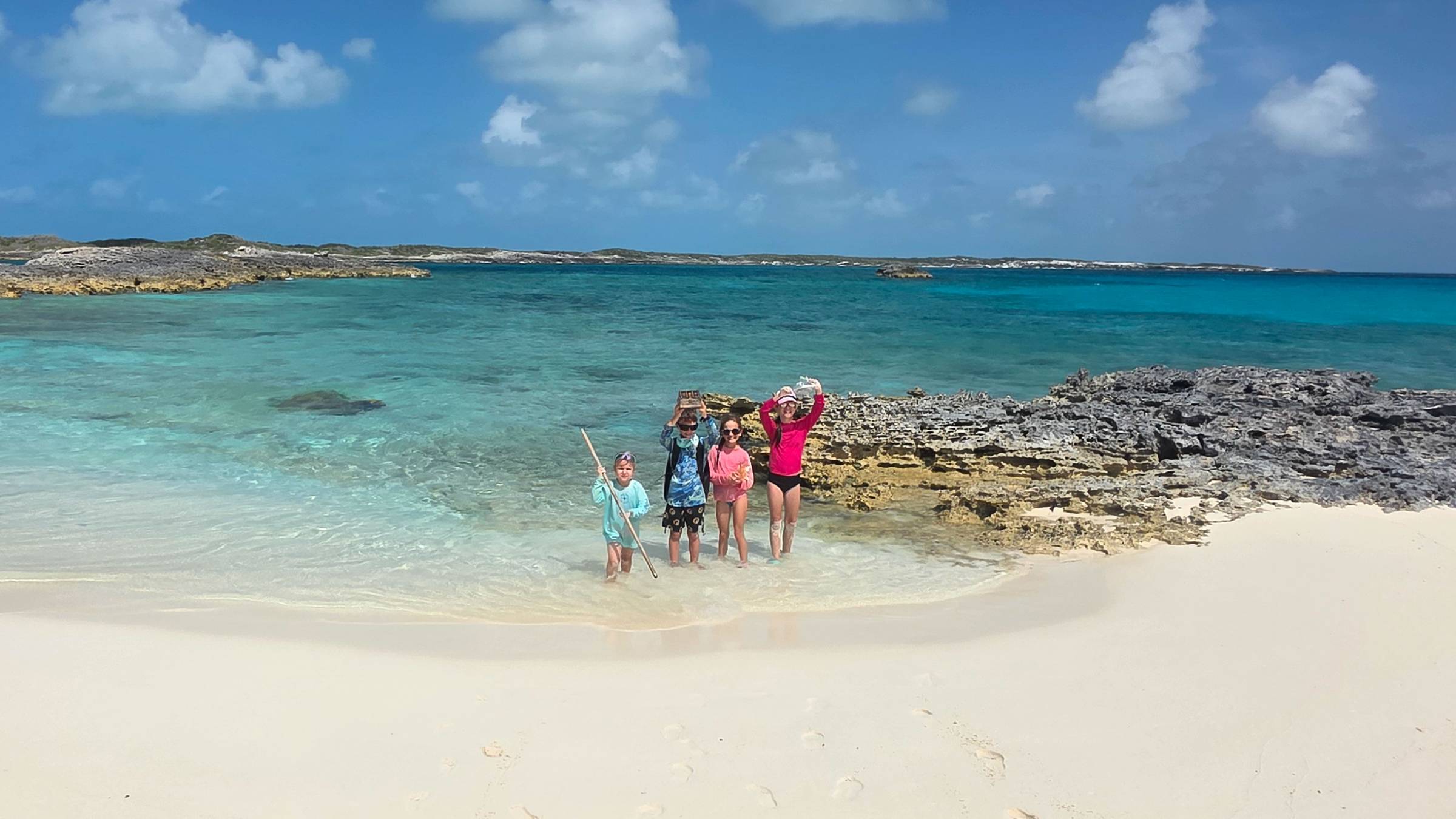
Family Yacht Charters
A crewed yacht charter is perfect for families of all ages. Safe, fun, and fully catered — your kids will never forget it.

Crewed Charter FAQ
Get answers to common questions about crewed yacht charters, from pricing and tipping to what's included and what to pack.

BVI Crewed Yacht Charters
The British Virgin Islands are the #1 crewed charter destination in the Caribbean. Short sails, protected waters, and world-class anchorages.

BVI Crewed Charter Guide
Everything you need to know before your BVI crewed catamaran charter — pricing, packing list, sample itinerary, and getting there.
Bahamas Crewed Yacht Charters
Explore the Exumas on a private crewed yacht. Swimming pigs, sandbars, and some of the clearest water on earth.
Caribbean Crewed Yacht Charters
All-inclusive crewed charters across the Caribbean — BVI, Bahamas, USVI, St. Martin, Antigua, and beyond.