


Montenegro vs Croatia: Which Adriatic Trip Should You Take?
Montenegro vs Croatia is usually not a geography question. It's a trip-shape question: breadth or concentration, islands or mountain walls, bigger hotel and restaurant depth or a smaller coast that feels easier to cover in one pass. I've spent the last few years talking with captains, brokers, and clients who run between these coasts every season, and this is the practical version for people trying to actually decide.
If you're here because you're considering a yacht charter, that's covered too. The top half is for any traveler deciding between the two countries; the back half gets specific about the Croatia yacht charter week, the Montenegro yacht charter week, and the Dubrovnik to Kotor one-way.
Montenegro vs Croatia: The short answer
If this is your first time in either country and you want the broader, easier first answer, pick Croatia. Specifically the southern Dalmatian coast from Split to Dubrovnik: more islands, more hotel and restaurant depth, more ways to move the trip around if weather or energy shifts. That's true whether you're doing a hotel trip, a ferry-hop, or a Croatia yacht charter.
If you've already done one Mediterranean summer trip and want the more distinctive contrast piece, pick Montenegro. The Bay of Kotor gives you something Croatia doesn't: a flooded mountain-walled bay, Kotor's medieval core at the inner head, and a coast small enough that the transfer math never dominates the week. If you're looking at a Montenegro yacht charter, that's the heart of it.
If you can combine them, do that. The Dubrovnik to Kotor one-way is the cleanest seven-night version, and the ten-to-fourteen-night answer is Croatia first, Montenegro second. The reverse, Kotor to Dubrovnik, works too; it just reads a little better southbound if Montenegro is the contrast ending you're after.
The rest of this is the why.
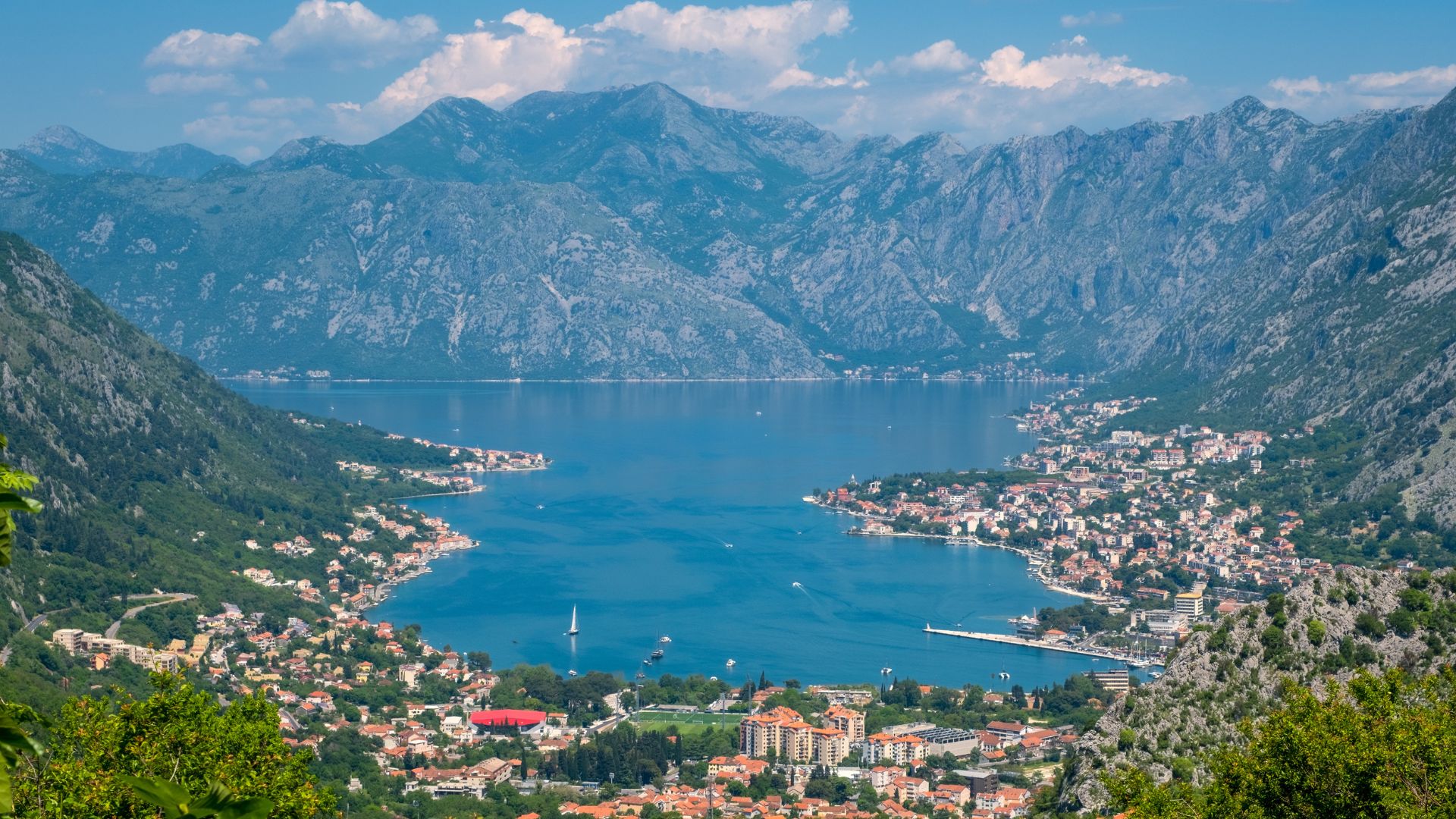
Montenegro's visual argument starts immediately: the Bay of Kotor is a different shape of coast from anything Croatia is trying to do.
Montenegro vs Croatia: The two cruising grounds
Croatia is the Dalmatian coast — about 1,800 km of coastline running south from Istria to Dubrovnik, with somewhere around 1,185 islands inside that span. The charter ground people actually use is the southern stretch: Split south through Brač, Hvar, Vis, Korčula, Mljet, the Pelješac peninsula, the Elaphiti islands, and Dubrovnik. That's where the marinas, the airports, and the marquee anchorages are. From the southernmost yacht-charter base at Dubrovnik's ACI Marina to the northern hub at Trogir is about 130 nautical miles direct — meaning a 7-night charter can do the highlights as a one-way or as a round-trip out of Split, and a 14-night charter can take in everything.
Montenegro is the opposite shape: roughly 60 nautical miles of charter-relevant coast, tip to tip, from the entrance of the Bay of Kotor at Herceg Novi down to Bar in the south. The marquee is the bay itself — the Bay of Kotor (Boka Bay), a long flooded river valley often called Europe's southernmost fjord. It isn't technically a fjord; it's a ria. The visual experience, though, is honest fjord-character cruising — Mount Lovćen rises 1,749 metres straight out of the water at the bay's inner head, and the medieval city of Kotor sits at the foot of that wall with stone fortifications climbing above the Old Town.
Two countries, two different trip geometries. Croatia is breadth and optionality. Montenegro is compression and verticality. They're not trying to win on the same metric.
Montenegro vs Croatia: The towns you'd actually spend time in
Croatia's marquee three are Dubrovnik, Split, and Hvar. Dubrovnik is the obvious draw: the UNESCO-walled city on the southern coast, the iconic walls walk, the cruise-ship congestion in the afternoons. Split is bigger, more functional, and built around Diocletian's Palace — a Roman imperial shell that's now a working downtown. Hvar town is the social capital: yacht clubs, beach clubs, and a real summer scene. Beyond those three: Korčula, Vis, Mljet, and the Pelješac peninsula for wine.
Montenegro's marquee four are smaller and closer together: Kotor, Perast, Tivat, and Sveti Stefan. Kotor is the UNESCO medieval town at the bay's inner head. Perast is the baroque town facing Our Lady of the Rocks. Tivat is the polished marina town built around Porto Montenegro. Sveti Stefan is the fortified island silhouette everyone recognizes even if they don't know its name. Smaller still: Budva, Herceg Novi, and the Luštica peninsula.
The walkability point matters. Croatian old towns are bigger and reward more time. Montenegro is easier to cover in smaller bites. Whichever country you pick, you spend less time getting in and out of stops in Montenegro and more time inside them.
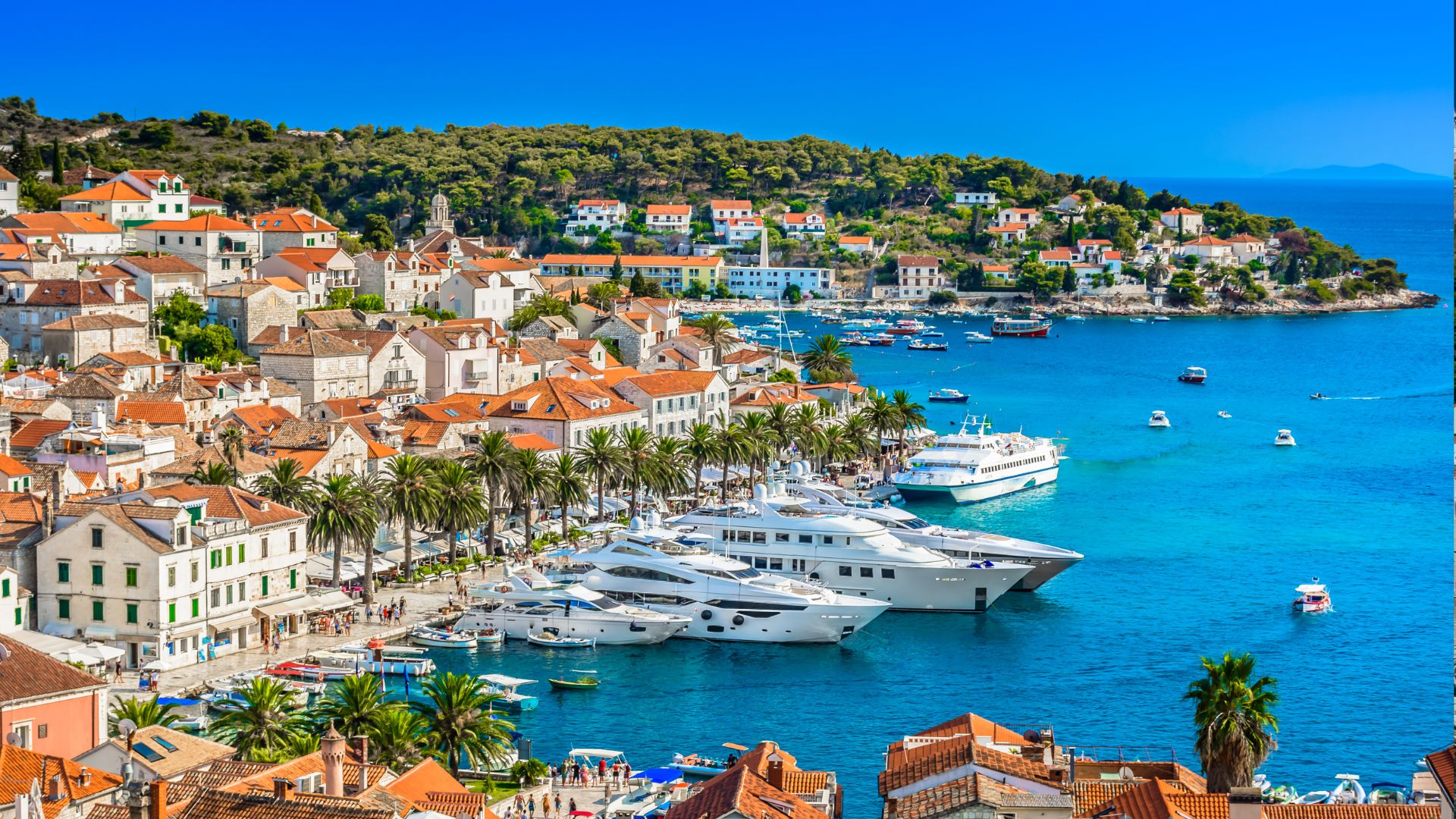
Croatia wins on range. Hvar, Dubrovnik, Split, Korcula, and Vis all pull the week in slightly different directions.
Montenegro vs Croatia: Food, wine, and trip feel
Both countries lean Mediterranean — olive oil, grilled fish, lamb, vegetables, bread — but the registers diverge. Croatian Dalmatian cooking is closer to coastal Italian than people expect: peka, brodet, pašticada, black risotto from cuttlefish ink. The wines are the bigger story — Pošip and Plavac Mali both justify paying attention. If you're a wine person, Croatia is the deeper country.
Montenegrin cooking shows the Boka region's crossover history: Venetian on the coast, Ottoman in the highlands, Adriatic-Balkan in the middle. Seafood at bay-front restaurants, but also Njeguški pršut, mountain cheese, lamb under the sač, and a more compact wine story built around Vranac and Krstač. Montenegro eats well. Croatia eats wider.
Montenegro vs Croatia: Getting there and doing the Dubrovnik to Kotor one-way
For Croatia, you usually fly into Dubrovnik (DBV) or Split (SPU). DBV has the strongest logic for the south and for one-way charters; SPU is better for guests starting in the north or doing Central Dalmatia only. Croatia also has the better ferry network, so a non-yacht island-hopping trip is straightforward.
For Montenegro, you fly into Tivat (TIV) if you want to start in-country, or DBV if you're combining it with Croatia. The DBV-to-Kotor drive is roughly two and a half hours including the border crossing, which is why so many non-charter travelers end up doing the same southbound progression as the charterers.
A Dubrovnik-to-Kotor one-way combines time in Croatia with a finish in Montenegro. Charter guests use it because it lets the Croatia week taper naturally into Montenegro. Non-charter travelers use the same logic by road. If you're deciding between the one-way and staying entirely inside Croatia, compare this post with the Split to Dubrovnik itinerary and the Adriatic Crossing itinerary.
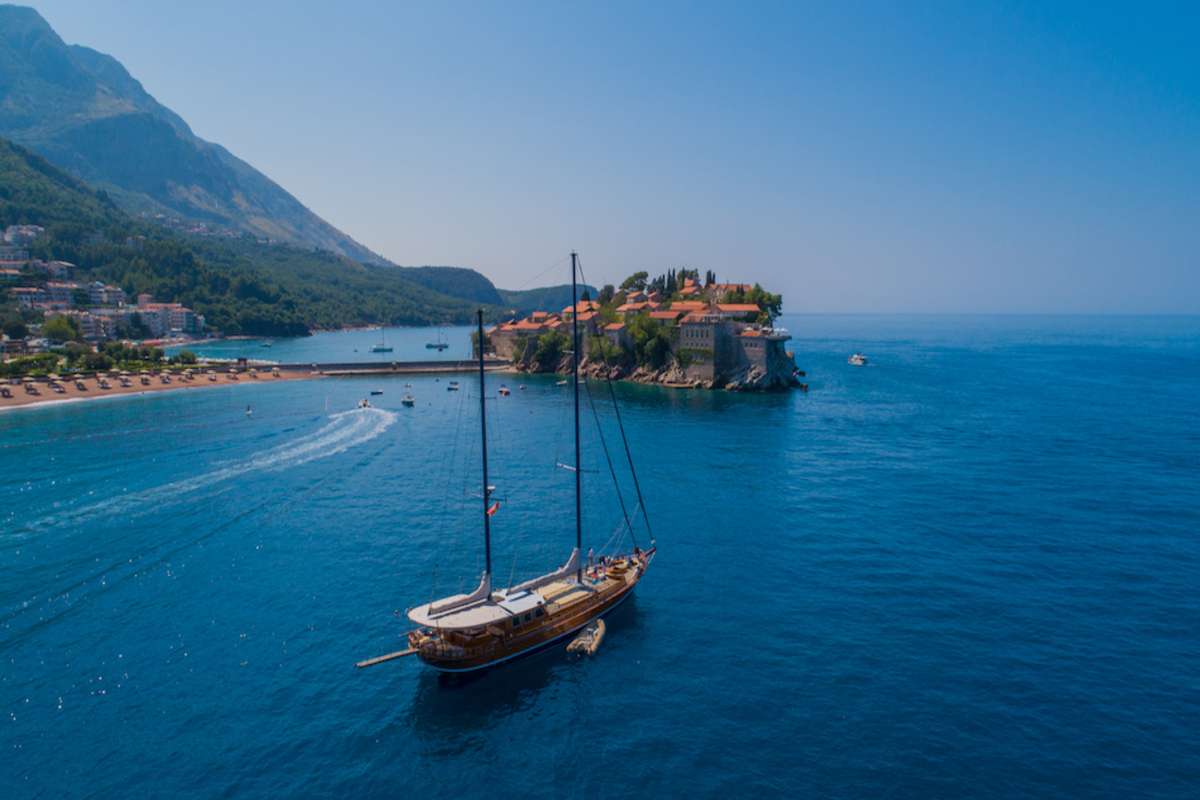
A wooden gulet at anchor offshore from Sveti Stefan. The Montenegro yacht-charter shot; the same fleet runs both coasts.
Montenegro vs Croatia: The cost math, beyond just the charter
For a non-charter traveler the cost math is more about hotels, restaurants, and transport than tax line items. Both countries are still meaningfully cheaper than France, Italy, or Spain at equivalent quality, but the gap between them is smaller than it used to be. Dubrovnik and Hvar in peak season can price like Italy; Montenegro outside the One&Only Portonovi and Regent Porto Montenegro usually stays lower on like-for-like.
Charter VAT — only relevant if you're chartering a yacht
Croatian charter VAT is 13% on the base rate. Montenegrin charter VAT for foreign-flagged commercial yachts is 0%. On the same yacht at the same base rate, a Montenegro yacht charter saves the 13% Croatia would charge.
One important caveat: if your itinerary crosses the border, Croatian VAT applies pro-rata for the days spent in Croatian waters. So a week that starts in Dubrovnik with one day inside Croatia and six in Montenegro would pay 13% on one-seventh of the base rate. That's why the Dubrovnik to Kotor one-way matters as both a real itinerary and a real pricing structure.
Yacht inventory — Croatia is wide, Montenegro is narrow
Croatia has the wider crewed fleet by far. Montenegro's resident fleet is smaller, and much of what works Montenegro in summer is Croatian-based inventory repositioning south for the booking. Practically, that means a Croatia yacht charter gives you more boats to compare, while a Montenegro yacht charter gives you a smaller but still workable pool if the route itself is the reason for booking.
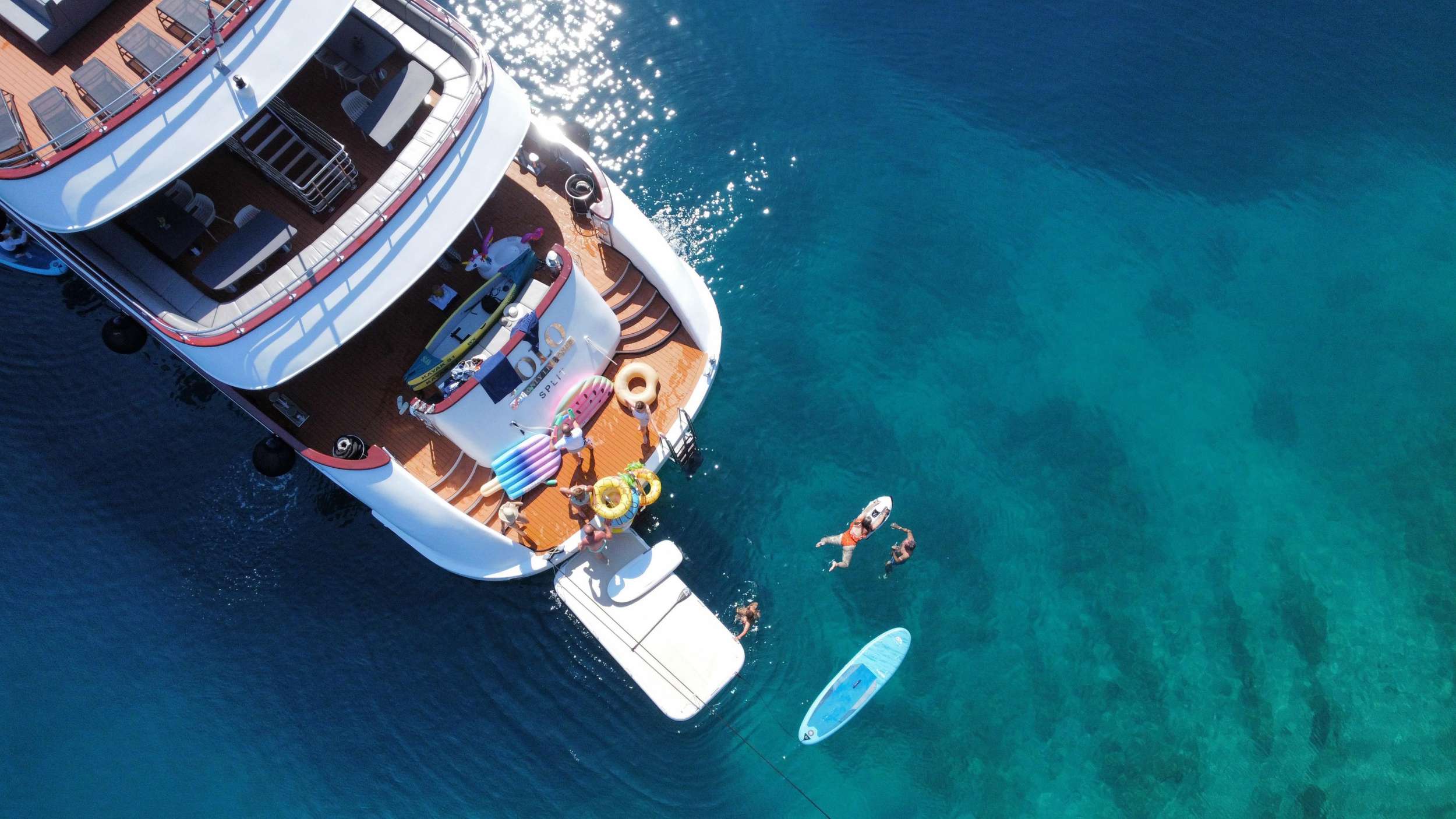
Croatia sells the between-stops rhythm as much as the stops themselves: short hops, a catamaran at anchor, long swims, dinner later.
If you're considering a yacht charter
The rest of the post is for charter shoppers. If a yacht trip isn't on the table, the sections above cover most of the real comparison.
Croatia yacht charter: what a week actually looks like
The two routes that get the most bookings are the Split to Dubrovnik one-way and the Central Dalmatia round-trip. Split to Dubrovnik is the iconic southern run: Brač, Hvar, Vis, Korčula, Mljet, the Elaphiti islands, and a finish under Dubrovnik's walls. It's the cleanest first answer for most groups because the distances stay manageable and the number of strong overnight stops is high.
The round-trip version trades Dubrovnik for logistical simplicity. Same broader flavor, fewer transfer complications, slightly more flexibility if the calendar or flights point back to Split.
Montenegro yacht charter: what a week actually looks like
The two we'd actually book are the Bay of Kotor round-trip from Tivat and the Dubrovnik to Kotor one-way. The round-trip is the slower Montenegro answer: Kotor, Perast, Luštica, the Blue Cave, Sveti Stefan, Porto Montenegro. The one-way route starts in Croatia and finishes in Montenegro, with a customs stop between the two.
What both Montenegro routes share is a slower cadence than Croatia. Less ground. Fewer alternate anchorages. More emphasis on a handful of known stops done well.
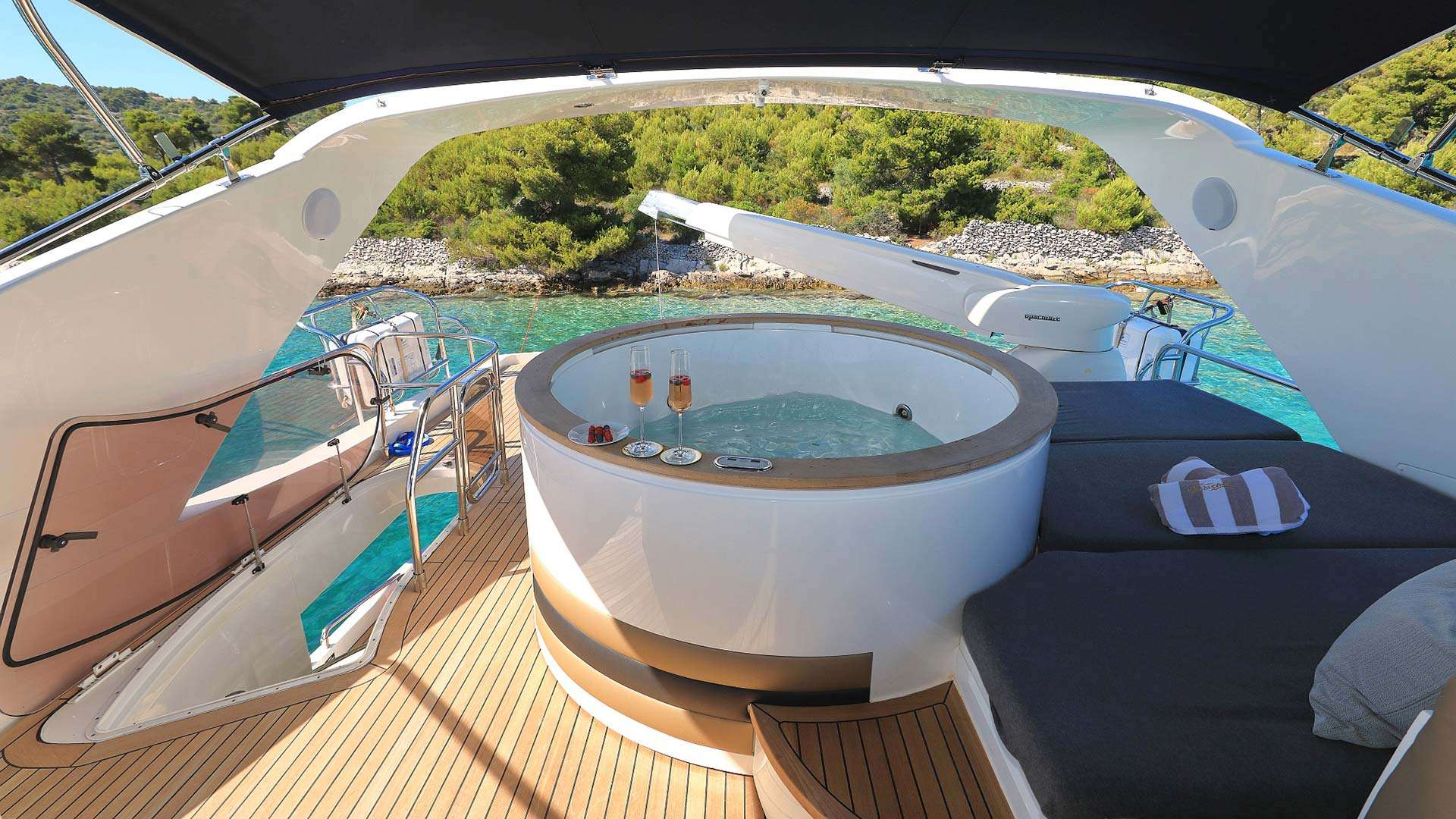
Montenegro should not read as catamaran-only. The route also works well on a motor yacht, especially if the group wants the marina and hotel side of the bay done properly.
Montenegro vs Croatia: Crowds, season, and who picks which
Croatia in July and August is busy. Hvar harbor fills, Dubrovnik gets congested in the afternoons, and the best restaurant tables go early. Montenegro in July and August is busy by Montenegrin standards, which still means meaningfully less crowded than Croatia. If peak-season quiet matters, that's a real point in Montenegro's favor.
June and September are the best answer for both countries. Warm enough to swim, easier reservations, and better rates. That's true whether the guest is booking hotels or a yacht.
- First Adriatic trip, bigger group, more optionality: Croatia.
- Repeat Mediterranean traveler, wants the more distinctive contrast: Montenegro.
- Traveler deciding between a Croatia yacht charter and a Montenegro yacht charter: usually Croatia first, Montenegro second, unless the Bay of Kotor itself is the point.
- Guest with ten to fourteen nights: combine them and let Croatia lead into Montenegro.
- Anyone specifically searching Dubrovnik to Kotor: they're usually asking the right question already.
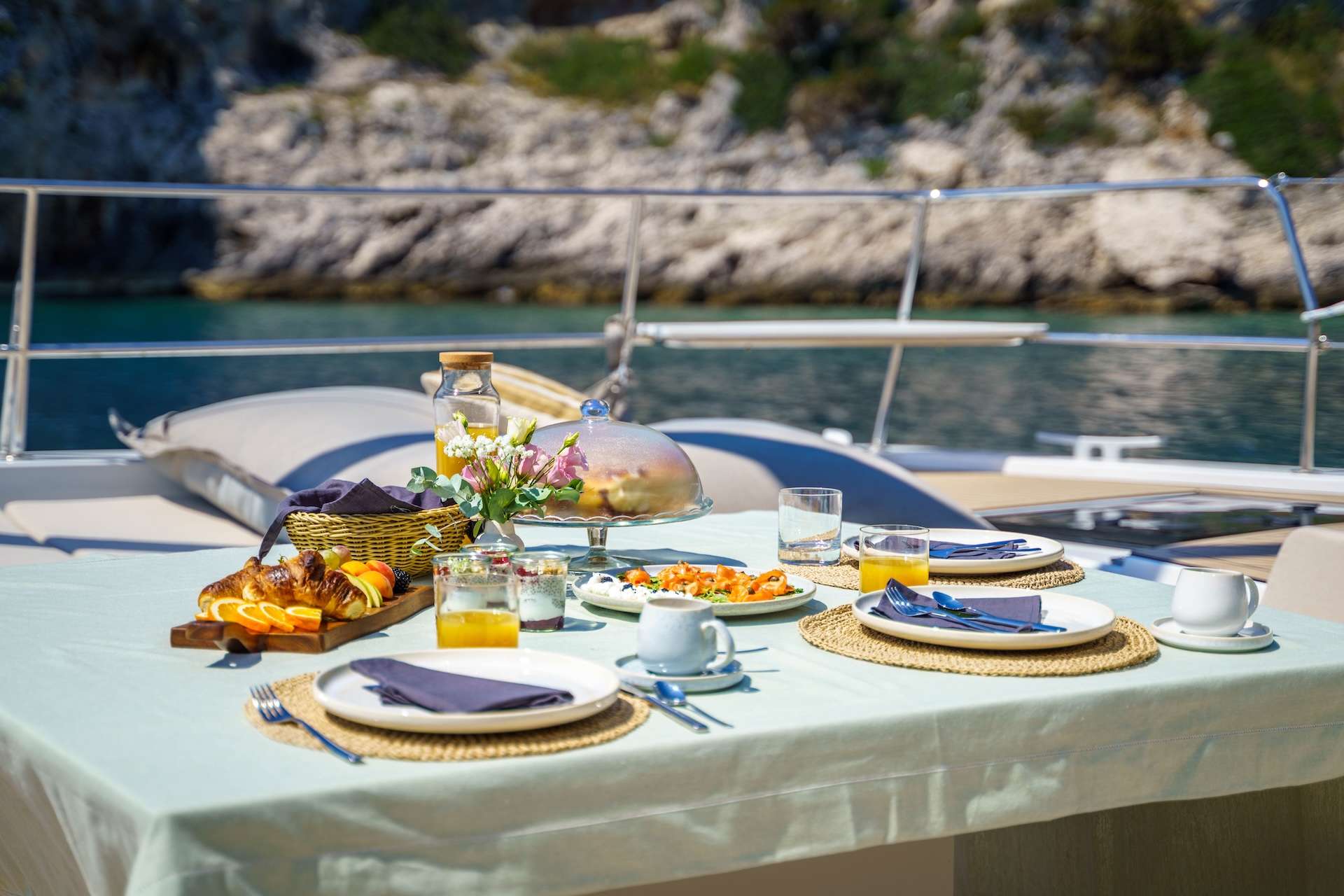
Not every useful yacht shot needs to be a drone. A Croatia week also sells through the on-board moments: breakfast on deck, an easy morning, then lines off.
Montenegro vs Croatia: The bottom line
Croatia is the stronger default answer. Montenegro is the sharper second answer. If you want the easiest first Adriatic trip, book Croatia. If you want the more visually distinct, quieter, more compressed coast, book Montenegro. If you have enough time or enough budget, stop pretending they do the same job and take both in sequence.
Keep going: Croatia yacht charter · Montenegro yacht charter · Split to Dubrovnik itinerary · Dubrovnik to Kotor itinerary
— Matt


