


The Best Yacht Charter Destinations for Scuba Diving
Most dive trips are built backwards.
You pick a resort, and the resort picks your diving — whatever sites its day boat can reach, on its schedule, with whoever else signed up at the shop that morning. The best site within fifty miles might be firing, but if it's not on the whiteboard, you're not diving it.
A scuba diving yacht charter flips that. The yacht anchors over the site. Tanks, weights, and gear travel with you, a divemaster is part of the crew on the dive-equipped yachts, and plenty carry a hydraulic swim platform that lowers you straight into the water. You're making your first descent while the dive shops are still loading coolers — and between dives it's still a private charter, with the chef's lunch on deck and an empty anchorage off the stern.
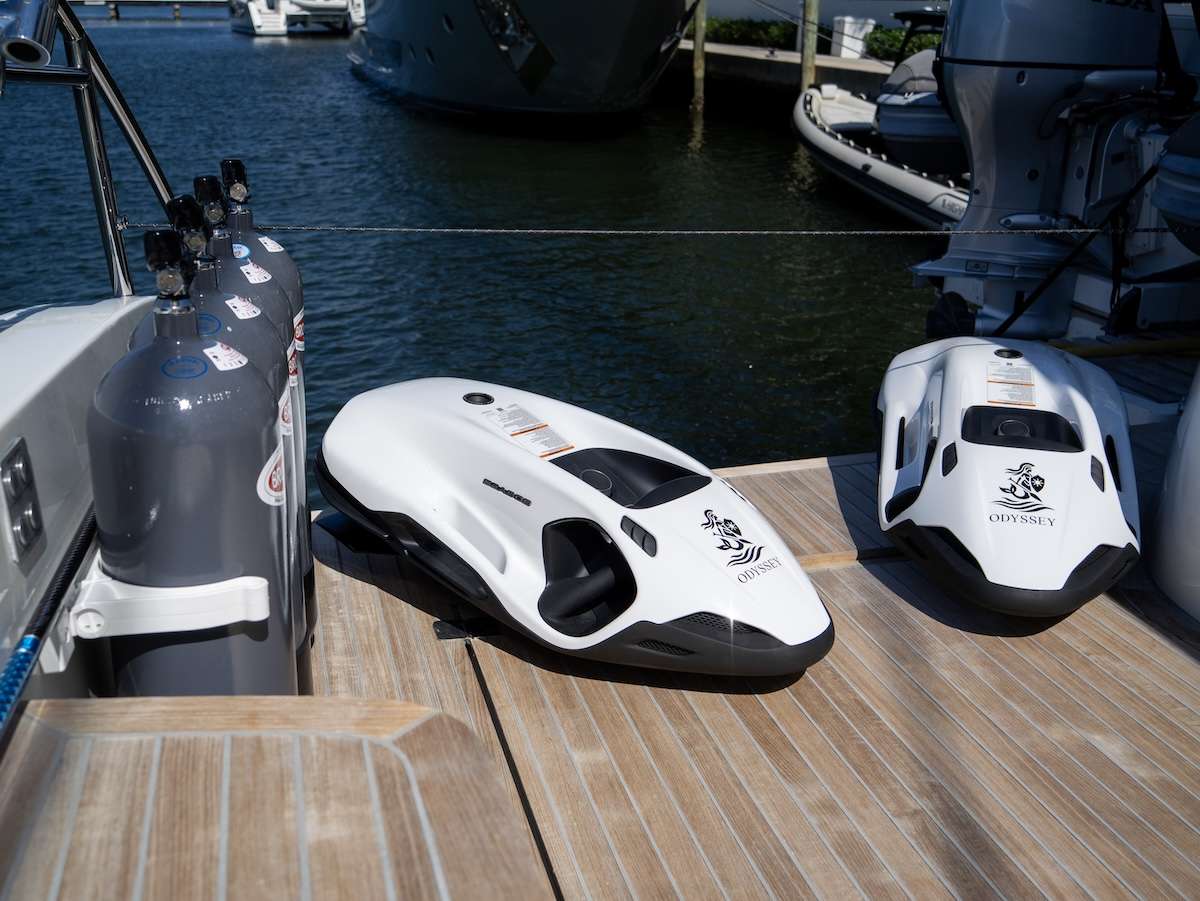
Tanks racked and toys charged on the swim platform | the dive shop comes with you
And if the yacht you fall for doesn't carry gear, that doesn't kill the diving — in most destinations we arrange rendezvous diving, where a local operator meets you at the yacht, runs your group out, and delivers you back to the swim platform. More on that below.
So where should you point the bow? Four destinations stand above the rest:
- The British Virgin Islands — the Caribbean's best wreck diving, and way more of it than people think
- Belize — the Great Blue Hole and the largest barrier reef in the hemisphere
- French Polynesia — drift the passes with hundreds of sharks
- The Exumas, Bahamas — easy, warm, family-friendly diving in a boat-access-only marine park
Scuba Diving in the British Virgin Islands
Let's clear something up first, because half the internet gets it wrong (including, until recently, a certain post on this very blog): the BVI's famous wreck is the RMS Rhone — Royal Mail Steamer, not "HMS." She carried mail and passengers for the Royal Mail Steam Packet Company, and she's been the Caribbean's benchmark wreck dive for fifty years.
The RMS Rhone
The Rhone was a 310-foot iron-hulled steamer, state of the art for her day, until the hurricane of October 1867 drove her onto the rocks off Salt Island and broke her in two. The wreck lies in two sections at two friendly depths: the bow in 75 to 85 feet — largely intact, lying on her side, with an open hull section divers swim through — and the stern scattered across 20 to 35 feet, where her massive bronze propeller sits shallow enough that snorkelers can see it on a calm day.
That split is what makes her perfect charter diving: a two-tank morning that starts deep on the bow and finishes shallow over the stern, where you'll find the famous "lucky porthole" — its glass still intact, kept shiny by decades of divers giving it a rub. Hollywood agreed, by the way: the 1977 film The Deep was shot here. The whole site has been a marine national park since 1980, and the resident green morays and groupers act like they own the place. They kind of do.
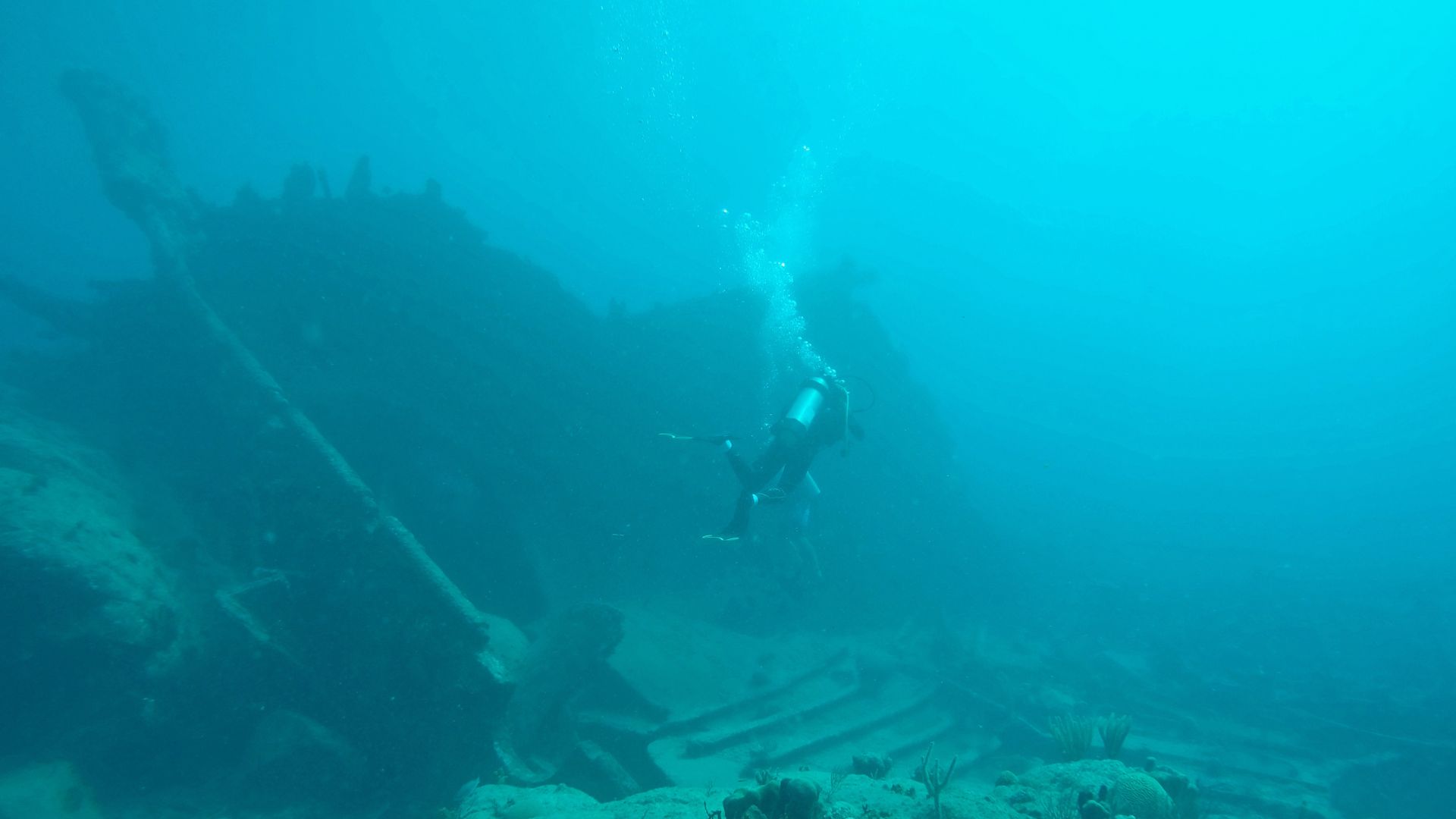
Diving the RMS Rhone | she's been down there since 1867 and she's still the best dive in the BVI
Way beyond the Rhone
Here's what the brochures undersell: the BVI is loaded with dive sites, and a yacht puts you on all of them.
Wreck Alley, off Cooper Island, stacks four deliberately sunk wrecks — two tugs, a cargo ship, and an upside-down barge — on one sandy bottom in 50 to 90 feet. The Kodiak Queen at Virgin Gorda might be the strangest dive in the Caribbean: a World War II Navy fuel barge that survived Pearl Harbor, rescued from a Road Town junkyard and scuttled in 2017 as an art reef with an 80-foot mesh kraken wrapped over her hull, now seeding coral in under 60 feet of water.
For reef and rock: the Indians near Norman Island (pinnacles, a tunnel swim-through, 10 to 50 feet — also the best snorkel in the territory), Painted Walls with its sponge-coated canyons, Blonde Rock's ledges between Dead Chest and Salt Island, and the Dogs, where Bronco Billy's coral archway and the Chimney's narrow swim-through have been crowd-pleasers since — as the old-timers tell it — Jacques Cousteau's day. Santa Monica Rock, an open-water seamount south of Norman, drops past 100 feet for the pelagic crowd, and the Chikuzen — a 246-foot refrigeration ship lying miles offshore in open sand — is the BVI's big-animal dive: eagle rays, sharks, huge schools of jacks, and one of those sites a day boat rarely bothers with but a yacht can position for when the weather window opens.
The logistics are the easiest in the Caribbean, too. Dive sites carry National Parks Trust moorings (your captain handles the permit), and the BVI runs on rendezvous diving — operators like Dive BVI and Sail Caribbean Divers pick your group up at your yacht's anchorage, dive you on the Rhone or the Dogs, and drop you back for lunch. It's the standard way charter guests dive here, certification cards and all.
Water runs 78°F in winter to 84°F in late summer, visibility 60 to 100 feet, diveable every month of the year.
Scuba Diving in Belize
Belize sits on roughly 190 miles of barrier reef — the largest in the Northern Hemisphere, second on earth only to Australia's, and a UNESCO World Heritage site. And the crown jewel sits 43 miles offshore at Lighthouse Reef atoll: the Great Blue Hole, a perfect sapphire circle a thousand feet across and 407 feet deep, a collapsed Ice Age cave that Jacques Cousteau put on the world's dive map in 1971.
Be honest with your group about what the Blue Hole dive is: a geology dive, not a fish dive. You drop down a sheer wall to about 110 feet, where giant stalactites hang from the overhangs — formed when this was a dry cave above sea level — and you hang among them in blue gloom while reef sharks cruise the mid-water. Eight minutes at depth, thirty minutes total, and you'll talk about it for the rest of your life.
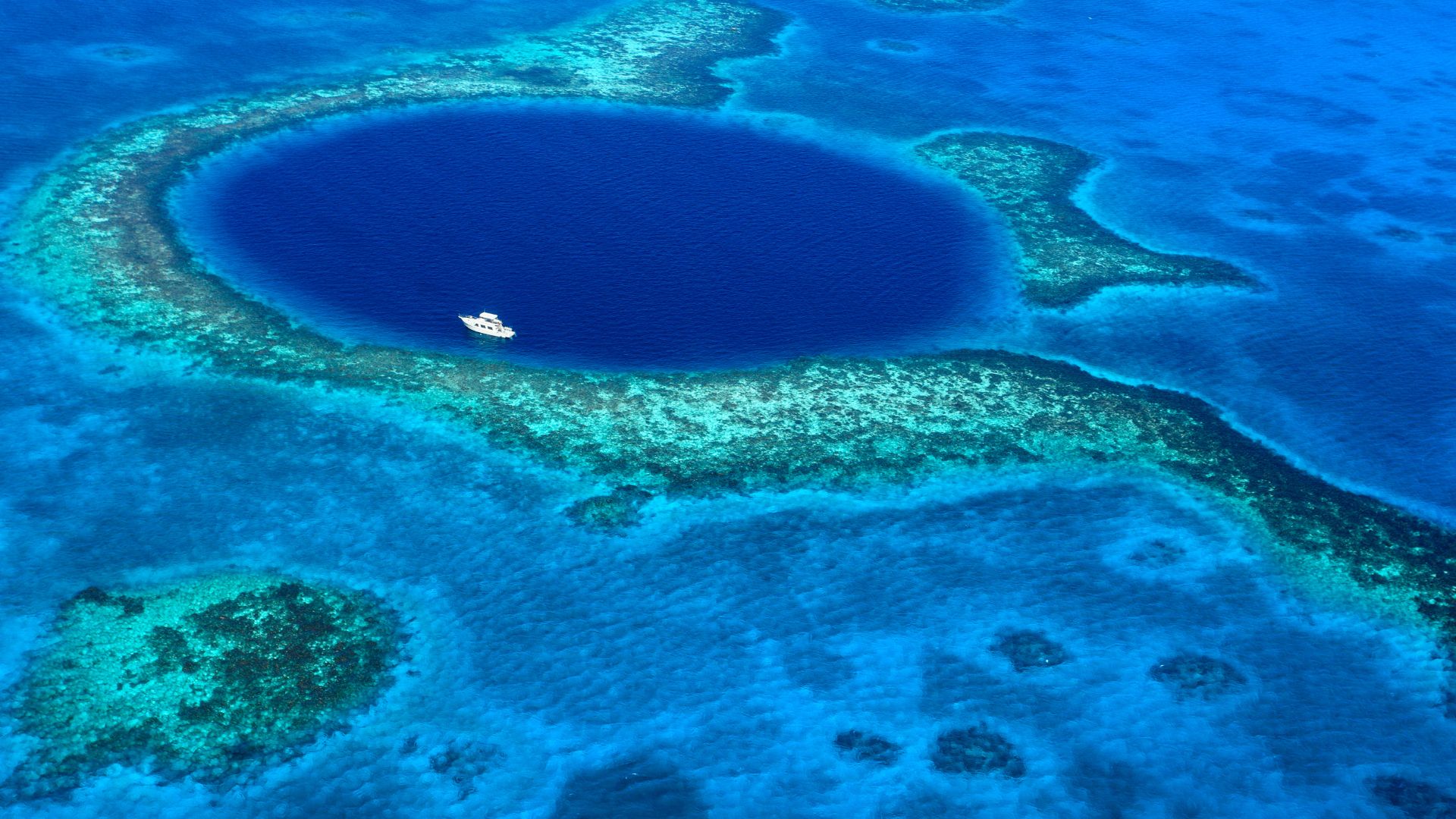
The Great Blue Hole | a thousand feet across, 407 deep, and worth every minute of the trip out — which from your yacht is no trip at all
Here's where the yacht earns its keep. Day boats out of San Pedro run two and a half hours of open ocean each way to dive the Blue Hole — a twelve-hour day for three tanks. A charter yacht anchors inside Lighthouse Reef atoll and wakes up next to all of it: the Blue Hole, the Half Moon Caye Wall (a sheer drop from 30-ish feet into the abyss, eagle rays and garden eels, plus a red-footed booby colony on the caye itself), and the Aquarium at Long Caye, the fish-soup shallow dive that rounds out the classic three-tank day. Add the Elbow at Turneffe Atoll — a current-swept point where the jacks and snapper school by the thousand — and Glover's Reef if you want walls with nobody on them. From March into June, whale sharks gather off Gladden Spit in the south around the full-moon snapper spawns.
Dry season, February through May, brings the calmest seas and the best visibility on the atolls. Onboard dive setups and divemaster crew are common on Belize crewed yachts — and where they're not, local guides come to you.
Scuba Diving in French Polynesia
French Polynesia is the destination for divers who've done the Caribbean and want the volume turned up. The diving here is pass diving: atoll lagoons breathe through narrow cuts in the reef, and when the tide floods in, you ride it — flying over coral at a couple of knots while the ocean's predators hold station in the current.
The headliner is Fakarava, a UNESCO biosphere reserve in the Tuamotus. Its south pass, Tumakohua, holds the famous wall of sharks — hundreds of grey reef sharks stacked in a 200-meter-wide channel, one of the densest shark populations anywhere on earth, and you drift right past the formation at 50 to 65 feet. Time your charter to the June–July full moon and you can witness the spawn that made this pass famous: thousands of camouflage groupers aggregating in a single night while the sharks work the buffet. The north pass, Garuae, is the biggest in French Polynesia and turns the current up another notch.
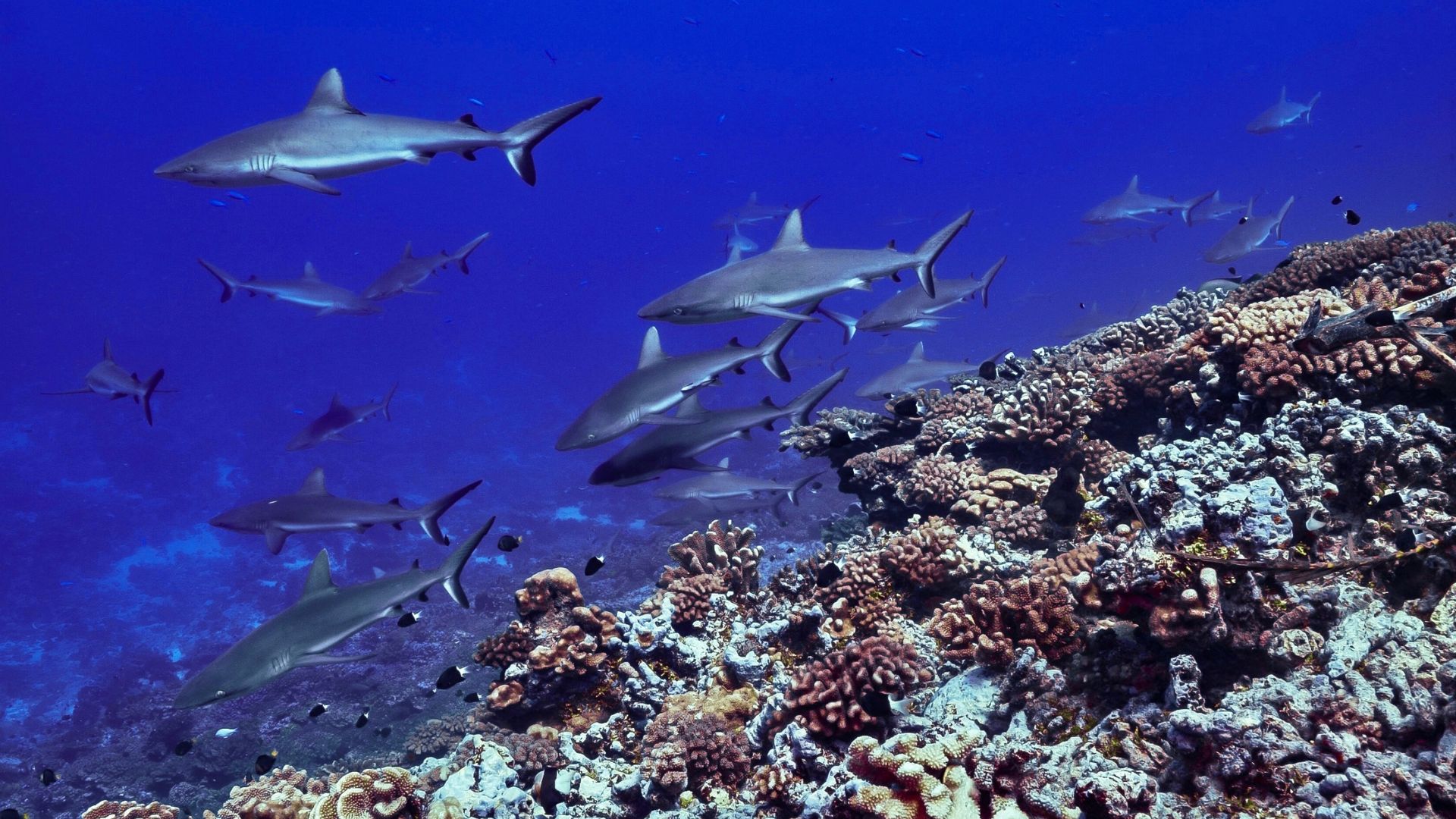
The wall of sharks at Fakarava's south pass | hundreds of grey reef sharks holding formation in the current
Rangiroa's Tiputa Pass is the other legend — a resident pod of bottlenose dolphins that genuinely seeks out divers, plus great hammerheads gathering from January through March and tigers and silvertips on the deep profiles. Tikehau keeps a manta cleaning station inside its lagoon in less than fifty feet of water. Over in the Society Islands, Moorea serves up lemon sharks and lagoon diving — and from mid-August through October, humpback whales (an in-water snorkel encounter with a licensed guide, and a worthy reason to time your trip).
This is advanced, current-driven diving, and it has to be timed to the tide — which is exactly why a yacht is the right tool. The dive sites are scattered across atolls that might each have one small dive center; a yacht living on-site hits the right tide window every morning instead of a resort's fixed schedule. It's a private liveaboard with a chef. Water runs 79 to 84°F with visibility that can stretch past 100 feet, and it dives year-round — May through October for the calmest, clearest water.
Scuba Diving in the Exumas, Bahamas
The Exumas are the honest opposite of French Polynesia, and that's their charm: most of the diving here is 15 to 60 feet deep, 70-to-100-foot visibility year-round, warm, and forgiving. If your group mixes serious divers with first-timers and kids with snorkels, this is the destination.
The anchor is the Exuma Cays Land & Sea Park — established in 1958 as the world's first park of its kind, a no-take reserve since 1986, and reachable only by boat. No dive shops, no day-trip fleets; your yacht is the access, and the payoff is what fifty-plus protected years look like underwater: fat grouper, conch the size of footballs, lobster wandering around in the open.

Exuma water clarity | half the best stuff here is in snorkel depth, which is exactly why families love it
The greatest hits run shallow and fun. Thunderball Grotto at Staniel Cay is the skylit cave where they filmed the Bond movie, swarming with sergeant majors under the light shafts — snorkel it at slack tide, then come back with a tank. The Washing Machine near Highbourne Cay tumbles you head-over-heels down a tidal chute and spits you out over a patch reef of turtles and nurse sharks. Inland-style blue holes like Angelfish (about 90 feet, eagle rays circling the rim) add a little vertical drama, and the Austin Smith wreck — a 90-foot Bahamian Defence Force cutter sitting upright in about 60 feet — is the resident sharky wreck dive.
And yes, sharks: the classic Exumas reef-shark dives at sites like Danger Reef put a dozen Caribbean reef sharks in front of you in 35 to 60 feet of water. (The famous nurse sharks at Compass Cay, for the record, are a dockside swim, not a dive — bring the kids.) Water runs 77°F in February to 85°F at summer's end; December through April brings the calm, clear, sharky best of it.
Do you need to be certified?
For most of the diving above, yes — an open-water card covers the great majority of these sites, including the Rhone's stern, the Exumas, and most BVI reefs. The deep stuff (the Blue Hole, the Chikuzen, the big-current passes) wants advanced certification and some logged dives. And for the uncertified, several dive-equipped yachts can run a Discover Scuba intro in calm, shallow water — more than one guest has come home from a charter with a certification started.
Gear-wise, it depends on the yacht: some carry full kit and a divemaster in the crew, others carry tanks and set up rendezvous diving with local operators. We confirm exactly what's aboard before you book, so the only surprise underwater is the good kind.
Final thoughts
If you want wrecks and easy logistics, it's the BVI — and now you know there's a week of diving there beyond the Rhone. If you want the bucket-list hole in the ocean, it's Belize. If you want sharks in numbers that rearrange your sense of scale, it's French Polynesia. If you want everyone in the family wet every day, it's the Exumas.
Browse the yachts set up for scuba diving charters, or start with the destination guides for the BVI, Belize, French Polynesia, and the Exumas. Tell us what you want to see underwater, and we'll find the yacht that gets you there.


